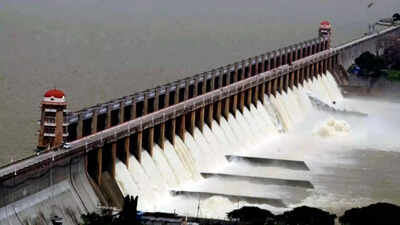
Imagine a network of canals and reservoirs that could carry water from the Brahmaputra basin in the Northeast, across the Ganga and Mahanadi systems, and eventually towards the Kaveri in southern India.The idea is to connect river basins through a series of engineered links, moving water from regions considered to have a surplus to those that face shortages.It is an ambitious vision for a country where floods and water scarcity often coexist. While parts of eastern and northeastern India experience heavy monsoon flows, several regions in the south grapple with erratic rainfall, competing demands for irrigation and drinking water, and recurring disputes over the sharing of rivers.The proposal has regained political attention amid efforts to resolve water-sharing disputes among southern states. In August 2026, Union home minister Amit Shah pitched interlinking rivers from the Brahmaputra to the Kaveri and through the Godavari, arguing that such a network could help India avoid water shortages for the next 100 years.
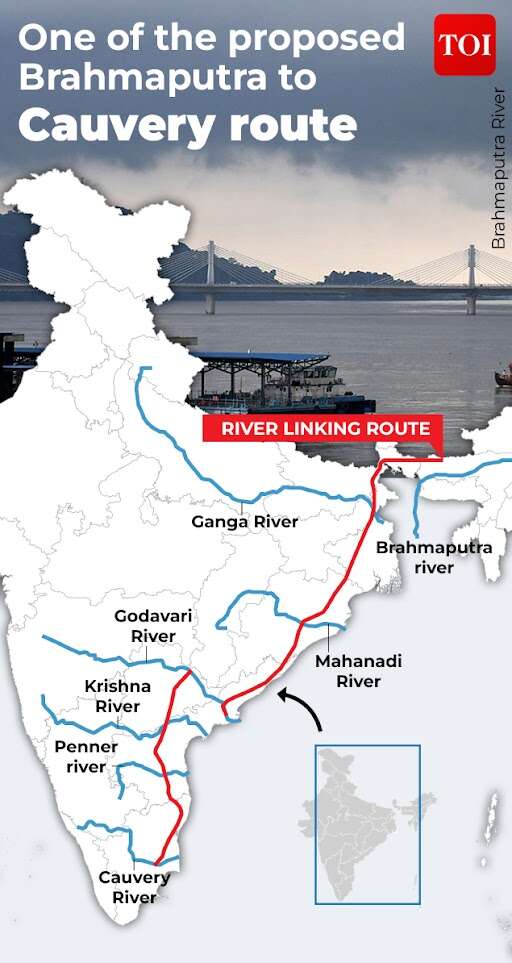
The proposed route from the Brahmaputra to the Kaveri
Speaking at the 31st meeting of the Southern Zonal Council in Mamallapuram, Amit Shah called for a fresh approach to water-sharing disputes.He also suggested that the Centre, the Jal Shakti ministry and the states concerned hold joint meetings to resolve outstanding disputes through dialogue.He also said that the network could create waterways, reduce fuel consumption and offer a more cost-effective transport system.Shah’s remarks came with a message to southern states: Disagreements over water sharing must be resolved through dialogue. He argued that protecting a state’s interests should not result in other states being deprived of water for years.The proposal is part of India’s long-running river-interlinking programme. However, the vision of connecting the Brahmaputra to the Kaveri should not be mistaken for a project that has received final approval or is ready for construction. It would require several separate links to be developed and coordinated, and the complete connection does not exist today.
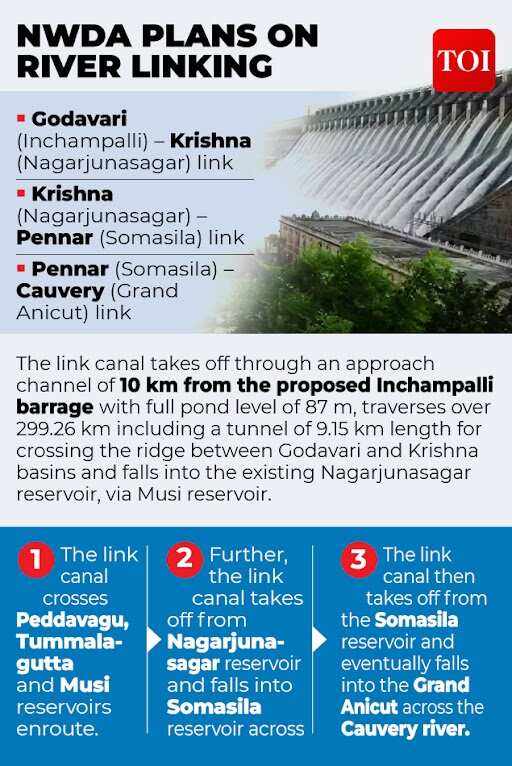
Water for Godavari-Cauvery interlinking plan may be drawn from Samakka Sagar
Why does India want to link its rivers?
India’s rainfall and water availability vary widely across regions and seasons. Some river basins receive substantial rainfall and experience flooding, while other areas face recurring shortages, particularly during dry periods. The central idea behind river interlinking is to transfer water between basins to help address this uneven distribution.The government formulated the National Perspective Plan (NPP) for water-resource development in 1980. It identified 30 proposed river links — 16 under the peninsular component and 14 under the Himalayan component.The National Water Development Agency (NWDA), established in 1982, was tasked with studying and developing proposals for inter-basin water transfers.The idea itself is older. In 1972, engineer and former union irrigation minister K L Rao proposed linking the Ganga with the Kaveri. Captain Dastur later put forward a much larger concept called the Garland Canal. Neither became an implemented national river-linking system in the form originally proposed.The National Perspective Plan subsequently provided a framework for studying a network of links rather than relying on one continuous canal. The broad vision is to connect river systems across eastern and peninsular India so that water could potentially be transferred towards regions with unmet requirements.
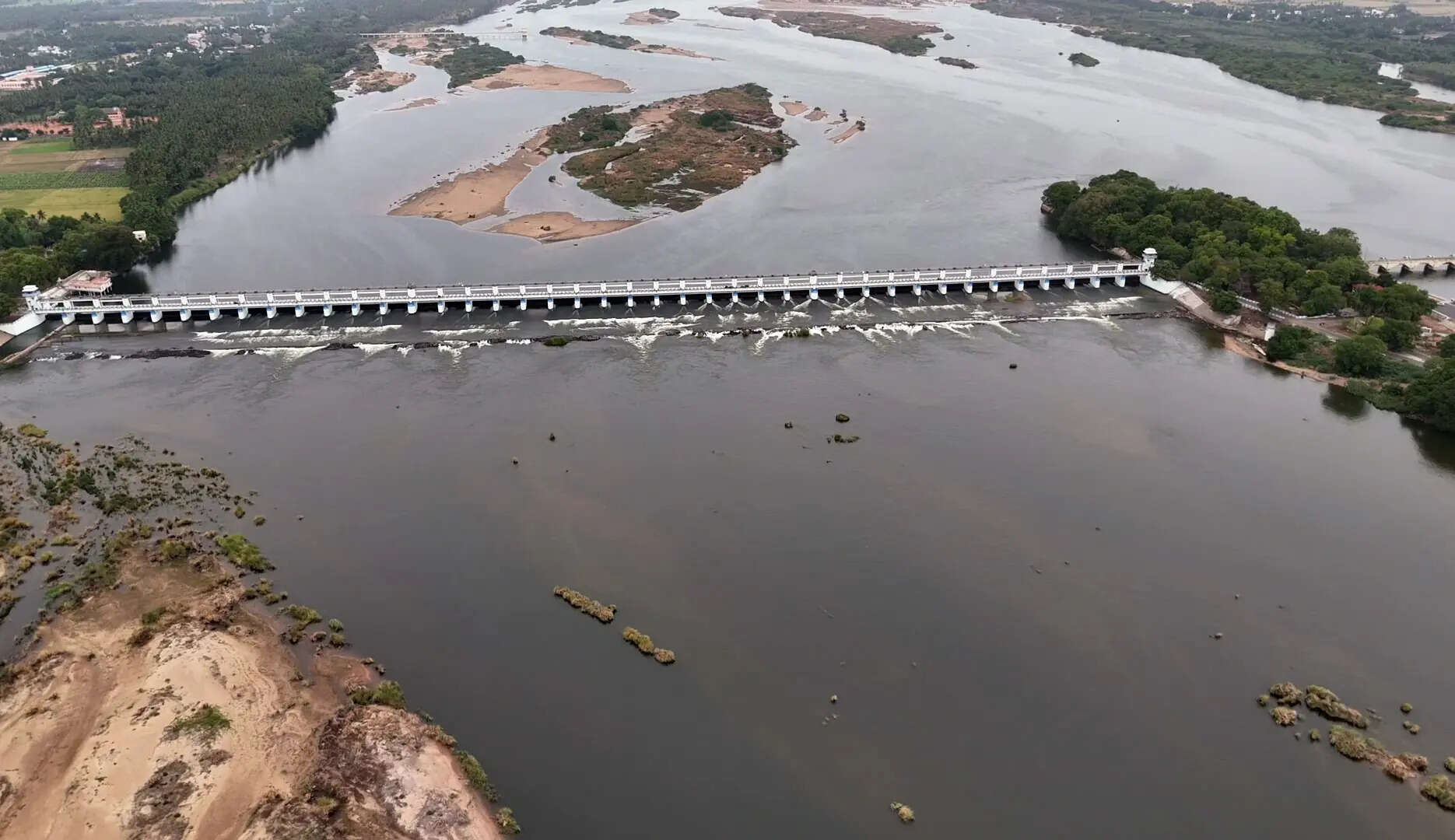
An aerial view of the Mukkombu Upper Anaicut dam across the Cauvery River, in Tiruchirappalli.
The potential benefits extend beyond irrigation. Depending on the design and water available, individual projects could help supplement drinking-water supplies, meet some industrial requirements, support agriculture and provide greater resilience during periods of shortage. The government has also highlighted the possibility of flood moderation and navigation benefits in suitable areas.But these are potential benefits, not guaranteed outcomes. They depend on how much water is actually available for transfer, the needs of the regions from which it would be drawn and the feasibility of each proposed link.
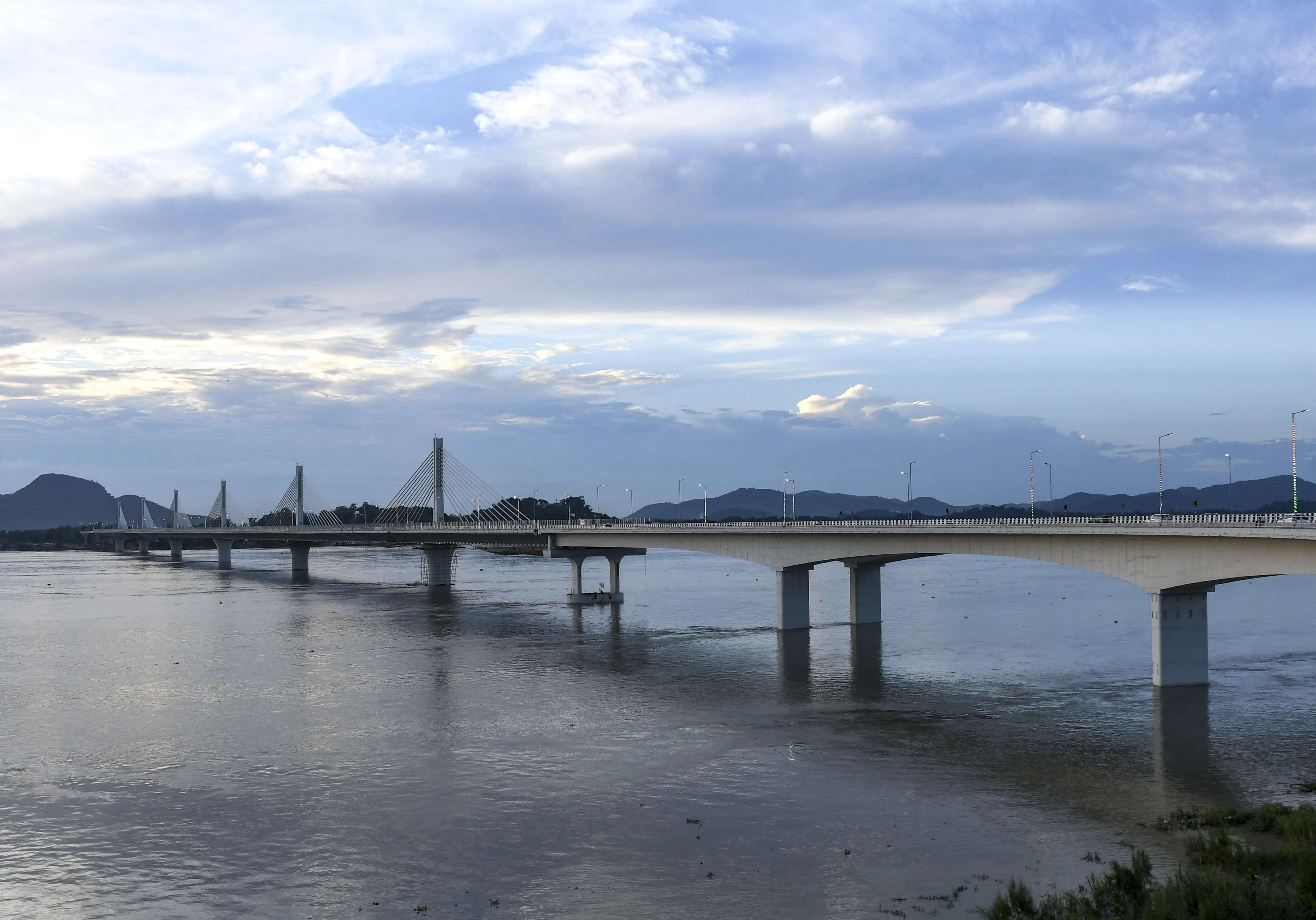
The Kumar Bhaskar Varma Setu, a six-lane extradosed bridge over the Brahmaputra river, in Guwahati, Assam. (PTI Photo)
What would the Brahmaputra-to-Kaveri connection involve?
The proposal does not envisage digging one enormous canal directly from Assam to Tamil Nadu. It would depend on a chain of separate river links, reservoirs, canals and other infrastructure connecting river basins.Broadly, the proposed network would extend from the Brahmaputra basin towards the Ganga and Mahanadi systems before connecting with peninsular rivers, including the Godavari, Krishna and Pennar, and eventually the Kaveri. The precise alignment and arrangements would depend on the individual projects that are studied, agreed upon and approved.This distinction is important: The existence of a proposal to link two river systems does not mean water can automatically be moved between them. A continuous Brahmaputra-to-Kaveri connection would depend on several links being developed and made to work together.One of the more developed proposals in the southern part of the broader vision is the Godavari-Kaveri link. It has also become the focus of renewed political attention.In October 2026, Andhra Pradesh chief minister N Chandrababu Naidu sought Prime Minister Narendra Modi’s intervention to advance the Godavari-Kaveri proposal. On October 13, Tamil Nadu chief minister C Joseph Vijay met Naidu in Vijayawada to discuss the project and the release of Krishna river water for Chennai. Vijay urged Andhra Pradesh to take the proposal forward and sought national-level support for it.“It is not a vision but a mirage. It is a colossal blunder, a grave misdirection of resources,” said Ramaswamy R Iyer, former secretary in the water resources department, questioning the feasibility of the ambitious river-linking programme.He argued that smaller projects implemented carefully could be a better alternative, citing concerns over cost overruns, displacement and environmental damage.Iyer also pointed out that the idea of linking the Ganga and the Kaveri had been examined earlier but rejected on grounds of technical feasibility.
How much water could be transferred?
The proposed Godavari-Kaveri link has undergone changes as authorities consulted the states concerned. In a January 2024 version of the proposal, the NWDA envisaged transferring about 4,189 million cubic metres of water associated with the Indravati sub-basin of the Godavari basin, along with a proposal to supplement the Krishna basin through the Bedti-Varda link.The plan was intended to provide irrigation benefits to around 5.74 lakh hectares in Telangana, Andhra Pradesh and Tamil Nadu, while also addressing domestic and industrial water requirements along the route, including in parts of Karnataka and Puducherry.However, the figure of 4,189 million cubic metres relates to a proposed Godavari-basin transfer. It is not an estimate of how much Brahmaputra water would reach the Kaveri.
Why is the plan difficult to implement?
The first challenge is deciding how much water can reliably be transferred without compromising the needs of the source basin. A river that experiences high flows during part of the year cannot automatically be treated as having surplus water available for diversion throughout the year. Assessments must account for seasonal variation, existing users, downstream requirements and the effects of dry years.The second challenge is interstate cooperation. Water is politically and economically sensitive, especially where states already have disputes over allocations. A project that crosses several states requires agreement not only on the quantity of water to be transferred but also on where it will be diverted, how it will be shared, who will bear the cost and how the system will be operated.The Godavari-Kaveri proposal illustrates these complications. States have raised concerns over the availability of surplus water, the diversion points and their respective shares. Chhattisgarh’s plans for water use, Andhra Pradesh’s concerns over its interests in the Godavari, and demands from other participating states have complicated efforts to reach a common position.Environmental and social considerations are equally important. Large-scale water transfers can require reservoirs, canals and other structures, potentially affecting forests, wildlife habitats, river flows and communities.Projects may involve land acquisition and the rehabilitation of affected families. Environmental assessments, forest and wildlife clearances, and safeguards for local communities therefore form an essential part of the process.There is also the question of cost and engineering. Building and operating a network of links across different terrains would require substantial investment.Some stretches may need complex infrastructure, while water transfers may also involve pumping and ongoing energy costs. The benefits would have to be weighed against construction expenses, maintenance and environmental impacts.Finally, the Brahmaputra basin is shared by China, India and Bangladesh. Any proposal involving water management in this basin must be assessed in the context of the river’s wider transboundary setting and the needs of downstream regions. This adds another layer of complexity to the broader vision.
What is the status of India’s river-linking programme?
The latest official figures underline the gap between planning and implementation. According to the Union government, feasibility reports had been completed for 26 of the 30 links identified under the National Perspective Plan, while detailed project reports had been completed for 13, as of February 2026.In an update on August 10, 2026, the government said the Ken-Betwa Link Project was the only priority link under the national plan to have entered the implementation stage. It has an estimated cost of Rs 44,605 crore and is envisaged to provide irrigation to about 11.88 lakh hectares and drinking water to around 62 lakh people, along with hydropower and solar power generation.The Godavari-Kaveri proposal remains a separate work in progress, with its implementation dependent on agreement among the states concerned. Political support for river linking has grown more visible in recent weeks, but support and discussions do not amount to approval of the entire Brahmaputra-to-Kaveri chain.The broader question is whether India can develop a national water-transfer network that is technically feasible, environmentally responsible and acceptable to all the states involved. One approach is to assess and implement individual links where the water balance, costs, benefits and clearances justify them, rather than treating the entire network as one project that must be completed at once.River linking is also not the only response to water scarcity. Better irrigation efficiency, groundwater recharge, restoration of lakes and traditional water bodies, reduction of leakage in urban supply systems and greater reuse of treated wastewater can help regions manage demand.The Brahmaputra-to-Kaveri vision is therefore best understood as an ambitious long-term idea within India’s river-interlinking programme, rather than a single project that is about to move water across the country.Its promise lies in addressing uneven water availability, but turning that promise into reality will depend on reliable water assessments, detailed engineering, environmental safeguards and, above all, agreement among the states.
Could India begin with a smaller water grid?
One possible approach would be to develop the network in stages rather than treat the entire Brahmaputra-to-Kaveri connection as a single undertaking.The first step would be to establish how much water could reliably be transferred from each source basin after accounting for existing and future needs.The next would be to assess individual links on their own merits, prioritising those with clear benefits, viable engineering designs and the necessary clearances.The Godavari-Kaveri proposal could be examined separately as part of the southern water-transfer network. Its feasibility would need to be established without assuming that water from the Brahmaputra would automatically be available.This approach would allow the Centre and the states to assess the benefits and costs of individual projects before committing to a much larger chain.River interlinking could also be considered alongside measures to reduce demand and improve the use of available water.These include restoring lakes and traditional water bodies, improving groundwater recharge, reducing leakage in urban water networks, expanding wastewater treatment and reuse, and improving irrigation efficiency.Such measures cannot replace every purpose of a large inter-basin transfer. But they could reduce the additional water required in shortage-prone regions and help determine whether the scale of the proposed network is justified.
Can the Brahmaputra-to-Kaveri plan ensure India’s water security for the next 100 years?
Amit Shah’s pitch places the proposed network within a much larger ambition: making water availability less vulnerable to regional imbalances and reducing the economic and social costs of recurring shortages.If technically and economically viable links were developed, the network could potentially supplement irrigation supplies and meet some domestic and industrial requirements in receiving regions.But it would be premature to conclude that the entire plan could eliminate water shortages for the next century.Its success would depend on how much water is actually available for transfer, how reliably it can be delivered, how the infrastructure performs during droughts and whether the participating states agree on allocations.It would also depend on the environmental and social costs of moving water across multiple basins.A national water grid cannot be evaluated only by the volume of water that could be diverted during a good monsoon. Its real test would be whether it could deliver dependable supplies when the source and receiving regions face competing demands.The Centre would need to publish updated assessments of the proposed links, establish a transparent water balance for each basin and reach agreements with the states on water sharing and costs. Environmental and social assessments would have to be completed before implementation decisions.
The bottom line
The proposal to connect the Brahmaputra to the Kaveri is part of India’s long-running effort to link selected river basins and address regional differences in water availability. It has an established basis in the National Perspective Plan, and the government has reiterated the idea in parliamentary replies and political discussions.But the complete connection remains a long-term proposal. The proposed Godavari-Kaveri link is an important part of the southern network, not proof that Brahmaputra water can already be transferred to the Kaveri.The immediate challenge is to establish how much water can reliably be moved, which links are feasible, what the total costs would be and how the states concerned can agree on the allocation of water.The vision is of a national water grid. Turning it into reality will depend on whether India can connect not just its rivers, but also the competing interests of the states that depend on them.