The defining sound of the North Indian dinner is not conversation. It is the soft slap of dough passed from palm to palm, then the hiss of a phulka ballooning over an open flame, then, a few seconds later, a voice from the kitchen asking whether anyone would like one more. Everyone would like one more, which is rather the point of a phulka, since it must be eaten within a minute or so of its birth before it collapses into something limp and apologetic. Somebody therefore has to stand at the tawa while everybody else sits, and in a great many homes between Amritsar and Ahmedabad, that somebody has her dupatta tucked into her waist and has not yet had her dinner.Rice does not work like this. Rice is cooked once, carried to the table in a single vessel and left there, steaming and indifferent, for everyone to help themselves, the cook included. Rice does not need a woman hovering over it. Rice, you might say, is the more democratic grain.I offer this as a theory, by which I mean a dinner-table provocation that has since done some reading. The reading turns out to be more supportive than I expected, and also, as reading tends to be, more inconvenient.
A line no cartographer would draw
Take a map of India and a ruler, and draw a straight line from Gangtok to Goa. No cartographer would draw such a line, which is precisely why a columnist should. North and west of it lie Punjab, Haryana, Delhi, Rajasthan, Gujarat, Madhya Pradesh, Uttar Pradesh, Maharashtra and the Himalayan states; south and east of it lie Kerala, Tamil Nadu, Karnataka, the two Telugu states, Odisha, Jharkhand, West Bengal and the whole of the North-east. Chhattisgarh, with an indecision I find touching, sits more or less on the line itself, while Bihar is sliced diagonally, with Patna on one side and Purnia on the other, which will surprise nobody who has eaten in both.The line is crude, but it is not arbitrary, because it follows with embarrassing fidelity the oldest culinary border in the country. In 11 states, according to the 2022-23 Household Consumption Expenditure Survey, wheat makes up more than half of all the cereal people eat, and the heaviest wheat-eaters per head are Rajasthan, Haryana, Madhya Pradesh and Punjab. Punjab does grow rice, mountains of it, but it grows rice the way Switzerland makes watches, largely for other people: economists at Punjab Agricultural University have noted that roughly three-quarters of the state’s rice has gone into the central pool for decades. North of the line, rice is something you ship. South of it, rice is something you eat, twice a day, from a pot that sits in the middle of the table and waits for nobody.
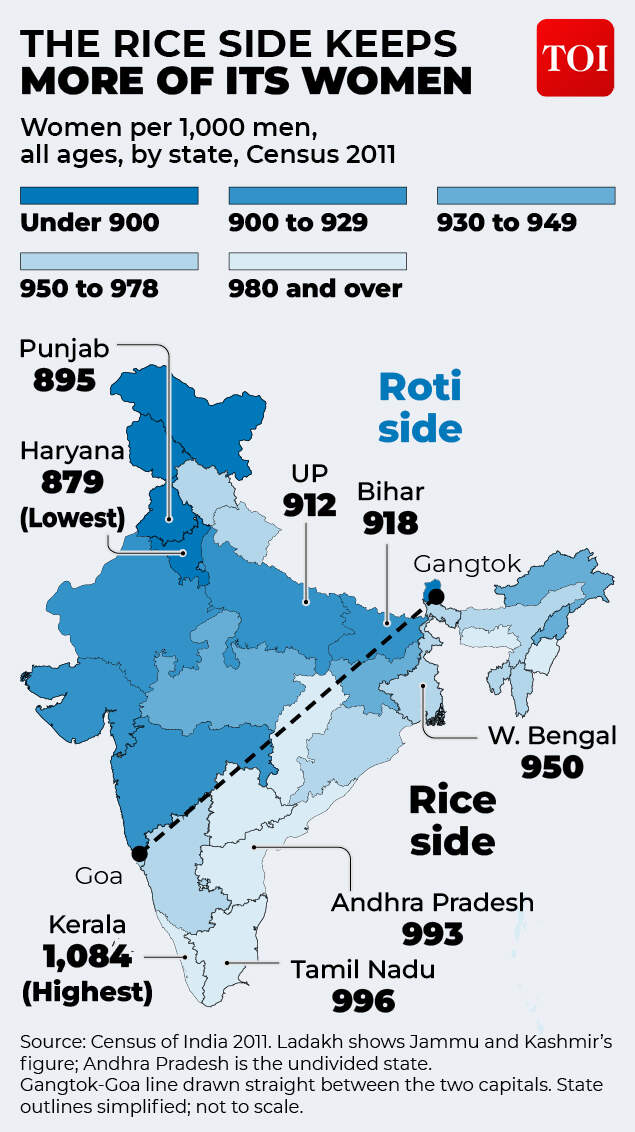
The 2011 Census shows a striking geographical divide in India’s sex ratio, with Kerala recording 1,084 women per 1,000 men against Haryana’s 879.
The case for the prosecution
Now look at what happens to girls on either side of the line. The cleanest measure available is the child sex ratio from the 2011 Census, the last one completed, which counts girls per thousand boys under the age of seven, and, on a map of India, it does not so much suggest a pattern as draw one.
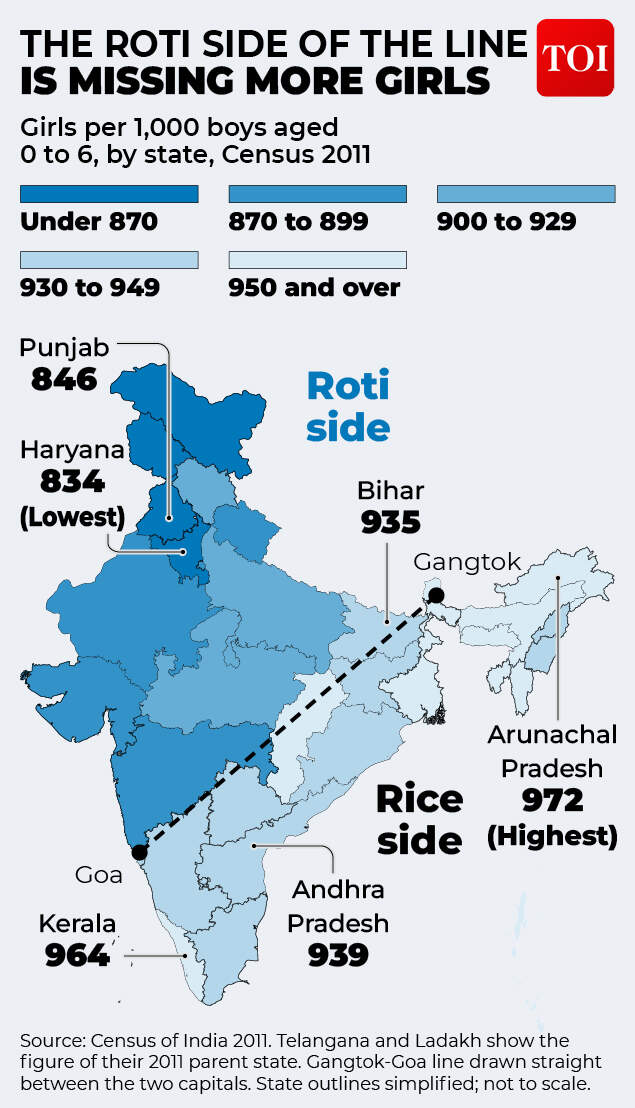
The 2011 Census reveals a sharp divide in child sex ratios, with Haryana recording just 834 girls per 1,000 boys compared with 964 in Kerala.
Haryana, at 834, brings up the rear, followed by Punjab, Jammu and Kashmir and Delhi, and the shading lightens almost obediently as one travels south and east. Among the large states, the separation is total: the best performer on the roti side is Bihar, at 935, a state that eats as much rice as wheat, while the worst on the rice side, the undivided Andhra Pradesh of 2011, still manages 939. One small north-eastern state, Manipur, spoils the perfection at 930, as small states will, but social science so rarely hands you a line this clean that the proper response is suspicion, to which I shall come.Women’s work, at least where the prosecution has chosen to look, tells a similar story. In 2022-23, according to Periodic Labour Force Survey figures tabled in the Lok Sabha, Delhi had the lowest female labour force participation of any state or union territory, at 14.8 per cent, with Haryana at 20.7 and Punjab at 27.6, while Chhattisgarh, on the line, reached 59.8 and Andhra Pradesh, Telangana and Odisha all cleared 44. Punjab and Haryana being among the richer states in the country, it is not poverty that keeps their women at home. Something else does.
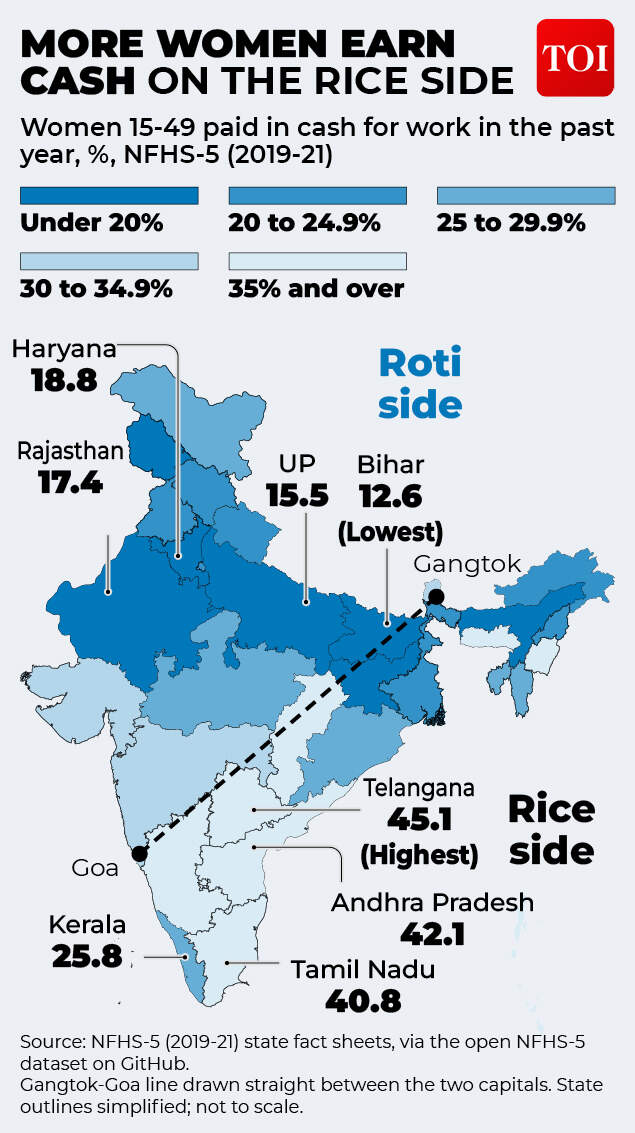
NFHS-5 data (2019–21) show wide regional differences in women’s paid employment, ranging from 12.6 per cent in Bihar to 45.1 per cent in Telangana.
That something is visible at dinner. When the World Food Programme studied poor households in Fatehpur and Lucknow in 2019, it found the order of service long settled: husbands, children and the elderly first, the women last, after everyone else had eaten their fill, a rule that applied equally to pregnant and breastfeeding women. Neither the men nor the women regarded this as discrimination; the women defended it on the grounds that the men went out to work. The phulka, in other words, is not the cause of anything. It is merely the clock by which the waiting is measured.
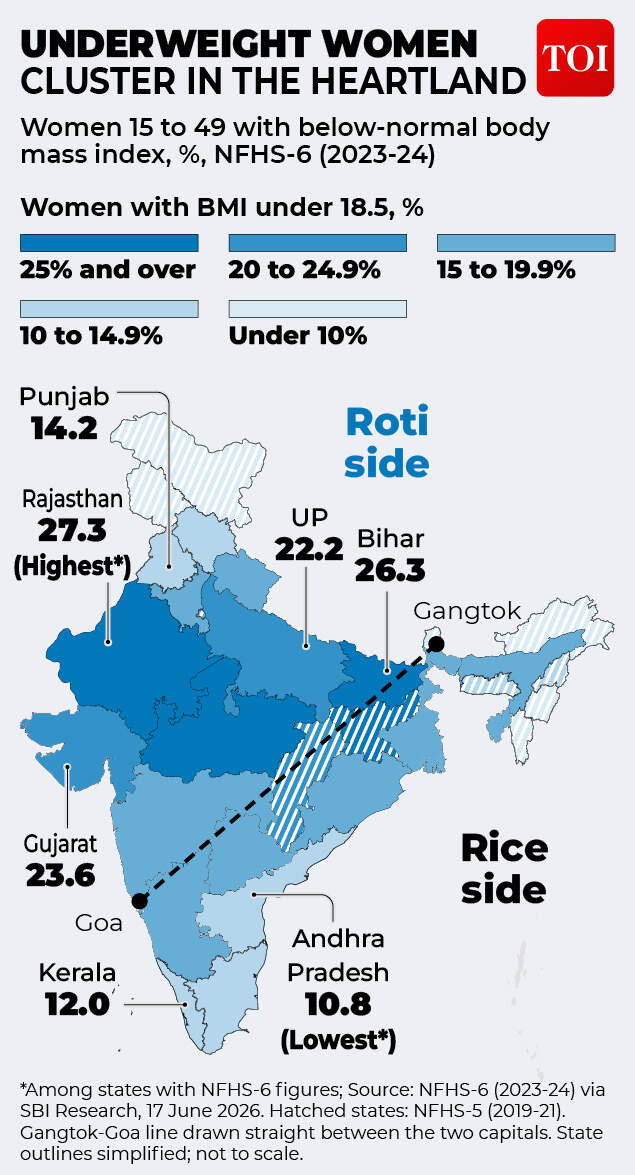
NFHS data reveal significant geographical differences in women’s nutritional status, with 27.3 per cent of women underweight in Rajasthan compared with 10.8 per cent in Andhra Pradesh.
The economists got there first
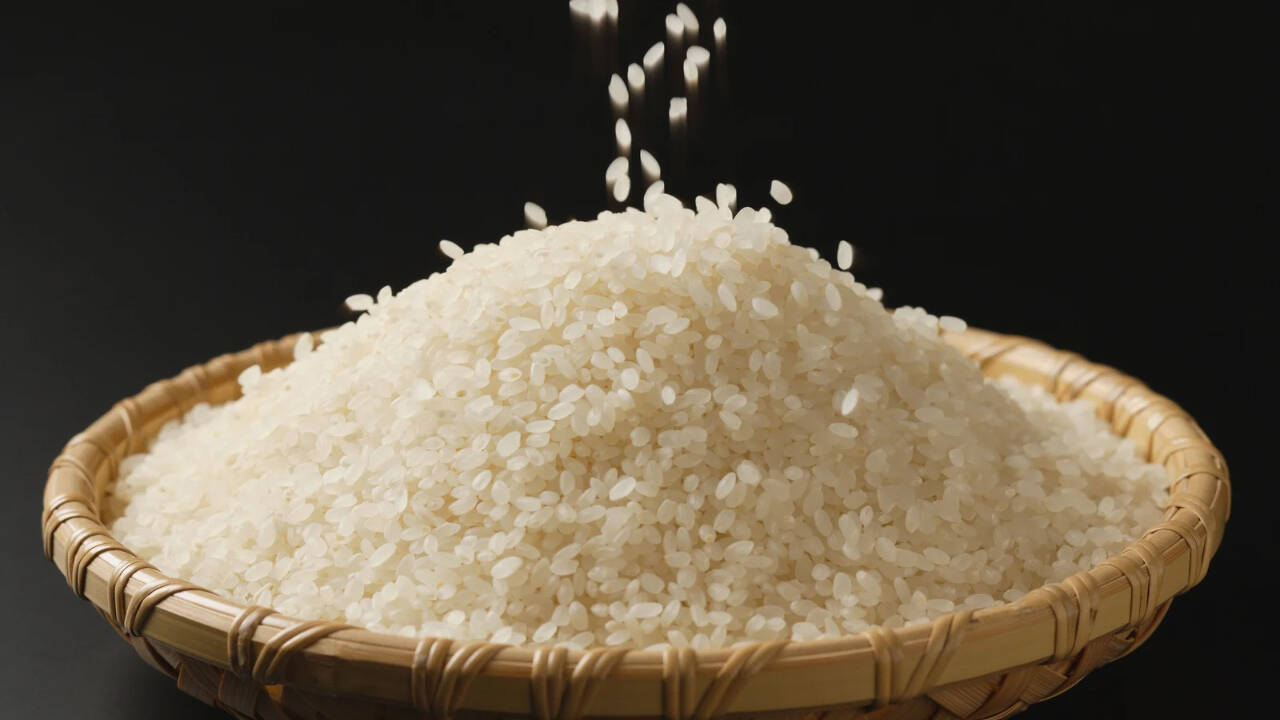
The democratic grain: cooked once, served together, and requiring nobody to stand over a stove while everyone else eats.
I would like to claim this theory as my own, but scholars have been circling the line for half a century, usually from the field rather than the kitchen. In 1970, the Danish economist Ester Boserup argued that the plough, involving heavy work that favoured male strength, pushed women out of farming and into the home, and four decades later, Alberto Alesina, Paola Giuliano and Nathan Nunn found that the descendants of plough-using societies still take a narrower view of a woman’s place. In 1974, Pranab Bardhan, writing in the Economic and Political Weekly, observed that girls fared better in India’s rice regions, where transplanting paddy has always needed women’s hands, than in its wheat regions, where it has not. Barbara Miller’s The Endangered Sex and a celebrated 1983 paper by Tim Dyson and Mick Moore drew the same map from another direction: the north marries its daughters into distant villages and cuts them off from their own people, while the south keeps them nearer their kin and, the authors argued, gives them more say.The newer work is sharper and, if anything, bleaker. Eliana Carranza of the World Bank showed in 2014 that districts with loamy soils, which permit deep ploughing and so need fewer women in the fields, have fewer girls than districts of heavy clay, where women’s labour is still wanted; a daughter, in the arithmetic of the agrarian household, is worth roughly what her labour is worth. Gautam Hazarika, writing in the Journal of Economic Behavior & Organization in 2024, calls rice the odd plough crop out, so hungry for labour that it has always needed women, and finds that the habit has outlived the paddy: urban women are more likely to work in districts better suited to rice than to wheat, an effect that shows up only among women native to the district, while urban housewives in wheat country are more likely to say they are required to stay at home. The field, it seems, follows a woman into the city long after she has stopped transplanting anything.Even China has been called as a witness. Thomas Talhelm’s 2014 study in Science found rice-growing southern China more interdependent in its thinking than the wheat-growing north, which turned out to be more individualistic. That last finding would puzzle anyone raised in a north Indian joint family, where individualism has traditionally been a privilege reserved for the eldest man at the table, who is, naturally, the one being served first. The economists, in short, blame the plough. My modest contribution is to move the crime scene from the field to the kitchen and to name the tawa as an accessory.
The case for the defence
The trouble with a theory this pleasing is that it is pleasing, and the defence has a strong case, which it may as well open with my own people. In the 2023-24 National Family Health Survey, released this year, the large state with the highest share of young women married before 18 is West Bengal, at 36.4 per cent, followed by Bihar at 34.6, Assam at 25.3 and Andhra Pradesh at 25.1, while Punjab, Haryana and Uttar Pradesh come in at 10.2, 11.9 and 13.7. On child marriage, the roti side wins, and wins handsomely; Kerala, at 2.9 per cent, remains the rice side’s best alibi. Nor is the Bengali dinner the democratic affair my theory requires, since it arrives in courses, shukto and dal and bhaja and macher jhol and chutney in strict liturgical order, and somebody has to stand and serve every one of them. Rice may be democratic. The fish head is a hereditary monarchy, and it passes down the male line.The prosecution’s labour figures, it must be admitted, were chosen by a columnist. The same 2022-23 survey puts Rajasthan at 47.9 per cent and Gujarat at 42.3, well ahead of West Bengal at 33.8 and Assam at 20.3, and the highest female participation of any state belongs to Himachal Pradesh, at 71.4; across the large states, the median on either side of the line sits at about 40 per cent, which is to say that on this measure the line all but vanishes. I was briefly cheered to learn from the National Sample Survey that Himachal eats more rice than wheat, until I noticed how quickly a spoiler had become evidence, which is the precise moment at which a theory should be taken outside and questioned, and until I noticed that Jammu and Kashmir, which eats more than twice as much rice as wheat, has the third-worst child sex ratio on my own map. Rajasthan’s women, meanwhile, are a reminder that working in the fields is not the same thing as being excused from the tawa; a great many women do both, in that order, every day.The sex ratio, my star exhibit, is less obliging than it looks. The 2011 Census is now fifteen years old, and the civil registration figures for 2023 put Jharkhand (899 girls per 1,000 boys at birth) and Telangana (906), both on the rice side, alongside Bihar (900) at the bottom of the table, with Haryana, at 911, merely joint sixth from the bottom, though registration in several of these states is still patchy. The historians are unkind too. James Fenske, Bishnupriya Gupta and Cora Neumann, rebuilding sex ratios from the colonial censuses of 1881 to 1931, confirm that the north skewed male long before anyone owned an ultrasound machine, but find its link with wheat and rice weaker than the literature has claimed, and Lupin Rahman and Vijayendra Rao concluded in 2004 that economics, the state and restrictions on women’s movement explain the north-south gap better than kinship does. Lines on maps, it turns out, are drawn in pencil.
The casserole solution
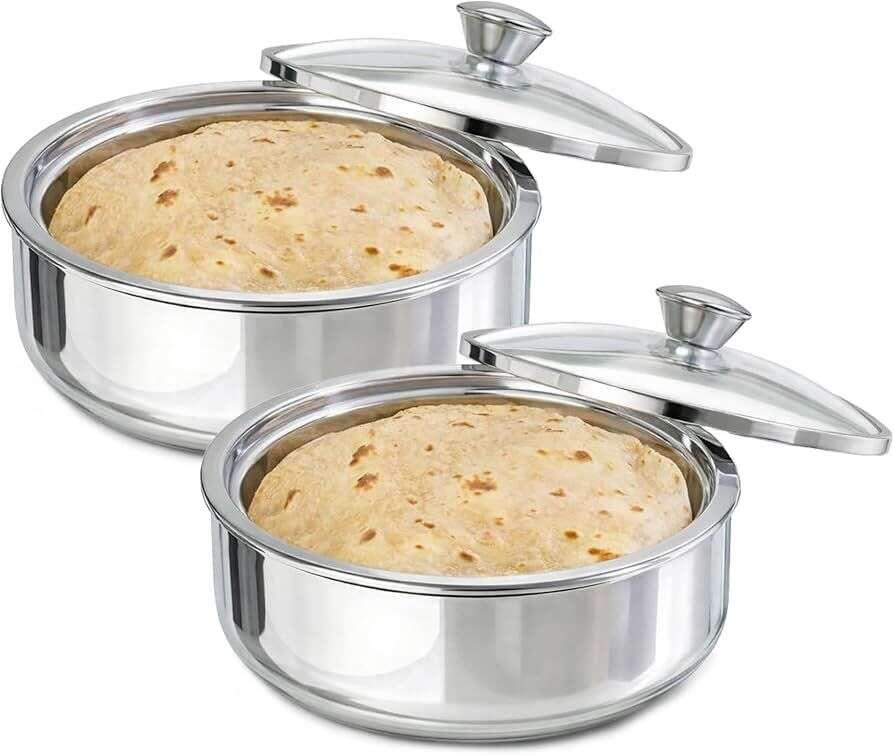
North India’s most underrated instrument of gender equality: keeping rotis warm so that everyone, including the cook, can eat together.
None of this proves that a flatbread oppresses anybody. Bread has no opinions, and the phulka, for all its theatrical puffing, has never once asked who is holding the tongs. What the line suggests, rather, is that a household arranges its food around whoever it has already decided can wait, and the phulka merely makes the arrangement easier to see, because the person doing the waiting is standing up.The remedy is not to abolish the phulka, which would be a crime against civilisation, nor to convert the north to rice, which Punjab is in any case too busy growing for the rest of us. North India already owns the technology of its own liberation: the insulated casserole, that pastel hot-case on every middle-class dining table from Ludhiana to Lucknow, which allows the rotis to be made in one batch and carried to the table the way rice is, so that the cook can sit down with everyone else. The roti will be a degree or two less heroic. The dinner will be considerably more just.Alternatively, and I say this as a man who has eaten more than his share of first phulkas, the person who wants one more could get up and make it.
Disclaimer: Views expressed above are the author’s own.