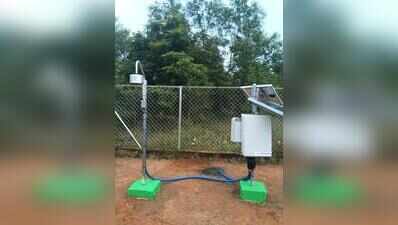
Bhubaneswar: With north Odisha districts such as Balasore, Keonjhar and Mayurbhanj witnessing several lightning deaths every year, Fakir Mohan University (FMU) has installed an Electric Field Mill (EFM) on its premises, with the help of the National Centre for Earth Science Studies (NCESS), Thiruvananthapuram, to strengthen lightning and thunderstorm research, and forecasting capabilities of the state.The ground-based instrument, installed on Friday under the supervision of C K Unnikrishnan of NCESS, continuously monitors atmospheric electric fields, enabling studies on thunderstorm evolution, lightning initiation and pre-lightning signatures.Balasore-based Fakir Mohan University vice-chancellor Santosh Kumar Tripathy said on Sunday that the facility will support atmospheric electricity climatology and improve lightning monitoring and forecasting capabilities in Odisha. “The EFM will help researchers from both the varsity and NCESS collect data for lightning research. The information can be used to create awareness among people about lightning and thunderstorms,” he said.He added the university had set up a community radio station through which it can share information with people living within a 25-km radius of the campus at Nuapadhi in Balasore district. “We are also planning to set up a centre for lightning research, as north Odisha districts such as Balasore, Keonjhar and Mayurbhanj witness many lightning deaths every year. We have signed an MoU with India Meteorological Department for lightning research, besides a collaboration with the NCESS. We will also conduct a workshop on lightning on the university campus this month,” he said.Manoranjan Mishra, a professor in the geography department of Fakir Mohan University, said the EFM will help researchers measure changes in the atmospheric electric field. The device can be used to track thunderstorm activity and understand how lightning develops. “The EFM continuously records the electric field near the ground. During normal weather, the electric field remains stable, but it changes sharply when thunderstorms form. By monitoring these changes, scientists can study different stages of a thunderstorm, from cloud formation to lightning strikes and storm dissipation. Researchers will be able to observe daily, seasonal, monsoon and pre-monsoon variations in the atmospheric electric field. Long-term observations can also help create a database on the electrical characteristics of weather over Balasore and other parts of Odisha,” he said, adding the instrument may also help identify warning signs before lightning occurs.Scientists can analyse the duration of strong electrical conditions before lightning. Such studies could improve understanding of lightning behaviour and support future lightning monitoring and forecasting efforts in the region, Mishra said.