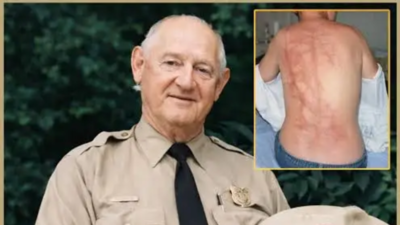
A lightning strike is usually a terrifying, potentially fatal encounter. For Roy Sullivan, it became an extraordinary recurring experience. The Virginia park ranger was struck by lightning seven times between 1942 and 1977, surviving every incident and earning a place in Guinness World Records as the person who survived the most lightning strikes. His encounters left him with burns, singed hair and injuries, and eventually earned him the nickname “Spark Ranger”, according to Guinness World Records.Sullivan’s first brush with lightning came in April 1942, when he was working at Shenandoah National Park in Virginia’s Blue Ridge Mountains. He was at a fire lookout tower when a storm set the structure ablaze. As he attempted to escape, lightning struck him in the right leg. The bolt left a scorch mark, tore through his boot and damaged the nail on his big toe.It was an experience that might have made most people wary of storms for the rest of their lives. Sullivan, though, would encounter lightning six more times over the next 35 years.
A series of increasingly bizarre encounters
For 27 years after the first incident, Sullivan reportedly went without another strike. That changed in July 1969, when he was driving his truck along a mountain road during a storm. Lightning struck trees nearby before travelling through the vehicle’s open windows. Sullivan was knocked unconscious, his eyebrows were burned and his wristwatch was damaged.The following year, in July 1970, lightning struck him while he was tending to his garden. The bolt reportedly burned his left shoulder and threw him off his feet. In April 1972, another strike hit while he was working inside a park guardhouse. His hair caught fire, forcing him to put it out with water.By then, Sullivan had begun taking precautions. According to a 2013 Washington Post profile, he carried water with him after the incident in which his hair caught fire. But avoiding storms and taking shelter did not appear to end his extraordinary run of misfortune.On August 7, 1973, lightning struck him again while he was driving. Sullivan later said he had stopped after trying to get away from a storm, only to see a bolt coming towards him. The strike set his hair alight, burned his legs and reportedly knocked him out of his vehicle.The sixth incident occurred on June 5, 1976, while Sullivan was walking along a trail. He suffered an ankle injury and his hair was burned once more. Five months later, he retired from the National Park Service. He and his wife moved to a property near Waynesboro, Virginia, where he installed copper lightning rods around his home, including on the trailer, television antenna and nearby trees. Still, the precautions did not bring his encounters to an end.
The seventh strike and a world record
On June 25, 1977, Sullivan was fishing when lightning struck him for the seventh time. He reportedly smelled sulphur and felt the hair on his arms stand up moments before the bolt hit. The strike burned his chest and stomach, singed his hair and damaged his hearing in one ear. He managed to reach his car and return home, after which he was taken to hospital.Guinness World Records lists this as his final lightning strike. Its record entry documents seven incidents, beginning in 1942 and ending on June 25, 1977. Sullivan was subsequently recognised as the person who had survived the most lightning strikes.His story attracted attention well beyond the national park. He appeared on television programmes and became a familiar name in accounts of unusual survival stories. The nickname “Spark Ranger” followed him, while his lightning-damaged hat and wristwatch became part of the lore surrounding his experiences.
A shocking tale
Sullivan’s record is recognised by Guinness World Records, but the details of his encounters have also attracted questions. A 2013 investigation by The Washington Post noted that none of the seven strikes was directly witnessed by another person. His wife and fellow rangers were not present for the incidents, and there was no medical record independently confirming every strike.The report found that newspaper accounts and statements from people who knew Sullivan offered some support for his injuries. His family doctor and a former park superintendent were said to have verified injuries, though not necessarily the lightning strikes themselves. A retired National Park Service historian interviewed for the report expressed confidence in the Guinness record, while others who knew Sullivan were more cautious.Sullivan died in September 1983, aged 71. His story remains an unusual chapter in the history of Shenandoah National Park and a reminder of the unpredictable power of thunderstorms.