
Miami-Dade Sheriff Rosie Cordero-Stutz’s legal arrangement with her longtime friend, former judge Israel Reyes, has sparked concerns over potential conflicts of interest and whether law enforcement can profit from property seizures. Under the agreement, Reyes’ law firm can retain up to 35% of assets seized in civil forfeiture cases handled on behalf of the sheriff’s office.The controversy intensified after the office seized more than $45 million in bank accounts and business inventory within two months of signing the agreement. Some affected businesses have not faced criminal charges and are challenging the seizures in court. The arrangement could earn Reyes’ firm more than $10 million from these seizures alone.Under the agreement, Reyes’ law firm receives 30% of assets seized in civil forfeiture cases. If property owners challenge the seizures in court, the firm’s share can increase to 35%, according to the contract. Unlike conventional legal arrangements, the sheriff’s office does not pay Reyes a fixed fee. His compensation is linked to the value of assets recovered.One affected business is SH Americas, described as South Florida’s largest distributor of Samsung phones. The sheriff’s office seized $42.5 million from its bank accounts, leaving the company unable to meet payroll obligations and potentially threatening its operations, according to court filings. The company has not been charged with criminal wrongdoing.Reyes also told a Miami-Dade circuit court that he had identified another $2.6 billion in assets belonging to the parties that could potentially be subject to forfeiture. Successful seizures could earn his firm more than $500 million. However, the court ruled that the identified funds fell outside its jurisdiction and could not currently be seized.
Why has the Miami sheriff ’s agreement raised ethics concerns?

A 35% cut of seized assets and $45 million in seizures put the Miami Sheriff’s office under scrutiny. (Photo: Miami-Dade Sheriff’s Office)
Civil asset forfeiture allows authorities to seize property suspected of being connected to criminal activity without necessarily charging or convicting its owner. Unlike criminal forfeiture, civil proceedings are brought against the property itself, meaning authorities do not always have to establish that the owner committed a crime.Legal experts argue that linking an attorney’s compensation to seized assets could create financial incentives that conflict with the responsibility to pursue justice impartially.Louis Rulli, a practice professor of law at the University of Pennsylvania Carey Law School, expressed concern about the arrangement.“The conflict of interest strikes at the foundation of our justice system, of neutrality and of seeking justice,” he told WLRN.The lawsuit filed by affected companies also argues that Reyes’ financial interest could influence which seizures are pursued and whether the sheriff’s office chooses to settle cases or continue litigation.
Miami-Dade sheriff’s office revenue from forfeitures rises 2,325%
The financial implications of asset forfeiture have also drawn attention. Before Cordero-Stutz took office, the existing Miami-Dade Police Department reported $396,000 in revenue from fines and forfeitures. By the following fiscal year, the figure had increased to $9.6 million, marking a 2,325% rise.The money came from cases in which property owners either did not challenge the seizures or lost in court. The sheriff’s office retains the remaining proceeds after deducting the law firm’s share, reporting the money as department revenue rather than transferring it to the state or county treasury.The issue is significant because the sheriff’s office is involved in an ongoing budget dispute with the Miami-Dade Board of County Commissioners. Legal experts fear forfeiture proceeds could allow law enforcement agencies to bypass regular public budgeting and appropriations processes.Rulli warned against allowing police departments to use forfeiture proceeds as an inadequately monitored source of funding.“State legislators ought to decide how money obtained through forfeiture should be used. They should not bypass the appropriations process, and that’s what guarantees the public that the money’s being well spent and it’s for appropriate purposes,” he said.The Miami-Dade Sheriff’s Office did not respond to requests by the publication for comment.
Miami-Dade judge rejects request to disqualify Israel Reyes
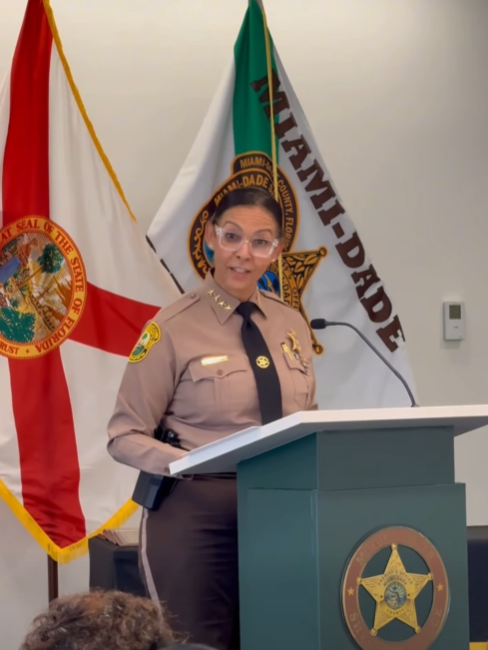
Israel Reyes’ firm reportedly saw revenue jump 2,325% amid the controversial arrangement. (Photo: Miami-Dade Sheriff’s Office)
Companies challenging the seizures sought to disqualify Reyes, arguing that his financial interest in the cases creates a conflict of interest and undermines public trust.However, Miami-Dade Circuit Judge Ariana Fajardo Orshan rejected the request. She observed that the sheriff’s office retains control over whether forfeiture cases proceed and must approve settlements.“It appears that [Reyes’ Law Firm] does not have the discretion to pick and choose which forfeitures will go forward, and therefore does not have the opportunity for example, to choose to bring only those forfeitures that are worth the most money and will result in the greatest profit to the firm,” Orshan wrote.The judge noted that the dispute raised a legal question not previously considered by a Florida court in this context. The affected companies are appealing the decision before Florida’s 3rd District Court of Appeal.Attorney Lisandra Guerrero, who represents the companies, criticised the arrangement.“Would we accept a police officer collecting a percentage of every traffic ticket he writes? Of course not. His job is to enforce the law, not to make money at the expense of citizens. So why allow it when it comes to lawyers with the power to seize property?” she told WLRN.“This practice should be abolished. Policing is not a for-profit enterprise,” she added.
Who is Israel Reyes? Former police officer and judge has longstanding ties to Miami sheriff
Reyes joined the Metro-Dade Police Department in 1980 and worked as a homicide detective during the 1980s, investigating organised crime cases. He left the department in 1994 and earned his law degree from Nova Southeastern University before working as a personal injury attorney and in the Dade County State Attorney’s Office.In 2002, Republican Governor Jeb Bush appointed him to a vacant county courthouse seat. A year later, he joined the Eleventh Judicial Circuit, where he served until 2011. He later entered Republican politics, serving as deputy campaign manager for Connie Mack IV’s unsuccessful 2012 US Senate campaign.Reyes also served on influential Florida Bar committees and established R.A. Asset Recovery LLC in 2018, according to state records. Campaign records show he donated $1,000 to Cordero-Stutz’s election campaign in August 2024.
How did Rosie Cordero-Stutz become Miami-Dade’s first elected sheriff in nearly 60 years?
In January 2025, Republican Rosie Cordero-Stutz was sworn in as Miami-Dade County’s new sheriff, becoming the first person elected to the position in nearly six decades. The position had been abolished by voters in 1966 following widespread corruption allegations. A statewide referendum approved in 2018 restored the requirement for voters to elect their top law enforcement official.During her January 7, 2025, swearing-in ceremony at Miami Dade College’s North Campus, Reyes publicly acknowledged their longstanding friendship.“We served together with the Miami-Dade Police Department and you honor me by inviting a has-been judge to come up here and give you and administer the oath,” he said.The sheriff’s office assumed control of a budget worth approximately $1.2 billion. About six months later, Cordero-Stutz’s office entered into the controversial agreement with Reyes, bringing their personal and professional ties under scrutiny.
Civil asset forfeiture faces criticism across political lines
The Miami-Dade controversy is part of a wider US debate over civil asset forfeiture, which has attracted criticism from both Republicans and Democrats.Tim Sandefur, vice president for legal affairs at the Goldwater Institute, argued that such arrangements could damage public confidence in law enforcement.“When you have public resources that are devoted not to hunting down the worst criminals, but instead to hunting down those criminals whose prosecution will be most profitable for the government, that’s a really perverse way to do government,” he told WLRN.Even conservative US Supreme Court Justice Clarence Thomas has questioned the constitutionality of civil asset forfeiture. In a 2022 statement, he highlighted how allowing law enforcement agencies to retain seized property could create financial incentives to pursue forfeiture cases. He also warned that the practice disproportionately affects poorer communities, whose members may lack the resources to challenge seizures in court.Florida has previously faced controversies involving forfeiture proceeds. In 2015, the US Department of Justice forced the city of Bal Harbour to return $4 million seized by its police department after investigators found that the money had been used for lavish expenses, including first-class flights.The Miami-Dade agreement has renewed questions about financial incentives behind civil asset forfeiture, public accountability and whether private lawyers should receive a percentage of property seized using government powers.