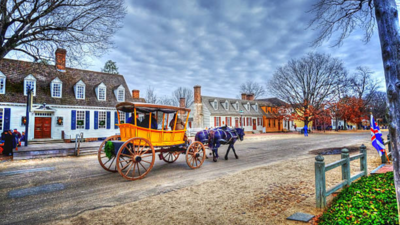
A century ago, a wealthy philanthropist agreed to help save a fading American town whose colonial-era character was disappearing behind petrol stations, garages and modern buildings. What began as an ambitious preservation idea backed by John D. Rockefeller Jr. eventually transformed Williamsburg, Virginia, into one of America’s best-known living history museums. Now, 100 years after the restoration project began, Colonial Williamsburg is preparing for another major transformation: a five-year investment plan backed by $600 million in fundraising, alongside a $10 million gift to promote education about the US Constitution and civic responsibility, according to the announcement reported by The Washington Post, as the institution marked its centenary.The story began with Reverend Dr W.A.R. Goodwin, rector of Bruton Parish Church in Williamsburg. He had long wanted to restore the town’s historic character and preserve its surviving 18th-century buildings. However, turning the idea into reality required financial backing on a scale that was beyond the reach of a local church rector. Goodwin approached several wealthy potential supporters, including industrialist Henry Ford, but did not succeed in securing his backing. His efforts eventually brought him to Rockefeller, the philanthropist and son of Standard Oil founder John D. Rockefeller. The two had first met in 1924, when Goodwin was raising funds for a memorial hall at the College of William & Mary.Rockefeller visited Williamsburg with his family in March 1926. During a later visit in November, Goodwin explained his vision of restoring the former colonial capital. Rockefeller agreed initially to finance architectural sketches before becoming more deeply involved in the proposal. On December 7, 1926, he authorised Goodwin to purchase the Ludwell-Paradise House, the first property acquired for the restoration project.What followed was a much larger effort to recover the town’s colonial appearance. Buildings were purchased, restored or reconstructed, while structures from later periods were removed. Architects, archaeologists, historians and craftspeople worked to recreate the Virginia capital as it appeared during the 18th century, when figures such as George Washington and Thomas Jefferson were involved in debates over Britain’s rule and American independence.The project gradually developed into Colonial Williamsburg, which opened its historic attractions to visitors as restoration work progressed. The Rockefeller family remained its principal financial backer for five decades. According to the foundation’s centenary history, the initial preservation effort eventually grew into a full-scale restoration of the former colonial capital.A hundred years later, the institution is looking beyond the physical restoration of buildings. Its new five-year investment plan will expand the historical periods represented at the site and strengthen its educational programmes. The foundation has raised $600 million through its Power of Place centennial campaign, supported by approximately 180,000 individual donors. The fundraising target was reached eight months ahead of schedule, according to local broadcaster WHRO.The plan will broaden the museum’s living-history interpretation beyond the period leading up to the American Revolution. Visitors will increasingly encounter the events and debates that followed independence, including the drafting and ratification of the US Constitution and the adoption of the Bill of Rights in 1791.The expansion will also include reconstructed period buildings, changes to the historic landscape and greater investment in interpreters who bring historical figures and everyday life to visitors. Traditional craftspeople, including blacksmiths and furniture makers, will receive additional support. Educational programmes will also cover archaeology, food, horticulture and historic trades, allowing visitors to explore how people lived and worked in the colonial period.A major part of the new initiative is the National Institute for the Constitution and Civic Virtue. Constitutional scholar Jeffrey Rosen, a professor at George Washington University, will serve as its founding director. The institute is intended to bring scholars with different perspectives together for lectures, discussions and public programmes exploring the Constitution and the responsibilities associated with citizenship.The initiative has received a $10 million gift from former federal judge J. Michael Luttig and his wife, Elizabeth. The institute plans to organise lectures in Williamsburg, Washington DC and partner institutions across the country. It will also develop educational resources for schools, including material that can be used by K-12 teachers.The foundation hopes to connect historical interpretation with contemporary questions about democracy, civic participation and the country’s founding principles. Its historical interpreters, who portray figures such as Thomas Jefferson and George Wythe, are expected to participate in some of the institute’s programmes, bringing historical debates to life for modern audiences.The timing of the announcement is significant. The foundation’s centenary falls in the same year as the 250th anniversary of the Declaration of Independence in 1776. Its five-year plan will continue through 2031, when the United States will mark 250 years since the British surrender at Yorktown in 1781, a decisive event in the American Revolutionary War.The institution has also faced challenges in recent years, including declining attendance and financial difficulties. The new investment plan is intended to strengthen its public programmes, visitor experience and long-term financial position while expanding its national educational role.For Rockefeller and Goodwin, the original ambition was to preserve a town whose historic buildings were at risk of disappearing. A century later, Colonial Williamsburg is attempting to preserve something beyond its architecture: the history, debates and civic ideas that shaped the country. Its next chapter will be judged not only by how successfully it restores the past, but also by how effectively it helps future generations understand it.