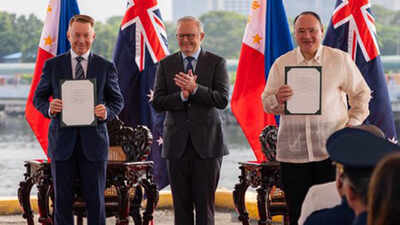
Australia and the Philippines on Sunday signed a defence cooperation agreement aimed at streamlining joint military activities and strengthening security ties, a move that could deepen regional coordination amid tensions with China in the South China Sea.The Defence Cooperation Arrangement (DCA) will simplify procedures under the bilateral Status of Visiting Forces Agreement (SOVFA), making it easier for the two countries to coordinate military activities involving their maritime, air and land forces.Philippine Defence Secretary Gilberto Teodoro said the agreement would reduce bureaucratic hurdles and strengthen Manila’s ability to respond to security challenges.“Rather than 100 steps to do a single thing, it will just now take 10,” Teodoro told reporters, describing the deal as an “anti-red tape measure” for implementing SOVFA.He said the arrangement would also facilitate cooperation in humanitarian assistance and disaster response, while bolstering the Philippines’ “credible deterrence posture”, including in the South China Sea.Australian Prime Minister Anthony Albanese witnessed the signing in Manila, where he is attending a summit of the Association of Southeast Asian Nations (ASEAN). He said the agreement would improve maritime awareness and information sharing, while expanding strategic dialogue, military training, interoperability and defence infrastructure development.Albanese also announced additional Australian investment in maritime domain awareness, including drone technology, equipment and training to improve the detection of maritime and cybersecurity threats.China’s defence and foreign ministries did not immediately respond to requests for comment on the agreement on Sunday.
Why is China concerned about the pact?
The agreement comes as the Philippines expands its security partnerships with countries including Australia, the United States and Japan amid repeated tensions with China over competing territorial and maritime claims in the South China Sea.Australia has consistently backed Manila’s position on the strategic waterway and supported the 2016 ruling by an international arbitral tribunal, which rejected the legal basis of China’s expansive claims in the South China Sea. Beijing has rejected the ruling and maintains that its actions in the disputed waters are lawful.The latest agreement could make military coordination between Australia and the Philippines easier, including through joint exercises, training and information sharing. The proposed expansion of maritime surveillance capabilities, particularly through Australian investment in drone technology, could also improve Manila’s ability to monitor activity in the disputed waters.For Beijing, closer military coordination between Manila and its security partners could complicate its efforts to deal with the Philippines bilaterally over maritime disputes.China has repeatedly opposed joint military activities involving the Philippines and countries outside the region, arguing that such exercises increase tensions in the South China Sea.
Philippines seeks wider security partnerships
The agreement reflects Manila’s efforts to broaden its network of defence partnerships beyond its longstanding treaty alliance with Washington.Australia, the US, Japan and the Philippines have stepped up military cooperation in recent years, including through joint maritime activities and exercises in the Indo-Pacific.In February, the four countries conducted joint patrols in the waters and airspace around China’s Huangyan Dao, also known as Scarborough Shoal. The activities drew criticism from Beijing.China’s defence ministry spokesperson Zhang Xiaogang had accused countries outside the region of increasing tensions through their military presence in the South China Sea.“countries outside the region, such as the US, have traveled thousands of kilometers to the South China Sea to flex their muscles and stir up tensions. They are the real source of uncertainty,” Zhang said.He also accused the Philippines of seeking external support to pursue its claims and warned that the Chinese military would respond to what it considers provocative actions.“The Chinese military remains on high alert and will take resolute countermeasures against any rights-violation and provocative acts,” Zhang said.
Can the ‘Squad’ emerge as a regional security bloc?
The growing defence cooperation among Australia, the US, Japan and the Philippines has also fuelled discussion about an informal security grouping known as the ‘Squad’.The four countries have increased joint military activities and cooperation, with a focus on strengthening the Philippines’ defence capabilities amid tensions with China.However, questions remain over whether the grouping can evolve into a more formal security arrangement similar to the Quad, which brings together India, the US, Japan and Australia.Chinese military affairs expert Song Zhongping told the Global Times that Manila was seeking to involve more external powers in the South China Sea dispute because it could not contend with China on its own.He said Australia’s involvement would largely depend on Washington’s approach to the region, adding that Canberra was unlikely to adopt a more aggressive position if the US chose to limit its involvement.Song also questioned whether the four countries could maintain a unified approach, saying the grouping’s cohesion would depend largely on Washington’s willingness to drive the initiative.The latest agreement strengthens military coordination between Australia and the Philippines. However, whether this translates into a more coordinated regional security framework will depend on the strategic priorities of all four countries.