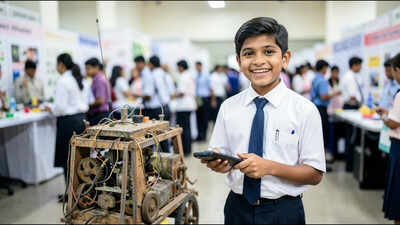
Farming is hard work. From preparing the land to carrying out different field operations, farmers often spend long hours doing physically demanding tasks. For many small farmers, buying separate machines for every job is also expensive.A Class 10 student from Kerala’s Idukki district has been thinking about whether there is a simpler way.Anax Joshi, a student of St Mary’s High School in Vazhavara, has designed a remote-controlled multipurpose agricultural vehicle. His innovation has won the Bala Shastra Puraskaram, a Junior Science Award instituted by Kerala State Sasthravedi.What makes the project interesting is its basic idea. Instead of making farmers depend on separate equipment for different operations, Anax has attempted to bring multiple farming functions together in a single machine that can be operated remotely.It is a simple thought, but one that addresses a problem familiar to farmers across the country.
A problem that inspired a young inventor
Agricultural mechanisation has improved considerably over the years. Yet, for small and marginal farmers, access to suitable machinery remains a challenge. Equipment can be expensive, difficult to maintain and sometimes unsuitable for smaller plots of land.Labour shortages and the physical demands of farm work add to the problem.Anax’s project approaches this challenge from a different direction. A remotely operated agricultural vehicle could allow farmers to control certain operations without having to remain physically beside the equipment throughout the process.The multipurpose design is another interesting aspect. If a single machine can perform several useful tasks, it could potentially reduce the need to invest in multiple pieces of equipment.For a student project, identifying a real problem and attempting to find an engineering solution is itself a meaningful achievement.
More than a school science project
Anax’s recognition through the Bala Shastra Puraskaram gives the project a wider significance. It also highlights the kind of innovation that can emerge when students look beyond textbooks and observe the difficulties faced by people around them.Not every useful invention begins in a sophisticated laboratory. Sometimes, it begins with a problem that a student has seen in everyday life.For Anax, that problem was the physical effort involved in farming.However, the real test of his invention will come when it is put through practical trials. Can it work on uneven farmland? How many tasks can it perform? Is it affordable for an ordinary farmer? And can it withstand regular use in the field?These are questions that will need to be answered before the machine can be considered a practical alternative to existing agricultural equipment.
Can a classroom idea find a place on the farm?
For now, Anax has achieved something important. He has taken an everyday challenge and tried to approach it through technology.His invention also offers an interesting lesson for other students. Science and engineering do not always have to begin with complicated theories or expensive equipment. They can begin by noticing something that needs to be made easier.If further testing establishes that his machine is reliable and affordable, the idea could have applications beyond a school exhibition.For a young student from Idukki, that is an encouraging place to begin. The next step is to take the machine out of the classroom and see how it performs where it matters most: on a farm.