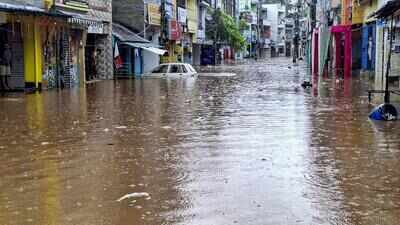
Berhampur: Odisha govt on Tuesday attributed the devastating floods in Ganjam to extreme rainfall in the catchment areas of Rushikulya and Bahuda rivers, rejecting allegations that faulty water management aggravated the disaster.The district received an average 338.74 mm of rainfall in three days from Oct 27 to 29 under the influence of cyclone Arnab, causing Rushikulya and its tributaries to swell, said Dillip Kumar Rout, engineer-in-chief (EIC) of the water resources department.His remarks came amid former chief minister Naveen Patnaik terming the disaster man-made and former chief secretary Suresh Chandra Mohapatra, who had also served as water resources secretary, blaming water management lapses for the scale of the floods.Rout said the rainfall this time was higher than during previous major floods in Ganjam. The district had received an average 298.46 mm of rainfall on Nov 3-4 during the 1990 floods, 205.5 mm on Oct 12-13 when cyclone Phailin struck in 2013, and 260.4 mm on Oct 11-12 during the 2018 floods. “We witnessed a peculiar phenomenon, with extreme rainfall concentrated in Ganjam and parts of Gajapati and Kandhamal districts,” Rout said.“We did not neglect flood management or do anything wrong. Our field staff did a good job in managing the dams during the floods,” he said at a news conference here. Rout said three reservoirs in Ganjam, Sorada, Dhanei and Bhanjanagar, do not have gates to regulate water release.The EIC, who visited different flood-hit areas to assess the situation, said damage to water resources department infrastructure in the district had been estimated at around Rs 335 crore. “We are now focusing on repair and restoration work,” he said.Govt’s explanation counters Mohapatra’s contention that the severity of the floods was linked to poor management of reservoirs and water resources. While Naveen wrote a letter to chief minister Mohan Charan Majhi seeking accountability, Mohapatra on Monday alleged that despite IMD warning of heavy rainfall from Oct 23, adequate steps were not taken to create storage space in reservoirs ahead of the downpour. According to him, reservoirs including Ghodahada, Bhanjanagar, Sorada, Dhanei and Daha were not sufficiently drawn down despite the weather warning.He contended that reservoir levels consequently rose rapidly after the heavy rain, forcing large quantities of water to be released and aggravating flooding downstream. Mohapatra’s allegations have also been echoed by opposition BJD and Congress.