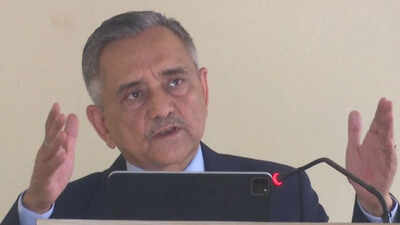
Former chief of defence staff General Anil Chauhan has warned that India’s national security challenges are increasingly extending beyond conventional military threats, with deepfakes, information manipulation and influence operations emerging as tools of cognitive warfare.He has called for making strategic thinking part of the country’s education system, arguing that universities, citizens and society must play a greater role in strengthening national security.According to news agency ANI, Chauhan made the remarks while delivering the inaugural lecture on ‘Strategic Culture of India and National Security’ at Jawaharlal Nehru University (JNU) on November 3. He stressed that strategic awareness should extend beyond the armed forces and government institutions to become part of India’s broader national education framework.“The first task is to make strategic thinking part of national education,” Chauhan said.Cognitive warfare and the threat to national securityHighlighting the changing nature of warfare, Chauhan identified cognitive warfare as a growing threat, pointing to the use of deepfakes, manipulated information, influence operations and social media to shape public perception and influence societies.He cautioned that such operations could create divisions within society by influencing public opinion before facts are verified. He said the challenge should not be treated merely as a battle of narratives or a public relations exercise.“Cognitive warfare is not just a battle of narrative nor it is public relations exercise. Its understanding must become part of national resilience building,” he said.The former CDS also called for stronger links between universities and military war colleges, arguing that subjects such as Indian political thought, statecraft, military history, diplomacy, technology and national security should become part of academic discourse.Chauhan’s remarks reflect the expanding definition of national security, which is no longer confined to territorial defence or military preparedness. The growing use of information, technology and economic dependencies as instruments of geopolitical pressure has made societal awareness an important part of a country’s resilience.Emphasising the role of citizens, he said national security depended on an informed population capable of recognising emerging threats.“No power, I repeat, no power can threaten the frontiers of a nation whose citizens are aware and informed,” he said.He also highlighted the importance of combining India’s traditional strategic thinking with contemporary security requirements. Referring to dharma and Kautilya’s principles of statecraft, Chauhan said India must maintain ethical restraint while remaining strategically prepared.On the growing use of economic instruments in strategic competition, Chauhan warned that interdependence itself was increasingly being used as leverage.“Economic interdependence is being weaponised. Trade, finance, critical minerals, energy, technology, standards, supply chains, data, information. Everything is weaponised today,” he said.He further stressed that Indian strategic thought should be communicated in languages accessible to the wider population, saying national security awareness must reach beyond academic and military institutions.