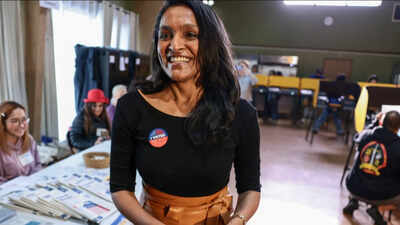
TOI correspondent from Washington: Nithya Raman stood before supporters at a downtown Los Angeles brewery in June, struggling to hold back tears. The early primary election returns had placed her third in the race for mayor, behind incumbent Karen Bass and reality tv personality Spencer Pratt, and it looked like the end of the road for her. She gave what was almost a concession speech. Her father Venkit Raman, an IITian, comforted campaign workers, telling them her full name Nithya Varsha means ‘everlasting monsoon,’ and her political life would be replenished soon.It came sooner than anyone expected because after all this is the la la land of Hollywood where plot twists are common. And appropriately too enough considering her husband, Vali Chandrasekaran, is a successful television writer and producer whose credits include 30 Rock and Modern Family. A batch of late ballots that came in took Raman past Pratt to second place, and because Bass did not get 50 per cent of the vote, there would be a run-off election in November. Even then, few gave the 45-year old political tyro, with only six years of experience on the City Council, any chance. Raman herself had once supported Bass, and the 73-year old party stalwart had the backing of the Democratic establishment, including endorsements from Kamala Harris, Nancy Pelosi and Governor Gavin Newsom. She had experience, name recognition, and the advantage of incumbency.What Bass could not quite escape was the perception that Los Angeles is broken and she did not have the toolkit to fix it. The devastating January 2025 Palisades wildfire, which killed 12 people and destroyed thousands of homes, became a defining political liability. Bass was abroad when the mishap occurred and her handling of the disaster and recovery became a persistent political liability. Raman’s campaign ignited. She offered herself as the candidate of change, promising better housing, improved public services and more accountable government. An urban planner by training, she could talk about the nuts and bolts of city administration rather than simply deliver ideological sermons. On Tuesday night, her persistence paid off, and although the race has not been officially called, she is ahead by 25,000 votes and looks likely to seal the deal. She invited supporters to join her in a dance on Wednesday, the tears in June now forgotten.Raman’s victory is more than an extraordinary personal turnaround. It is another major breakthrough for the Democratic Socialists of America (DSA), the left-wing movement that has been steadily challenging the Democratic Party establishment. And for India, it provides an especially striking political subplot: New York and Los Angeles, America’s two largest cities, will now be led by mayors of Indian origin, with Zohran Mamdani already in office in New York.What’s even more striking: Long before Mamdani and Raman began making their mark in American municipal politics, several prominent Indian nationalists and intellectuals had encountered the country’s radical political traditions first hand. Lala Lajpat Rai spent five years in the U.S between 1914 and 1919, establishing the India Home Rule League and publishing the journal Young India in New York. The radical humanist M.N. Roy arrived in the U.S in 1916 as a global itinerant, encountered American radicals and began studying socialism, subsequently moving to Mexico City, where he founded the Communist Party of Mexico in 1919. He later played a foundational role in establishing the Communist Party of India in 1920. B.R. Ambedkar, meanwhile, studied at Columbia University in NYC, encountering some of America’s leading liberal and progressive intellectuals, including philosopher John Dewey. And Jayaprakash Narayan spent seven years in America (1922-1929), studying at Berkeley, Iowa, and Wisconsin, where he encountered Marxism and returned to India a committed socialist.All this was at a time socialism was enjoying considerable electoral popularity. In 1912, Socialist Party presidential candidate Eugene Debs won nearly a million votes, then about 6% of the national total. Socialists also held hundreds of municipal offices, including mayoralties. In fact, in the early 1950s Donald Trump’s father Fred Trump clashed with the folk singer Woody Guthrie, an avowed socialist, over racial segregation and housing discrimination in Brooklyn, causing him to write a song — a scalding takedown of a predatory landlord — titled “Old Man Trump” who stirred up racial hatred “in the bloodsport of the human heart.“How Socialists are storming across American cities:Indeed, even in the modern era, the current upsurge of socialists did not emerge overnight. One of its earliest conspicuous faces was another Indian activist: Kshama Sawant, born in Pune and raised in Mumbai, who won a seat on Seattle’s City Council in 2013. A former economics professor and member of Socialist Alternative rather than the DSA, Sawant became a prominent voice for a $15 minimum wage, rent control and taxing the wealthy. Her victory demonstrated that a politician openly identifying with socialism could win in an American city.Bernie Sanders subsequently took the argument national with his presidential campaigns in 2016 and 2020 bringing democratic socialism into mainstream political conversation, particularly among younger Americans frustrated by inequality, expensive healthcare, housing costs and the influence of corporate money. Alexandria Ocasio-Cortez’s (AOC’s) stunning 2018 primary victory over veteran Democrat Joe Crowley gave the movement another national face. The election of Mamdani as New York mayor in 2025 was an even bigger breakthrough. Mamdani defeated Democratic political heavyweight Andrew Cuomo by campaigning on affordable housing, free bus services, universal childcare and a city government that would work for ordinary people.The movement now has a growing presence in municipal government. Besides Mamdani in New York, democratic socialist or DSA-affiliated mayors include Katie Wilson in Seattle, Janeese Lewis George in Washington DC, Emma Mulvaney-Stanak in Burlington, Robert Cantelmo in Ithaca and Eduardo Martinez in Richmond, California. In the mid-terms, six DSA-endorsed candidates have won seats in the House of Representatives: Darializa Avila Chevalier and Claire Valdez in New York (both backed by Mamdani), Melat Kiros in Colorado, Angela Gonzales-Torres in California, Donavan McKinney in Michigan and Chris Rabb in Pennsylvania. DSA members Alexandria Ocasio-Cortez and Rashida Tlaib also won re-election.The organisation’s own election tracker reported victories across an even wider range of state and local contests, including in Florida, Maryland, Washington, Oregon, Pennsylvania and Vermont. The significance is not simply the number of elected socialists, but their willingness, like in the case of Raman v Bass, to challenge Democratic incumbents and party leadership rather than wait patiently for establishment approval.While their electoral success is undeniable, the jury is still out on their ability to translate ambitious promises of affordable housing, safer streets, better transport and sustainable municipal finances into reality. Governing New York or Seattle or LA is considerably more complicated than winning an election with a catchy slogan. Already, MAGA bros are cranking up right wing fearmongering with Conservative commentators Benny Johnson invoking scenarios of urban ‘Armageddon’ a favorite Trump theme.For now though the socialists are having their moment in the sun. The MAGA crowd is predicting an apocalypse, the billionaires are checking their property portfolios, and the Democratic establishment is wondering whether it should start taking out membership in the DSA. Raman and Mamdani now have the rather unenviable task of proving that running a city is not quite the same as running against one. In the process, America’s urban political landscape is getting a makeover — and this time, the revolution has an Indian accent.