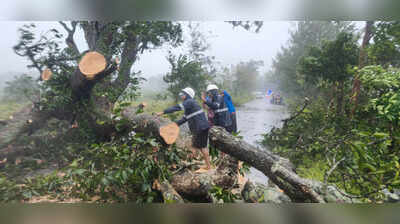
Bhubaneswar: With Cyclone Arnab making landfall in neighbouring Andhra Pradesh, widespread rain lashed most parts of the state, primarily affecting southern Odisha, uprooting trees and electric poles in several areas. With rain likely to continue for another day, govt authorities said they were maintaining a close watch on the situation.Chief minister Mohan Charan Majhi, after reviewing the situation, said 17 districts were affected by the cyclone, with Gajapati bearing the maximum impact. Other southern districts, including Ganjam, Koraput and Rayagada, were also significantly affected.No loss of life has been reported so far, while assessment of damage and restoration work are under way, Majhi said, adding the govt’s “zero casualty” approach had brought a positive outcome.“Leaving nothing to chance”, Odisha had prepared on a scale more than twice that of Andhra Pradesh while maintaining constant coordination with the neighbouring state and the Centre, the CM said. Govt continues to keep a close watch as the cyclone is still crossing the state, he added.Ganjam and Gajapati bore the brunt of Arnab’s fury as torrential rain also damaged rural roads and caused waterlogging.Winds reportedly touched 80 kmph in parts of Gajapati, with trees uprooted along several stretches in Rayagada, Mohana, R Udayagiri and Gosani blocks. Water flowed over roads at Ramagiri-Udayagiri and Purunapani-Udayagiri, while a guard wall near Adava was damaged by heavy water flow, sources said.In Gajapati district, Mahendragiri recorded the highest rainfall of 249.9 mm in 24 hours ending at 8.30 am, followed by Mohana (182.4 mm) and Paralakhemundi (140 mm).In Ganjam district, Ganjam block recorded 161.4 mm of rain during the period. The other areas, which received significant rainfall during the period, are Chhatrapur (154.6 mm), Digapahandi (139.5 mm) and Berhampur (132.4 mm). Meanwhile, water from Baghalati reservoir was discharged as it was overflowing.Heavy rain accompanied by winds reaching up to 50 kmph also disrupted normal life in Bhubaneswar and Cuttack. Trees were uprooted across the cities, a prominent Gajalaxmi Puja pandal was damaged and air connectivity to southern Odisha was affected.Torrential rain left large parts of Cuttack city, as well as Kendrapada and Jagatsinghpur districts, waterlogged on Wednesday.Tidal waves caused extensive damage to agricultural land due to a breach in the saline embankment at seaside villages in Mahakalapada and Rajnagar blocks of Kendrapada district.In another incident, a 150-ft-long embankment of Baitarani river at Naranapur village under Dasarathpur block in Jajpur district caved in on Wednesday morning.Power infrastructure also suffered extensive damage. Of the 20 lakh consumers affected across eight districts, supply had been restored to 13 lakh. Of the affected infrastructure, nine of 11 33-KV feeders, 35 of 49 substations, 552 of 747 11-KV feeders and 44,320 of 70,159 distribution transformers had been restored.Meanwhile, the India Meteorological Department (IMD) issued a red warning for Thursday in Gajapati, Ganjam, Rayagada, Koraput, Nabarangpur and Malkangiri, forecasting heavy to very heavy rainfall at a few places and extremely heavy rainfall at one or two places.Thunderstorms accompanied by lightning and gusty surface winds of 60-80 kmph, gusting up to 90 kmph, are also likely at one or two places in Gajapati, Ganjam, Rayagada, Nabarangpur, Koraput and Malkangiri.Even as Arnab’s impact persists, the IMD has predicted the formation of another low-pressure area over the Bay of Bengal by Thursday. An upper-air cyclonic circulation over the south Andaman Sea and neighbourhood, extending up to 5.8 km above mean sea level, persists. Under its influence, a low-pressure area is likely to form over the same region during the next 24 hours, the IMD said. Its impact will be clearer gradually, a weatherman said.(With inputs from Ashis Senapati in Kendrapada and Hrusikesh Mohanty in Berhampur)