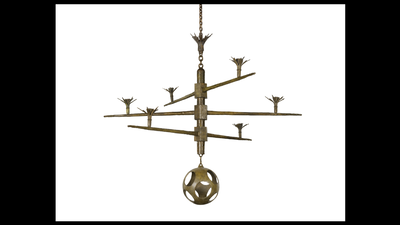
A chandelier that an artist bought for £250 after spotting it in a London antiques shop sold for £2.922 million at Christie’s in 2023, turning a chance discovery into one of the more remarkable stories of the art market. The bronze light fitting, created by Swiss sculptor Alberto Giacometti, had been recognised by British artist John Craxton in the late 1960s, when the shop had listed its maker as unknown. According to Christie’s, Craxton paid all his savings for the piece and kept it for the rest of his life.The chandelier, titled Chandelier for Peter Watson, was sold at Christie’s London auction on February 28, 2023. The final price of £2,922,000 included the buyer’s premium, with the hammer price itself reaching £2.4 million. The result followed decades in which the object remained in Craxton’s family home, largely away from public view. Christie’s identifies the work as unique, conceived in 1946–47 and cast around 1947–49.
A chance discovery in a London antiques shop
Craxton, who lived from 1922 to 2009, encountered the chandelier at Elizabeth Denton’s antiques shop in London’s Marylebone area. Christie’s recounts that he had visited intending to collect a bronze lion but struck his head on a low-hanging chandelier while leaving the shop. He immediately recognised the work as Giacometti’s, despite the absence of an artist’s attribution on its listing.The sculptor’s identity was only part of the attraction. Craxton believed the chandelier had a connection to Peter Watson, an art collector and patron who had supported him earlier in his career. He paid £250 for it and subsequently displayed it in the music room of his family home in Hampstead, north London.The object remained there until Craxton’s death in 2009. It also became part of the surroundings in which musicians and other cultural figures gathered for performances and recitals. Craxton’s father, Harold, was a distinguished pianist, while his sister Janet was an accomplished oboist. The chandelier therefore spent decades in a setting connected to the family’s musical life.
Commissioned for a literary magazine
The chandelier’s history began well before Craxton discovered it. Watson commissioned Giacometti to create it for the London offices of Horizon, a literary and cultural magazine he co-founded with critic Cyril Connolly in 1939. Watson, who lived from 1908 to 1956, was a wealthy patron of modern art. He collected works by European avant-garde artists and supported younger British painters, including Craxton and Lucian Freud. His backing helped artists pursue their work and brought modern European art into conversation with Britain’s literary and cultural circles.According to Christie’s, Watson visited Giacometti’s Paris studio in 1946 or 1947 and commissioned the chandelier for Horizon’s offices on Bedford Square in Bloomsbury. The magazine published writing by figures including W.H. Auden, George Orwell, E.M. Forster and Dylan Thomas.The chandelier occupied a central position in the offices, where its sculptural form made it more than a functional light fitting. When Horizon closed in 1950, the offices were cleared and the chandelier went into storage. Its subsequent journey to Denton’s shop remains uncertain. Christie’s says there is no surviving record explaining how it ended up there.
Why Giacometti’s design stands out
Giacometti, who lived from 1901 to 1966, is widely known for his elongated bronze figures, but he also designed decorative objects, including lamps, vases and chandeliers. His work often blurred the boundary between sculpture and functional design. The chandelier is made of bronze with a golden-brown patina. It stands 134cm tall and measures 153.5cm across. Its branching arms extend from a central stem, with intricate detailing around the light fittings. A perforated sphere hangs beneath the central structure, creating a visual link with Giacometti’s earlier Surrealist sculpture Boule suspendue (1930).Its design reflects the period when the artist was exploring both decorative objects and sculptural forms. The chandelier was also a rare commission: its connection to Watson and Horizon gave it a documented place in the cultural history of post-war London.
From £250 to a multimillion-pound sale
Before the 2023 auction, the chandelier’s authenticity had faced questions. The Craxton estate undertook a process to establish its provenance, and the work was examined by the Fondation Giacometti in Paris in December 2021. Its identity was subsequently confirmed, clearing the way for the Christie’s sale. The auction attracted attention because the object’s story combined an extraordinary price difference with a significant artistic and historical background. However, its importance extended beyond its market value.In July 2023, the UK government announced a temporary export deferral for the chandelier, valued at £2.922 million, to give a British institution an opportunity to acquire it. The Reviewing Committee on the Export of Works of Art and Objects of Cultural Interest said it met criteria relating to its connection with national history, aesthetic importance and significance for studying Giacometti’s decorative work.The government highlighted the chandelier’s role in the offices of Horizon, where art, literature and European cultural influences intersected in the years after the Second World War.