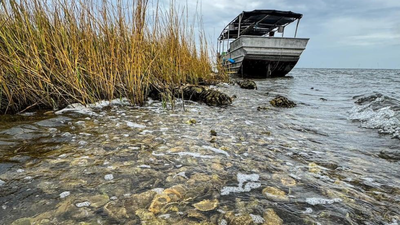
Discarded oyster shells from restaurants are helping rebuild a vulnerable stretch of Louisiana’s disappearing coastline. At Grand Bayou Indian Village, volunteers used 200 tons of bagged oyster shells to create a 400-foot reef designed to protect the Indigenous community’s shoreline. Two years after the project was built, monitoring recorded a sharp increase in live oyster density, rising from 52 to 130 oysters per square metre between 2025 and 2026, according to the Coalition to Restore Coastal Louisiana (CRCL).The project, completed in 2024, is part of an effort to recycle oyster shells and return them to the water, where they can provide a surface for young oysters to settle and grow. The reef was constructed by hand along the residential shoreline of Grand Bayou Indian Village in Plaquemines Parish, southern Louisiana. CRCL’s monitoring records list the community, the National Oceanic and Atmospheric Administration (NOAA) and several other organisations among its partners.The increase represents 78 additional live oysters per square metre, or a rise of 150% from the 2025 measurement. The figures offer encouraging evidence that the restored reef is supporting oyster growth, although the monitoring data alone do not establish that the reef was the sole cause of the increase.
A living barrier against coastal land loss
The reef was built to address a problem affecting communities across Louisiana’s coast: land is being lost to erosion, rising sea levels and storm damage. For Indigenous communities whose homes and culturally significant sites are located along the water, the loss threatens both their physical surroundings and their connection to ancestral places.A report by WWNO, New Orleans Public Radio, published in October 2024, described volunteers carrying heavy bags of recycled shells along the shoreline and loading them onto boats before placing them in the water. The shells had been collected from restaurants in New Orleans.James Karst of the coastal restoration coalition explained to WWNO that the reef would develop as young oysters attached themselves to the shells. As the oysters grow, the reef can build vertically, potentially helping it continue to provide protection as water levels rise.Unlike a conventional seawall, a living shoreline is designed to work with natural processes. Oyster reefs can create habitat for marine life while helping reduce wave energy and erosion along nearby marshes. Their ability to grow also makes them a potentially useful component of coastal restoration, though their effectiveness varies with local environmental conditions.
Why the oyster numbers matter
Oyster shells provide a hard surface for oyster larvae, also known as spat, to attach to. As the animals grow, they can form clusters that create additional habitat for other organisms. A functioning reef can support a wider coastal ecosystem, including other shellfish and small marine animals.CRCL says its monitoring programme involves revisiting restoration sites each year to count new oysters growing on recycled shells and assess other ecological benefits. Its website lists the Grand Bayou reef’s density at 52 live oysters per square metre in 2025 and 130 in 2026.The measurements suggest that the site has become more densely populated with live oysters. However, oyster populations can also be influenced by salinity, water quality, temperature, storms, food availability and the arrival of oyster larvae. Further monitoring would help establish whether the increase continues and how the reef performs over a longer period.The project is part of CRCL’s broader Oyster Shell Recycling Program, which collects used shells and returns them to coastal waters rather than sending them to waste. The organisation says it has worked with local communities and more than 6,000 volunteers to construct over 10,000 feet of oyster-reef living shoreline protection using recycled shells.
Protecting a community as the coastline changes
The stakes are particularly high for Grand Bayou Indian Village, home to members of the Atakapa-Ishak/Chawasha tribe. WWNO reported that the community has experienced substantial land loss over generations. Nearly 1,000 people lived in the village in the 1940s, according to the report, while only around a dozen homes remained there in 2024. Boats are the primary means of getting around.The 2024 reef was the second project CRCL had undertaken in partnership with the community. An earlier reef was built to help protect Lemon Tree Mound, a culturally significant site that has become surrounded by water as the landscape has changed.The reef cannot reverse Louisiana’s wider coastal land loss on its own. Community members have acknowledged that such structures may eventually be overtaken by water and waves. Their value, however, lies in slowing erosion, creating marine habitat and buying time for places that hold cultural and historical significance.For coastal restoration groups, the project also demonstrates how a discarded material can be repurposed into infrastructure that supports both ecosystems and communities. Rather than treating restaurant oyster shells as waste, the programme returns them to the environment as a foundation for new reef growth.The increase in live oyster density is an encouraging monitoring result, not proof that the shoreline is now secure. But as Louisiana continues to lose land to the water, the Grand Bayou project illustrates how community-led restoration can combine waste recycling, habitat creation and a practical effort to protect an Indigenous village’s remaining shoreline.