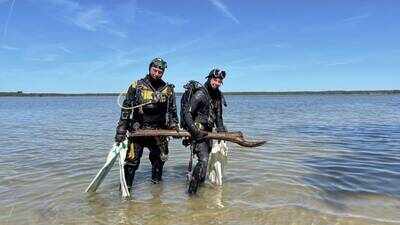
Archaeologists have recovered exceptionally well-preserved pieces of worked wood dating back around 10,500 years from beneath Lake Arendsee in northern Germany, potentially offering fresh evidence of wooden structures built by Mesolithic hunter-gatherers.The discoveries were made during underwater archaeological investigations by the State Office for Heritage Management and Archaeology (LDA) Saxony-Anhalt. Among the finds are a 1.60-metre-high wooden post bearing felling marks and split boards measuring up to 1.30 metres long. Researchers are investigating whether the pieces belonged to huts or other previously unknown structures.
Ancient shoreline preserved beneath the lake
The finds were recovered from approximately 20 metres below the surface, where the former shoreline of Lake Arendsee has been exceptionally well preserved.Researchers say the lake’s unusual geological conditions played a crucial role. Unlike many inland bodies of water, whose floors gradually fill with sediment, the bottom of Lake Arendsee is slowly sinking because of geological processes associated with an underlying salt dome.As a result, traces of the Mesolithic landscape and archaeological remains became submerged beneath a relatively thin layer of sediment, creating unusually favourable conditions for preservation.The period dates to a time when communities had not yet adopted permanent farming settlements and relied largely on hunting, gathering and fishing.
Rare wooden evidence of Mesolithic life
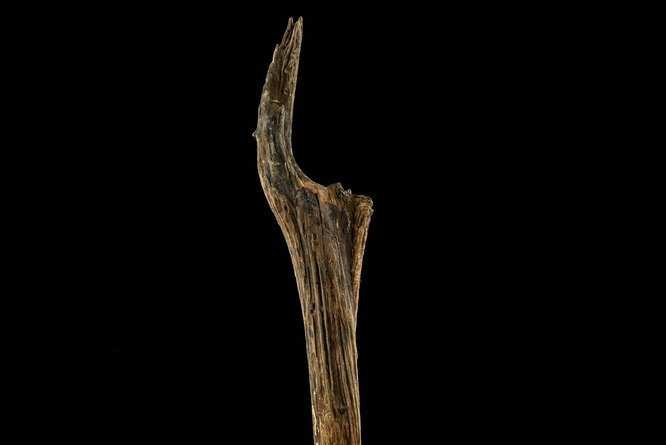
A 1.6-metre wooden post bearing felling marks was among the remarkable Mesolithic discoveries. (Photo: State Office for Heritage Management and Archaeology (LDA) Saxony-Anhalt)
State archaeologist Harald Meller described the wooden discoveries as particularly significant because organic material from this period rarely survives.“Besides the usual finds from this period, such as stone tools or animal bones, our divers were able to recover spectacular pieces of wood, which have very rarely survived from this era,” Meller said.The discoveries could provide a rare glimpse into construction practices during the Mesolithic. According to initial assessments, the post and split boards show evidence of deliberate human working, including felling marks.Meller said the finds shed “a completely new light” on the Mesolithic period, when evidence of buildings in Central Germany has generally been identified only through soil discolorations.
Could the remains point to permanent structures?
Researchers are still determining exactly what the wooden remains represent.Marcel Weiß, project head for the LDA Saxony-Anhalt, said the material could potentially be associated with huts or other structures that have not previously been documented in the region.“Whether we are looking at the remains of huts or other, previously completely unknown wooden structures is the subject of ongoing and future research,” Weiß said.If researchers establish that permanent buildings or intensively used living spaces existed at Lake Arendsee 10,500 years ago, the discovery could alter existing interpretations of how hunter-gatherer communities lived and used landscapes before the arrival of farming.The potential significance is considerable because such evidence would predate the first farmers and their longhouses in Central Europe by around 3,000 years.
Technology is helping map the ancient landscape
The investigation has continued since the initial discovery in spring 2026, with researchers recovering additional samples and individual finds to establish the site’s extent and chronology.During a second campaign, the archaeological team worked with the Fraunhofer IOSB-AST in Ilmenau to conduct high-resolution sonar scans using a remotely operated vehicle, or ROV.The underwater robot was used to document the relief of the former shoreline and help researchers determine where archaeological remains may be concentrated.The precise positioning of the finds is expected to help archaeologists delineate potential sites and plan future underwater investigations.Sven Thomas, diving operations manager for the LDA Saxony-Anhalt at Lake Arendsee, said advanced technology developed at the Fraunhofer Institute has been particularly valuable for the project.
A window into the Mesolithic past
Lake Arendsee has already produced important archaeological discoveries, including Neolithic fish weirs, a High Medieval flat-bottomed cargo vessel and a Late Medieval dugout canoe.The newly recovered wooden remains now offer researchers an opportunity to investigate an even earlier chapter of the lake’s history.The discoveries date to roughly the period when the famous shaman of Bad Dürrenberg lived. Evidence shows that people were already present around the shores of Lake Arendsee during this period.The finds are also expected to contribute to wider research into how humans began transforming natural environments into cultural landscapes – a process traditionally associated with the arrival of early farmers in Central Europe around 5500 BC.The discoveries from beneath Lake Arendsee are therefore not simply rare examples of ancient preserved wood. Researchers hope they could reveal how Mesolithic communities organised their living spaces and interacted with their environment thousands of years before farming fundamentally changed life in Central Europe.