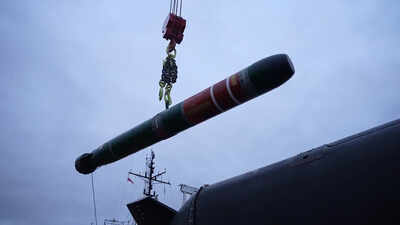
The Royal Navy’s 19-tonne XV Excalibur unmanned underwater vehicle has successfully launched a US-made Mk 48 heavyweight torpedo in a first-of-its-kind test.The US navy and Royal navy conducted the joint test on September 13 at the British Underwater Test and Evaluation Centre in Scotland under AUKUS Pillar 2.According to the US Navy, the trial was carried out under Project Broadsword and Trial Iron and was aimed at demonstrating whether a US heavyweight torpedo could be integrated with and launched from a British autonomous underwater platform.The test validated the mechanical, electrical and software integration between the weapon and Excalibur, which the Navy said demonstrated the ability of allied forces to achieve rapid weapon interchangeability.US chief of naval operations Admiral Daryl Caudle called it a “historic first for allied undersea warfare”, saying the successful launch demonstrated the allies’ ability to integrate weapons and autonomous platforms.XV Excalibur and Mk 48 heavyweight torpedoThe XV Excalibur is the Royal Navy’s first extra-large uncrewed underwater vehicle (XLUUV), developed under the three-year Project Cetus programme.The 12-metre-long vehicle weighs around 19 tonnes and is designed as a testbed for advanced underwater technologies and payloads. The Royal Navy says Excalibur is intended to help develop future operations involving crewed and uncrewed systems working together.The weapon integrated onto Excalibur was the US Navy’s Mk 48 heavyweight torpedo, the US submarine force’s primary weapon for engaging enemy submarines and surface combatants.The torpedo is about 19 feet long, weighs roughly 3,500 pounds and carries a 650-pound high-explosive warhead, according to the US Navy. It is also capable of re-attacking a target if it misses during an engagement.Why it mattersThe test shows that unmanned underwater vehicles can potentially move beyond surveillance and carry heavyweight weapons.For future naval operations, armed XLUUVs could potentially extend underwater surveillance and strike capabilities while reducing the need to expose crewed submarines to certain missions.Integrating a US Mk 48 torpedo with a British autonomous platform also demonstrates how allied navies could build distributed, armed underwater capabilities without putting crews inside every launch platform.