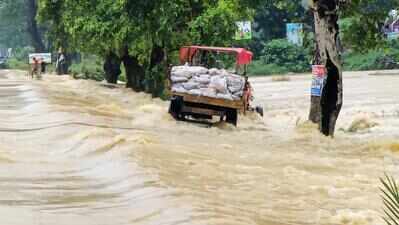
Debabrata MohapatraBhubaneswar: With depression-triggered heavy rain lashing several parts of Odisha and the recent tragedy in Madhya Pradesh, where eight people, including seven from Bhubaneswar, died after their car was swept away in a rain-swollen drain, still fresh in people’s minds, the state govt on Tuesday directed regional transport officers (RTOs) to intensify surveillance at low bridges, culverts and other vulnerable road stretches.Authorities have been instructed to halt or divert vehicular movement wherever water is flowing at dangerous levels. “We have stepped up preparedness measures to ensure safe movement of vehicles and passengers, with special attention to night-time traffic on Wednesday and Thursday,” a senior transport official said.Transport commissioner Amitabh Thakur held a video conference with all RTOs and directed them to take immediate steps. As part of the preparedness plan, RTOs have been asked to operate 24×7 control rooms, step up night patrolling and maintain strict vigilance at low bridges, culverts and other vulnerable stretches. Traffic must be stopped or diverted wherever necessary.Officials have also been directed to identify low-lying road sections, submerged crossings, vulnerable bridges and culverts, underpasses, ghat roads, landslide-prone stretches, construction diversions and accident-prone locations. They have been asked to obtain regular road condition updates from concerned agencies, identify verified alternative routes and earmark safe vehicle-holding areas. Alternative routes must be suitable for the category of vehicles being diverted.RTOs will disseminate time-stamped, route-specific advisories in Odia and other locally understood languages through transport associations, bus terminals, operators, media outlets and official communication channels. They have also been told to coordinate with police and highway patrol units to enhance monitoring of vulnerable corridors, especially at night.The transport department stressed that drivers must not attempt to cross flowing water or submerged roads. Traffic should resume only after road-owning agencies and police certify the route as safe. Temporary speed restrictions may be imposed on severely affected routes, while enforcement teams will check dangerous driving and overloading.RTOs have been asked to coordinate with NHAI, toll-plaza managers, bus operators, transporters and school-transport agencies for weather alerts and route advisories. “Operators may defer, divert or suspend services on unsafe routes. Arrangements have also been made for stranded passengers, evacuation vehicles and inter-state coordination to ensure emergency transport moves only on routes declared safe,” the circular stated.