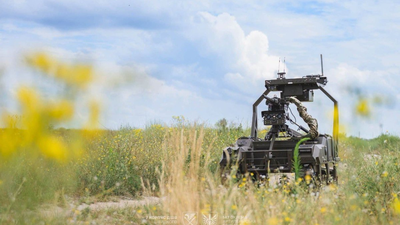
The ongoing Ukrainian offensive known as Operation Vivaldi has expanded the use case of drones. The embattled nation used Unmanned Ground Vehicles (UGVs) against Russia. Interestingly, the drones were deployed by the Ukrainians via heavy-duty aerial drone bombers, according to the country’s army.The commander of Ukraine’s 3rd Corps stated that the drones were carried and deployed 10km deep inside territory occupied by Russia. These UGVs were deployed against logistics nodes that were supporting Russian frontline troops. In the offensive, the Ukrainians have recaptured some 50 square kilometres that were under Russian occupation.Ukrainian forces paired the assault with electronic warfare and air defence assets specifically to ‘blind’ Russian reconnaissance drones, preventing Moscow’s forces from detecting preparations for the offensive until it was already under way.This layered approach, combining robotics, jamming and air defence, allowed Ukrainian troops to achieve an element of surprise against an enemy that has otherwise relied heavily on drone surveillance to track troop movements.How Ukraine is expanding the battlefield role of UGVsThis isn’t Ukraine’s first foray into ground-based unmanned warfare either. In July 2026, Ukrainian troops had already carried out a separate operation, delivering a UGV to the occupied Kinburn Spit using an uncrewed surface vessel, with the ground robot equipped with a remotely operated machine gun.UGVs are now being deployed across three core mission areas. First, they play a critical logistics role. Units such as Ukraine’s 3rd Assault Brigade conduct around 80% of frontline resupply missions with UGVs, while in heavily contested areas like Pokrovsk and Myrnohrad, they handle up to 90% of logistics tasks.These vehicles can carry significantly heavier loads than soldiers. Second, UGVs support engineering operations as they lay and clear mines, emplace obstacles, transport electronic warfare equipment and serve as one-way explosive platforms. Third, UGVs increasingly assist infantry as weapons platforms, and they also conduct casualty evacuation missions, recovering wounded soldiers from dangerous areas that would otherwise put rescue teams at risk.However, operating UGVs remains difficult. Limited depth perception, terrain obstacles, communication disruptions and intense electronic warfare frequently degrade performance. These challenges can be overcome with the help of satellite links, radio networks, fibre-optic cables and aerial relays.Why Ukraine’s drone warfare is moving beyond the skiesThese operations point to a broader shift in how combat operations will be carried out in the future, moving unmanned systems well beyond their now-familiar role as aerial reconnaissance and strike tools and into genuinely multi-domain use, spanning air, sea and land, all designed to conduct reconnaissance, strike and assault-support missions while keeping human soldiers out of the most exposed positions.For a military that has leaned heavily on drone warfare innovation throughout this conflict, the Vivaldi offensive represents another marker of how deeply robotic systems are now embedded into Ukraine’s offensive playbook.