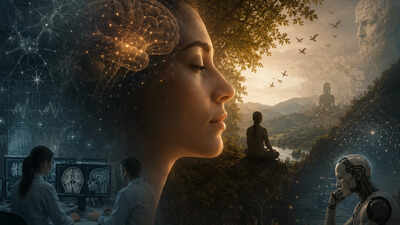
Open your eyes, and a world appears. Among the many mysteries in science and philosophy, consciousness is unique. It is both intimately familiar – we all know what it is like to taste ice cream on a hot day – and deeply confounding, befuddling and beguiling thinkers of all kinds, and from all traditions, for thousands of years.Over the last thirty years, neuroscientists like me have been getting in on the game. We want to know how the tofu-textured grey matter inside our skulls can give rise to the redness of red, to the dull ache of bruise, or to any conscious experience whatsoever, from the mundane to the magical. The task might seem hopeless: the philosopher David Chalmers dubbed it the “hard problem”. But progress is being made, and in the rapidly changing world in which we live, this progress really matters.Here are some examples. Researchers are zooming in on the so-called ‘neural correlates’ of consciousness. These are brain regions, or patterns of neural activity, that correlate with changes in consciousness. While there’s still no consensus about precisely what or where these correlates are, there is agreement that large parts of the brain – like the cerebellum, which houses about three-quarters of all your neurons – isn’t much involved.We also have a plethora of theories, perhaps too many, which go beyond mere correlation to explain why particular processes in the brain are associated with consciousness. Some of these theories are now being pitted against each other in what will hopefully become a virtuous circle of theory and experiment – the flywheel of scientific progress.Perhaps most importantly, some findings from consciousness research are already making a difference in the real world. To pick just one example: researchers are now able to detect when people with severe brain injury retain some kind of consciousness, even if they cannot express this in words or behaviour. Reliable detection of ‘covert consciousness’ is game-changing for neurology, and is likely to make a huge difference to thousands of patients and their families.My own work on consciousness, which goes back about 25 years, follows one single and powerful idea. This is the idea that the brain is prediction machine, and every conscious experience we have – whether of the world, or of the self – is a kind of controlled hallucination: a brain-based best-guess that is tied to reality by signals coming into the brain from the senses. In this view, what we experience comes as much from the ‘inside out’ and from the ‘outside in’, and we don’t experience the world as it really is, but in ways that help us to survive and thrive. As the novelist Anaïs Nin once said: “We don’t see things as they are, we see them as we are.”I’ll mention two implications of this line of work. The first is that we each experience the world (and the self) in our own unique way, even for the same shared objective reality. We’re currently running experiments to explore how wide, and how deep, this perceptual diversity goes. For me, this research encourages a powerful humility about our own individual takes on the world, and provides a new opportunity to build bridges by recognising that we live in perceptual echo chambers just as constraining as the echo chambers of social media.The second implication is that consciousness is likely to be a property of our nature of living systems, rather than of information processing or algorithms. That is, it might be life rather than computation that breathes the fire into the equations of experience. Thinking this way reminds me of the Hindu concept of ātman, which associates consciousness with life and breath rather than with reason or intelligence.And if this is right, then AI systems like language models might at best only simulate consciousness without ever feeling anything at all, similar to how a computer can simulate a rainstorm without anything getting wet. A language model might give the strong impression of being conscious, but inside its likely only silicon oblivion. Among the many questions about consciousness, the question of whether AI can be conscious is perhaps the most urgent we face. For example, if we give ‘rights’ to AI systems because we mistakenly believe they have the capacity to suffer, we make the challenge of aligning AI with human and planetary interests much harder than it already is. We might be even prevented from deactivating a ‘rogue AI’ if society decides that this would count as murder.Behind these immediate concerns lies a deeper question, a more profound challenge. The quest to understand consciousness is part of the millenia-long human adventure of understanding ourselves and our place in the universe. Consciousness is not just a mystery out there to be solved, like an unproven mathematical theorem. It’s a mystery that matters to each of us, every single day. Consciousness is what makes life worth living, and with greater understanding of its basis in our brains and bodies comes a greater appreciation that we are part of, and not apart from, the rest of nature.Finally, with a deeper understanding of consciousness comes the chance to reconcile with the impermanence of the ever-changing bundle of perceptual experiences that we call ourselves and that define our worlds. The line “I open my eyes and a world appears” comes from my book Being You. The poet Sylvia Plath closes the circle: “I shut my eyes and all of the world drops dead.”