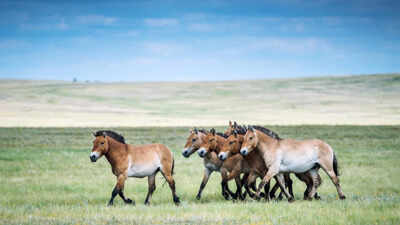
The Przewalski’s horse, considered the world’s last truly wild horse, has returned to China’s grasslands after once disappearing from the wild in the country. Forty years after China began its Wild Horse Return Program, the population of the species has grown to about 900, with the animals now reproducing independently in several protected areas.The conservation effort began in 1986, a year after the species was considered extinct in the wild in China, according to Good News Network. The programme focused on breeding, relocating and protecting Przewalski’s horses across China’s grasslands. The animals living today came from a small number of horses that had survived in zoos and breeding centres in Europe.Data from the project’s monitoring arm for 2025 showed that the population in China had reached about 900. This is around one-third of the global population of Przewalski’s horses. The species has since become an important symbol of ecological restoration in China and has also gained a place in the country’s culture. It also inspired “Chengcheng”, the mascot for the 2026 Year of the Horse Spring Festival Gala.The return of the horses has involved moving animals between breeding centres and protected areas. One of the major locations is the Dunhuang West Lake Nature Reserve in Gansu province. About 200 Przewalski’s horses live there in 28 herds. Their numbers have increased over the past 15 years through relocations from the Gansu Endangered Animal Protection Center in Wuwei city.
Moving the horses without crating them
The Wuwei centre developed a method known as “loose relocation” to transport the animals over long distances. Instead of anaesthetising the horses and placing them in crates, the method gives them more room to move during transportation. This approach was used when 28 Przewalski’s horses were transported more than 600 miles to the Dunhuang reserve.Once the horses reach a new reserve, they do not immediately become fully independent. They first go through an acclimatisation period, during which they get used to their new surroundings and begin foraging again.During this stage, their diet can be supplemented with hay stored at the reserve. The amount of hay is gradually reduced and eventually stopped. The aim is to encourage the horses to find food through natural foraging.“Around six foals are expected in 2026. We aim to build a healthy population with stable generational succession,” said Wang Hongjun, head of the centre’s wildlife management department.
Populations now reproducing on their own
Dunhuang West Lake is not the only protected area where the horses are being conserved. Przewalski’s horses are also found in reserves in Xinjiang, Inner Mongolia and Ningxia.These populations are described as self-sustaining, although introductions of animals into some areas are still continuing.The population in China reached this stage after decades of breeding and relocation efforts. The 2025 monitoring data showed that the animals were reproducing without depending entirely on continued human intervention.
A species with a long evolutionary history
Przewalski’s horse is also important because of its place in the evolutionary history of the equine family. The species carries about 60 million years of evolution, making it a source of genetic knowledge about horses and their relatives.Unlike domesticated horses, Przewalski’s horses are not domesticated. They are regarded as the last non-domesticated species in the horse family. The other wild equines are either donkeys or zebras.The species has therefore become more than a conservation success in China. Its return to the grasslands also provides an opportunity to maintain genetic information from a distinct branch of the equine family.The Wild Horse Return Program has now reached its 40th year. From being considered extinct in the wild in China in 1985, the species has reached a population of about 900 in the country, with populations in several reserves able to reproduce independently.The effort is continuing as China monitors the animals, moves them between suitable areas and works towards stable populations. In 2026, the Year of the Horse has given added attention to a conservation programme that began four decades ago to return one of the world’s rarest wild horses to the grasslands.