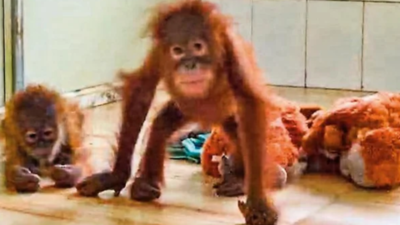
BHUBANESWAR: As wildlife campaigners press for repatriation of the five infant orangutans rescued from an alleged international trafficking racket in Odisha’s Balasore, history suggests returning the primates to their native forests may be far more complicated.Indonesian authorities have expressed willingness to coordinate with Indian agencies to establish the animals’ origin and facilitate their eventual return. The orangutan cubs, currently under intensive care at Nandankanan Zoological Park in Bhubaneswar, are thousands of kilometres away from the rainforests of Southeast Asia where they were born. Orangutans are a species native to Southeast Asia.Experts point out that establishing their origin is a lengthy process involving molecular genetic analysis and identification of maternal lineage before any repatriation decision can be taken.While the Wildlife Society of Odisha has urged the Odisha principal chief conservator of forests to initiate repatriation, the intricate scientific, legal and diplomatic processes involved mean that, for now, Nandankanan remains the only home the orangutans know.The forest department constituted a five-member technical committee for the orangutans Saturday. The committee will assess their health and other requirements and will be empowered to consult and co-opt national and international experts, if required.“Wild animals should be released into the wild. The same principle applies to orangutans even if they come from a foreign forest. Previous efforts to release rescued wild animals have failed, and many eventually became permanent inmates,” said wildlife campaigner Biswajit Mohanty.In 2013, a male tiger strayed into Nandankanan and was shifted to an enclosure. Mohanty and others campaigned for his release. However, after briefly escaping from captivity, the tiger returned to the zoo on its own. Nandan lived the rest of his life in captivity. Another example emerged in 2021 when five bears rescued from traffickers near Chandaka Wildlife Sanctuary were brought to Nandankanan. Initially suspected to be sloth bears, they were later identified as the far rarer Himalayan black bears. After spending nearly three years off exhibit, Central Zoo Authority approved their display at the zoo. Wildlife activists also point to rescued pangolins and elephants that were never released back into the wild.Against this backdrop, conservationists fear the five baby orangutans may follow a familiar path. Until then, the unlikely castaways are adapting to their surroundings.Zoo officials say the babies appear healthy and are settling comfortably into captivity.