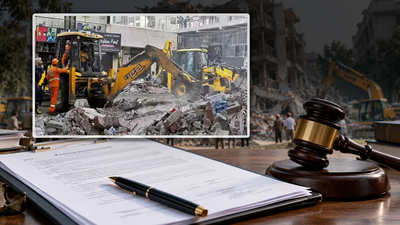
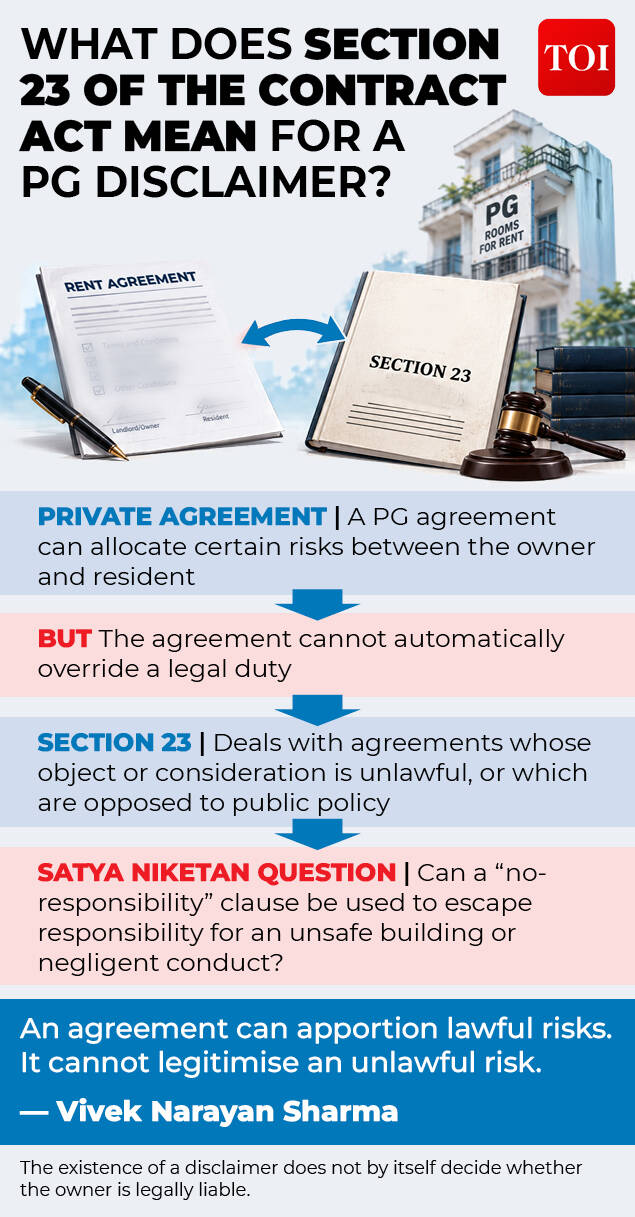
NEW DELHI: The Satya Niketan building collapse, which killed seven people and injured several others, has raised questions about who can be held responsible when people living in private paying guest (PG) accommodation are exposed to an unsafe building. The issue has gained a legal dimension after the rent agreement signed by residents of the PG reportedly contained clauses limiting the hostel’s responsibility for casualties, injuries and loss or damage in certain circumstances.The incident has also prompted the Delhi high court to examine whether responsibility for the tragedy, if negligence is established, could extend beyond the building owner. While hearing a PIL, the court questioned the role of the Municipal Corporation of Delhi (MCD) and Delhi University (DU), and noted that inadequate hostel accommodation leaves many outstation students dependent on private PG facilities.This raises a larger question: can an owner avoid liability for a death or injury simply because residents signed an agreement containing a clause saying the PG was not responsible for casualties?Can a PG owner escape liability through a ‘no-responsibility’ clause?The agreement signed by residents of the Hostel Daze PG contained provisions limiting the establishment’s responsibility for casualties and for personal injury or loss or damage to belongings in certain situations, including events described as being beyond the control of the PG.But such a clause does not by itself settle the question of legal responsibility, said Vivek Narayan Sharma, Senior Advocate, Supreme Court of India.Sharma said a private agreement can decide who bears certain lawful risks, but it cannot be used to permit conduct that violates a legal duty.“A false disclaimer cannot be a licence to delay or breach the law. Real hazards outside of one’s influence can be agreed upon, but not legal safety measures or liability for personal misconduct,” Sharma said.He referred to Section 23 of the Indian Contract Act, 1872, which deals with agreements that have an unlawful object or are opposed to public policy.“An agreement can apportion lawful risks. It cannot legitimise an unlawful risk,” Sharma said.In simple terms, a tenant may agree that the owner will not be responsible for an unexpected event genuinely outside the owner’s control. That is different from using the same clause to escape responsibility for an unsafe building or harm caused by the owner’s own conduct.What if the collapse was linked to negligent maintenance or unsafe construction?The legal position would depend heavily on what caused the collapse and whether the owner or someone acting on the owner’s behalf was responsible for the dangerous condition.Sharma said that if negligent maintenance, an unsafe structure or unauthorised construction, renovation or alteration caused or materially contributed to the collapse, the case would have to be examined on the basis of the owner’s legal duty, whether that duty was breached, whether the breach caused the incident and what damage resulted.“No disclaimer can get rid of duty. Should the defendant’s negligent maintenance, unsafe structure, and/or unauthorised renovation or alteration have caused or materially contributed to the event, liability might turn on the issues of duty, breach, causation and damage rather than an exclusion clause,” he said.This would also affect clauses dealing with events described in the agreement as being beyond the owner’s control.“Coverage for events ‘beyond the owner’s control’ is usually not available if they result from the owner’s own conduct,” Sharma said.Therefore, the exact cause of the collapse would be central. A contractual clause dealing with an unforeseen event outside the owner’s control would raise a different question from one being relied upon after an accident allegedly linked to unsafe construction or negligent work.Does signing the agreement mean residents accepted the risk?Sharma said residents cannot normally be treated as having accepted the risk of living in an unsafe building simply because they signed the agreement.
–
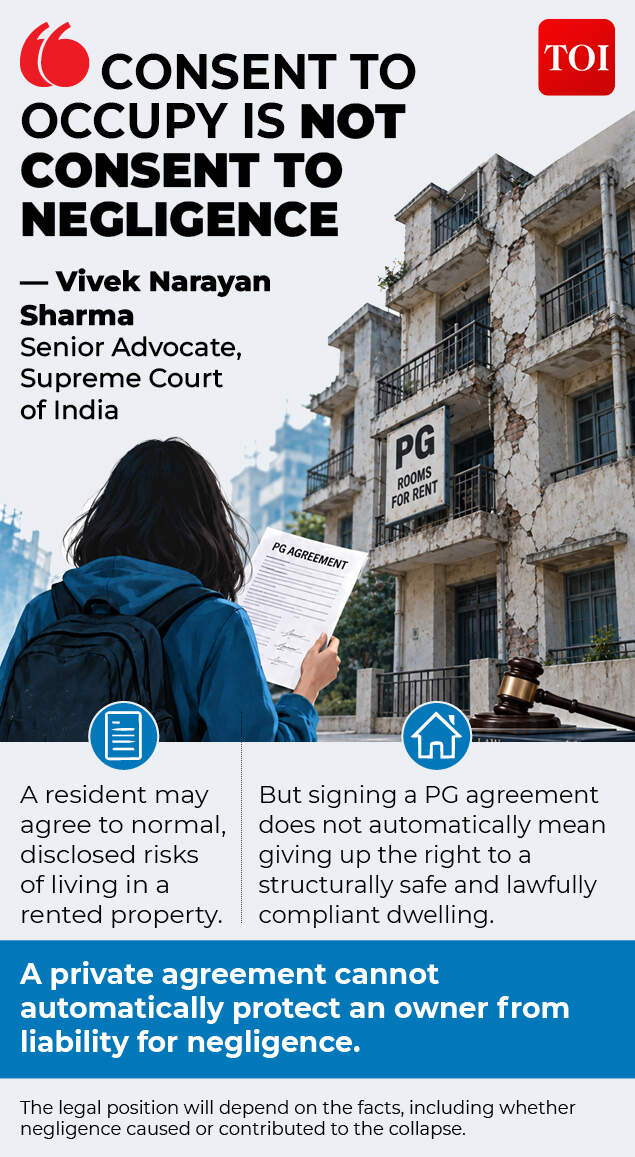
A resident may accept ordinary and disclosed risks associated with living in a rented property. But that does not mean the person has given up the right to expect the premises to be structurally safe and legally compliant.“A resident may consent to normal, revealed risks, but generally cannot be regarded as having relinquished the right to a structurally safe and lawfully compliant dwelling,” Sharma said.He said the issue becomes more serious where a risk is concealed or involves an illegal alteration or other unsafe condition known to the owner.“Freedom of contract has its footing in the law, not above it,” Sharma said.Can families of those killed still seek compensation?The disclaimer would not automatically prevent the families of those killed or injured from seeking compensation, Sharma said.“Once negligence and causation are proven, a private disclaimer cannot, by itself, negate the remedies of the family,” he said.Depending on the circumstances, families could pursue relevant civil, public or consumer-law remedies. The exact route would depend on the facts and the evidence available.The existence of the disclaimer may be considered during the proceedings, but it would not automatically defeat a claim based on actionable negligence.“The presence of the disclaimer may be taken into account but it cannot automatically cut off a claim based on actionable negligence,” Sharma said.Can the agreement protect the owner from criminal liability?A private contract cannot waive criminal liability, Sharma said.“No. Criminal liability cannot be waived,” he said.If an investigation establishes that a person’s death was caused by a rash or negligent act and the statutory requirements are met, Section 106(1) of the Bharatiya Nyaya Sanhita, 2023, could become relevant.
–
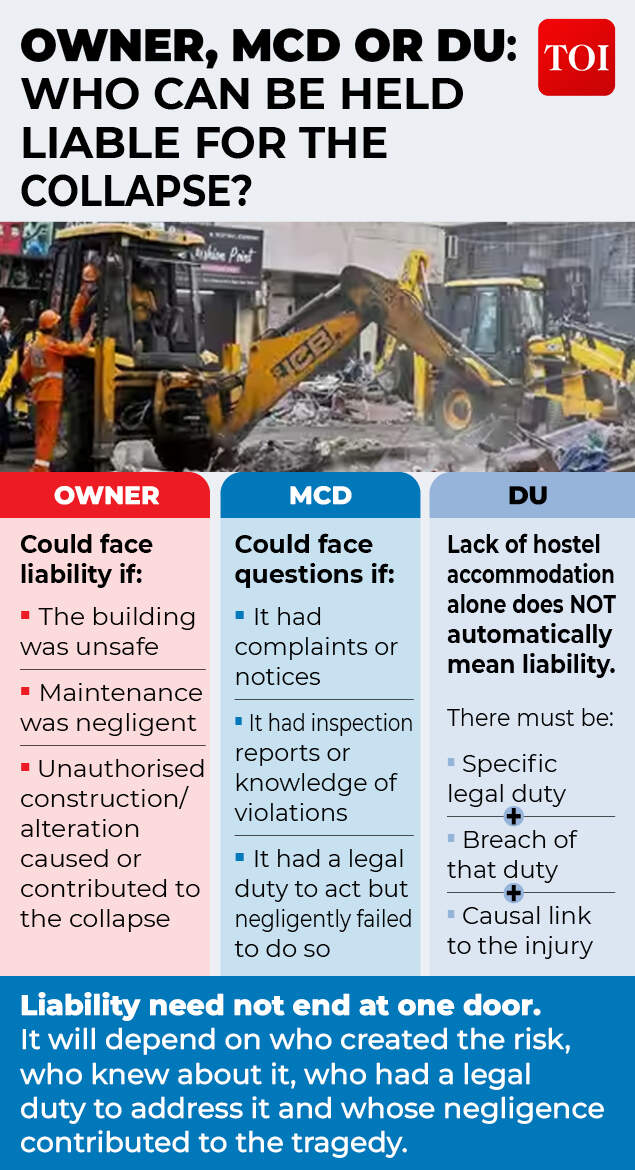
The prosecution would still have to prove the required elements, including the rash or negligent conduct and its proximate connection with the death. The existence of a disclaimer would not prevent an investigation or prosecution.“The prosecution shall have to prove the rash or negligent act behavior, coupled with the death, as a proximate correlative. An agreement entered into between private individuals can’t give immunity in future,” Sharma said.Could MCD also face liability?The high court’s questions have widened the issue beyond the private agreement between the PG and its residents. Sharma said MCD’s liability would depend on what the civic body knew about the building, what legal duties it had and whether it failed to act despite being aware of a possible danger.“If MCD had complaints, notices, inspection reports, or it had knowledge of violations and it negligently failed to take action, then some liability in the public authority may be contributed to, depending upon the evidence as to duty, breach and causation,” he said.This would not mean MCD is automatically responsible because the building was within its jurisdiction. Evidence would be needed to establish a legal duty, a failure to perform that duty and a connection between that failure and the deaths or injuries.The tragedy has also led to calls for closer scrutiny of buildings and action against unauthorised construction. The Indian Chamber of Construction Industry (ICCI), expressing grief over the Satya Niketan incident, appealed to authorities to evaluate such structures and prohibit unauthorised and unapproved construction, which it described as a potential hazard.Could Delhi University be held responsible because students depended on private PGs?Sharma said DU’s position would be different from that of the building owner or a civic authority responsible for enforcing building rules.The high court had noted that limited hostel accommodation leaves students, particularly those coming from outside Delhi, dependent on private PG accommodation. But that circumstance alone would not make the university legally responsible for what happens inside a privately operated building.“Delhi University is not the same. Students being forced to stay in private PGs due to lack of hostel accommodation does not automatically give rise to legal liability,” Sharma said.For DU to face liability, there would have to be a specific legal duty that it was required to perform, evidence that the duty was breached and a causal link between that breach and the harm.“There must be a specific legal duty which has been breached as well as a causal link to the injury,” he said.Thus, the shortage of university accommodation may explain why students turn to private PGs, but it is legally different from establishing that the university caused or contributed to the collapse.Who could ultimately be held responsible for the tragedy?Sharma said responsibility may not necessarily fall on only one party. The final assessment would depend on who created the risk, who knew about it, who was legally required to address it and whose conduct contributed to the tragedy.“In the end, the liabilities would be concurrent among everything and hinge upon who engendered that risk, who became conscious of it, who had been legally liable to counteract the hazard, and whose negligent conduct led to the unfriendly event,” Sharma said.This means the owner, contractor, civic authorities or other parties could have different levels of responsibility depending on the evidence. The rent agreement alone would not determine that question
–
Sharma summed up the distinction between private contracts and legal safety duties:“A private owner cannot by contract avoid a duty to make sure a building is safe; a public authority cannot hide from a known dangerous building with an administrative dismissal. If both sides are negligent in bringing about the same tragedy, liability need not end at one door,” he said.Ultimately, the Satya Niketan case will turn on the investigation into the building’s condition, the circumstances surrounding the repair or alteration work, what the different authorities knew or were required to do, and whether any act or omission can be linked to the deaths and injuries.