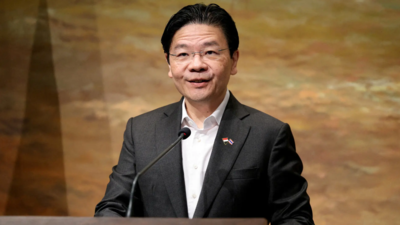
Singapore’s ministers, who are among the world’s highest-paid government officials, are set to receive their first salary increase in 15 years. Prime Minister Lawrence Wong has justified the increase in pay by stating that it is necessary to attract top talent into politics.Under the revised framework, the benchmark annual salary for a minister at the lowest grade will rise to S$1.8 million (approx Rs 13.5 crores) from S$1.1 million (approx Rs 8.2 crores). The prime minister’s benchmark will increase to S$3.6 million (approx Rs 27 crores) from S$2.2 million (approx Rs 16.5 crores).The increases will not immediately take ministers to those benchmarks. Instead, they will receive a one-time adjustment of up to 9% from October 15, depending on their performance and responsibilities. Wong said most ministers at the lowest grade are expected to earn about S$1.35 million (approx Rs 10.12 crores) by the end of the current term.Wong did not disclose his own salary but said a 9% increase would take it to about S$2.4 million (approx Rs 18 crores). He added that he would donate his entire salary increase to charity for the next five years.Political pay remains a sensitive issue in Singapore, as ministers tend to earn far more than most citizens. The government has long defended the system stating that it is required to attract capable people from both private sector and public service and to maintain a clean government.Wong said ministerial salaries had increasingly fallen behind comparable earnings in the private sector and civil service, making a review necessary. The new framework uses the median income of Singapore’s top 1,000 citizen earners as a reference, with a 40% discount applied to reflect the nature of political service.The government said the new framework would be reviewed every five years. Singapore’s current political salary system was established after a 2011 review, which resulted in a roughly 36% pay cut following public concerns over political salaries. A 2017 review recommended adjustments that were not implemented, while a review scheduled for 2023 was deferred.