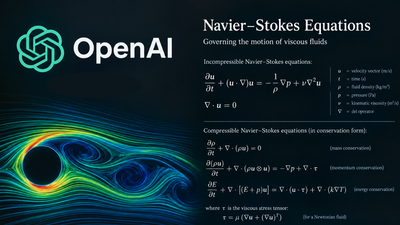
OpenAI says it has solved a 90-year-old mathematical problem in just 88 hours by using a new artificial intelligence model and around 10,000 AI agents. The problem, known as the Navier–Stokes existence and smoothness problem, deals with how fluids move and is one of the major unsolved challenges in mathematics.According to a BBC report, the ChatGPT maker announced the result on Tuesday, calling it a “milestone” in the development of AI. However, the claim has not yet been independently verified and has not been accepted by the Clay Mathematics Institute, which offers a $1 million prize for solving the problem.
AI agents worked around the clock
OpenAI said it deployed about 10,000 AI agents to work on some of the world’s most difficult mathematical questions after a new internal model showed strong mathematical abilities.The company began training the model in late August. It said the system was “significantly more capable” than its latest publicly released model.On September 1, OpenAI said it had heard rumours that two Millennium Prize problems had been solved. It then decided to put thousands of AI agents to work on some of the remaining problems.By September 5, roughly 88 hours after the agents began working, OpenAI said they had solved the Navier–Stokes problem.The scale of the effort was enormous. The AI agents exchanged nearly 3 million messages and generated about 130 billion output tokens while working on the problem.OpenAI estimates that running such a great effort would have cost around $10 million based on its own pricing for output from its most advanced models.
Mathematician raises questions over timing
OpenAI’s announcement has also triggered controversy among mathematicians.Tristan Buckmaster, a mathematics professor at New York University, said he and Levent Alpöge, a mathematician at OpenAI rival Anthropic, had also been working on the Navier–Stokes problem.The pair had been using OpenAI’s Codex tool as part of their work.Buckmaster said that on September 3, he learnt that information about their progress had been passed to OpenAI.He alleged that OpenAI began working on the Navier–Stokes problem only after information about their work had reached the company.Buckmaster included excerpts from emails exchanged with OpenAI and raised questions about the company’s timing and methods.He said he had not yet read OpenAI’s complete proof. But he felt compelled to make the information public.Buckmaster said he wanted to explain “what I was told, when, and what was proposed to me…because the alternative is to let a sequence of announcements say something I know to be false.”
OpenAI denies seeing their work
OpenAI congratulated Buckmaster and Alpöge on their “concurrent work”, describing it as “remarkable”.The company said it had not seen any of their work through any means before they released it publicly.It also said that no user data was accessed during its work on the Navier–Stokes problem.However, OpenAI acknowledged one possibility that it said could not be ruled out completely.“While unlikely, we cannot rule out that de-identified data derived from their usage of our products helped improve our models”, the company said.OpenAI added that its proofs differ significantly from the work of Buckmaster and Alpöge.“However, our proofs differ significantly, and even the precise results proved are different.”
Problem linked to turbulence
The Navier–Stokes equations are used to describe the movement of fluids. They are central to the study of phenomena such as water flow and air movement.But despite being studied for around 90 years, important aspects of the equations have remained unproven.The problem is also closely linked to turbulence, a phenomenon that scientists still do not fully understand.The Navier–Stokes existence and smoothness problem is one of the mathematical challenges selected by the Clay Mathematics Institute for its Millennium Prize.
OpenAI is not claiming the $1 million prize
Despite calling the result a major milestone, OpenAI is not claiming the Millennium Prize.The company said its solution resolved two of the four statements required in the proof set out by the Millennium Prize.“Our goal in releasing this result is to report on the substantial progress of our AI models”, OpenAI said on Tuesday. “We do not intend to claim the Millennium Prize for this result.”The solution will need to undergo independent scrutiny before its significance can be fully established.The Clay Mathematics Institute has not publicly accepted OpenAI’s result as a solution to the Millennium Prize problem.
What the result could mean for AI
The claim is significant because it suggests that AI systems may be moving beyond solving routine mathematical problems and beginning to tackle questions that have challenged mathematicians for generations.OpenAI’s experiment also highlights the growing use of multiple AI agents working together on complex tasks.But the result still faces an important test: independent mathematicians will need to examine the proof and determine whether it stands up to rigorous scrutiny.For now, OpenAI is presenting the work as evidence of rapid progress in AI rather than as a completed solution to one of mathematics’ most famous unsolved problems.