Today, the India Leaders for Social Sector (ILSS) launched the Digital Transformation for Social Impact (DT4SI), a knowledge and action toolbook designed to help Social Purpose organisations navigate their AI and digital transformation journeys. The toolbook brings together digital and AI tools, real-world case studies, solution providers and training courses in one place to help organisations move from understanding what is possible to identifying what is relevant for them and taking the next step.
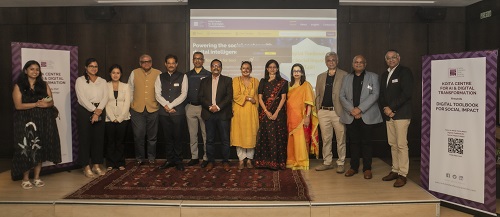 |
Leaders and partners from across the social impact ecosystem at the launch of the DT4SI Toolbook by ILSS’s Koita Centre for AI & Digital Transformation (KCADT)
Launched under ILSS’s Koita Centre for AI & Digital Transformation (KCADT), DT4SI toolbook seeks to make the discovering the AI & digital journey easier by contextualising and categorising digital tools for the social sector. The tool book brings together information that can help organisations understand what a tool does, what problem it can address, where it may be useful, its key features, pricing and relevant use cases.
DT4SI also brings together case studies from social purpose organisations that have successfully adopted AI & digital technologies. These examples are intended to make AI & digital transformation more tangible by showing how organisations are using technology in real settings, what they are trying to solve and what they have learned along the way.
The toolbook also aggregates learning resources and courses to help organisations build the internal capabilities required to use digital technologies effectively. Together, these resources create a pathway from awareness to understanding, from understanding to choose, and from choice to action.
Lastly, DT4SI is intended to evolve beyond a repository of tools and information. Its long-term ambition is to create a collaborative space where social purpose organisations, technology providers, practitioners and experts can learn from one another and contribute to the sector’s digital transformation journey.
Anu Prasad, CEO, India Leaders for Social Sector said, “India has emerged as a global technology powerhouse, with deep capabilities in software, digital infrastructure, artificial intelligence and technology services. AI and digital technologies are increasingly embedded in how corporate India operates. The opportunity now is to bring India’s growing AI and Digital capabilities accessible to Social Purpose Organisations working to solve population-scale challenges and advance India’s development. For many social purpose organisations (SPOs), the challenge is knowing where to begin, what technology is relevant to their needs, which tools are appropriate, and who can help implement them. For close to a decade, ILSS has believed the social sector’s greatest constraint isn’t a shortage of purpose or passion, it’s a shortage of capacity. That gap isn’t just a technology gap, it’s an equity gap, and equity is exactly what ILSS exists to protect. The bigger question is often how to make these choices with confidence, using evidence, real-world use cases and learning from other organisations in the sector. It is this gap that ILSS’s Koita Centre for AI & Digital Transformation (KCADT) is seeking to address with the launch of ‘Digital Toolbook for Social Impact’ (DT4SI), a single, freely accessible space bringing together trusted service providers, real case studies, mentors and practical resources, with no gatekeeping, so that any non-profit leader, anywhere, can begin decoding their own digital-enabled strategy.”
Rekha Koita, Co-Founder, Koita Foundation said, “Digital and AI capabilities are non-negotiable in the social sector today. As any organisation looks to scale, technology is the only thing that will enable it to maintain and improve programme quality and consistency. Over the last 10 years, working closely with nearly 35 organisations and engaging with many more, I have seen tremendous growth in the availability of new technology and now AI, along with a real increase in the number of NGOs embarking on this journey. But what I have also learnt, from working with organisations on the ground, is that access to tools or funding alone is not enough. The real gap is between the availability of technology and the ability to use it effectively. We need to stop viewing technology as a tech project, an overhead, or an MEL exercise, and instead treat it as a core part of organisational capacity building. That means asking three simple questions together as a sector, what NGOs need to do differently, what donors and funders need to do differently to enable this ecosystem, and what platforms like KCADT’s DT4SI can do to make that capacity building faster, easier and more accessible.”
The toolbook was launched at an ILSS-hosted leadership event in Mumbai, featuring a panel, ‘Accelerating Social Impact with AI & Digital’, that brought together senior leaders from the philanthropic, corporate, and technology ecosystems, including Rizwan Koita (Chairperson, NABH; Co-founder Koita Foundation; Co-Founder Citius Tech), Rekha Koita (Co-Founder, Koita Foundation), Ms Amrtha K. Rangan (COO, A.T.E. Chandra Foundation), Gayatri Nair Lobo (CEO, Educate Girls), Maharshi Vaishnav (CEO, Motilal Oswal Foundation), and Abhejit Agarwal (Head, Sustainability & CSR, Axis Bank).
The event featured a live presentation and demonstration of the DT4SI toolbook, followed by a panel discussion that explored the opportunities and barriers to AI and digital adoption within the social sector. The discussion highlighted that while SPOs are increasingly primed for AI- and digital-led transformation, many continue to face challenges in accessing affordable, contextually relevant tools and replicable models. Panellists also shared examples and case studies from the field, demonstrating how organisations are already overcoming these barriers and using India-specific solutions to drive meaningful impact on the ground.
The need for such a toolbook emerged from ILSS’s work with social purpose organisations and from its research on the state of digital transformation in India’s social sector. The research found that organisations across different geographies and areas of work face common challenges: uncertainty about available technologies, difficulty identifying and articulating their technology needs, questions around affordability and budgeting, and uncertainty about how to navigate an increasingly crowded technology landscape. DT4SI toolkit will continue to expand its collection of tools, solution providers, case studies, learning resources and insights as more organisations across the sector experiment, learn and share their experiences.
About India Leaders for Social Sector
Established in 2018, India Leaders for Social Sector (ILSS) is India’s pioneering leadership and institution-building organisation dedicated to strengthening the leadership infrastructure of the social sector. ILSS believes that India’s greatest development challenge is not a shortage of purpose, but a shortage of leadership capacity. Through its four Centres of Excellence—Talent and Leadership Development, Fundraising, Board and Governance, and AI & Digital Transformation—ILSS develops leaders, strengthens institutions, and advances knowledge to help social purpose organisations build resilience, strengthen governance, mobilise resources, embrace innovation, and create sustainable social impact at scale. Through executive education, flagship convenings, original research, and practitioner-led thought leadership, ILSS is advancing leadership and institution building across the sector. ILSS has trained over 1,300+ leaders, partnered with 800+ social purpose organisations, facilitated 250+ leadership placements, and built a robust community of alumni network. Guided by its vision of “Transformed Leaders. Transformed Society. Transformed World.”, ILSS aims to partner with 1,000 leading social purpose organisations and empower 5,000 impact leaders by 2030.