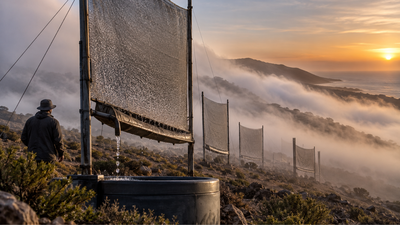
A drought-hit community in northern Chile has found an unusual source of water in something that usually passes unnoticed. On the hills above Peña Blanca, in the Coquimbo region, giant mesh nets are positioned to intercept coastal fog, locally known as camanchaca, as it moves inland from the Pacific. Tiny droplets suspended in the fog collect on the mesh, combine into larger drops and flow into gutters before being channelled into storage. The community has been developing the approach since around 2005, using the harvested water for agriculture, livestock and ecological restoration. Today, 34 fog catchers covering 306 square metres can collect up to 650,000 litres of water a year, according to the UN Food and Agriculture Organization, offering an unconventional response to severe water scarcity and helping support efforts to restore degraded land.
How the fog catchers turn mist into water in Chile’s drought-hit region
The technology is surprisingly simple. Large mesh panels are placed across the path of the prevailing fog and wind. When fog passes through the mesh, microscopic water droplets collide with its fibres and accumulate on the surface. As the droplets become larger, gravity pulls them down into collection gutters. Pipes then carry the water towards storage tanks or ponds, where it can be used later. The system does not create water or extract groundwater. Instead, it captures moisture that is already present in the atmosphere. The effectiveness depends heavily on local fog conditions, wind and the type of mesh used, which is why the community has spent years experimenting with different designs and materials.
A water source hidden above a dry landscape
Peña Blanca lies in one of Chile’s driest regions, where prolonged drought has placed pressure on farming, livestock and natural vegetation. The community is part of the Fray Jorge Biosphere Reserve, an area known for the unusual contrast between an extremely dry surrounding landscape and vegetation sustained by coastal moisture. Researchers studying Peña Blanca have documented how declining rainfall and historical land use contributed to soil degradation and reduced agricultural activity. Yet while rainfall became increasingly unreliable, coastal fog continued to arrive over the hills. The community’s response was to treat that fog as a potential source of water rather than simply as a weather phenomenon.
The experiment began around 2005
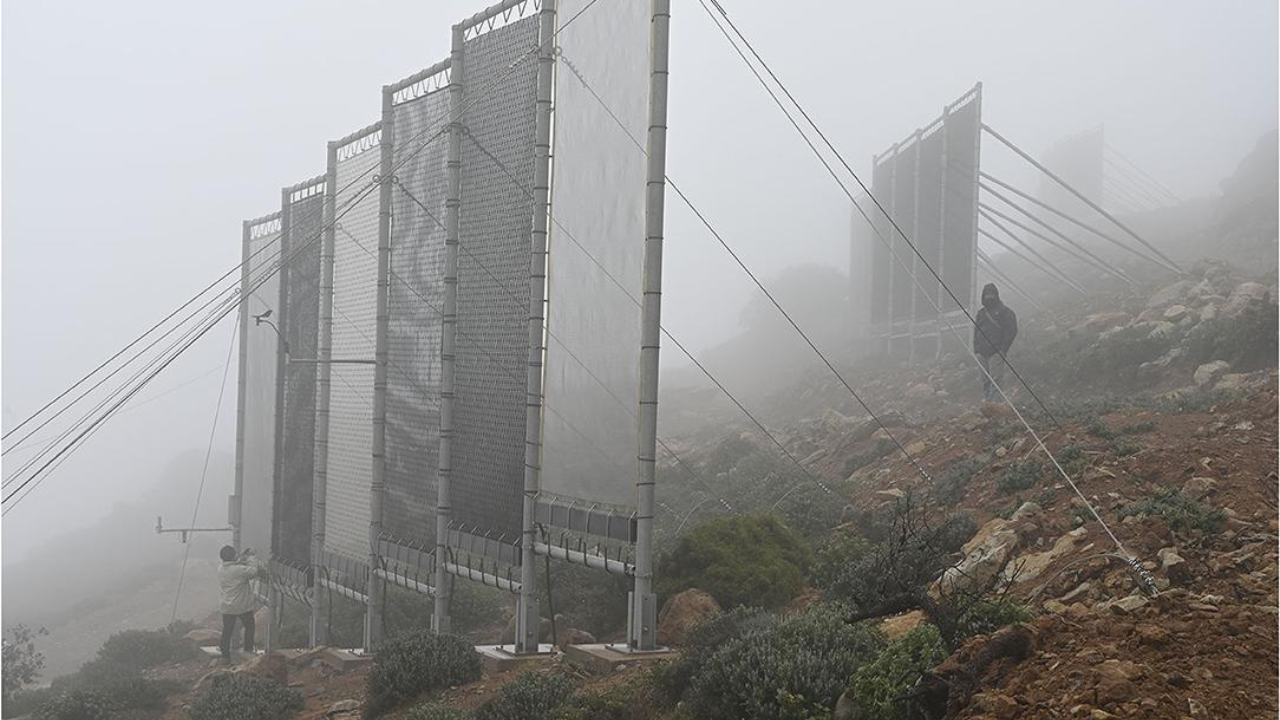
The Peña Blanca initiative developed in the mid-2000s through cooperation between local residents and Fundación Un Alto en el Desierto. The organisation worked with the community to explore ways of addressing water scarcity, desertification and land degradation. Cerro Grande, a hill rising to roughly 650 metres, became an important location because of its persistent fog. Residents and project workers began installing and testing fog collectors there, gradually adapting the technology to local conditions. The project was not simply a matter of putting up nets and waiting for water. Community members participated in construction, monitoring and maintenance, while repeated experimentation helped determine where collectors worked best and how their design could be improved.
The water is being used to restore land
One of the most important aspects of the project is that the collected water is not being used solely as an alternative water supply. It has also been channelled towards ecological restoration at the Cerro Grande reserve. Part of the hill was fenced to prevent livestock from damaging recovering vegetation and the fog-catching infrastructure. Harvested water has been used to support native plants and restoration efforts in an area affected by degradation. This created a direct connection between atmospheric water harvesting and land restoration. Rather than attempting to restore the landscape simply by planting vegetation and hoping for sufficient rainfall, the project created a small, locally controlled water source to support the recovery process.
The collectors also support agriculture and livestock
The harvested water has several practical uses outside the reserve. Research on the community’s system has documented its use for irrigation and livestock, while more recent projects have expanded its agricultural application. In 2026, a new 10-panel system covering 90 square metres was installed to supply water for a 0.2-hectare plot growing forage crops. Chile’s agricultural development agency INDAP said the project involved an investment of more than 28 million Chilean pesos and was designed to provide an additional source of water for local agricultural production. The new system demonstrates how the technology is being adapted not only for ecological restoration but also for the day-to-day needs of farming communities facing increasingly unreliable rainfall.
The 650,000-litre figure needs some context
The headline figure refers to the reported potential of the current system rather than a guaranteed amount of water collected every year. FAO says the 34 fog catchers, covering 306 square metres, can collect up to 650,000 litres annually, with collection particularly strong during periods when fog and wind conditions are favourable. Earlier academic research provides a more specific measured figure. Monitoring of 28 meshes in 2021 recorded approximately 571,590 litres of harvested water. The difference is important because fog collection varies according to atmospheric conditions, collector design and season. The system therefore should not be presented as producing exactly 650,000 litres every year.
The community has spent years improving the design
The project has effectively become a long-running experiment in how to make fog harvesting work under local conditions. Recent research analysed five years of community monitoring data from 2020 to 2025 and compared different mesh materials. The study found that Kimre mesh performed about 25 per cent better on average than double-layer Raschel 35 per cent mesh, with the advantage reaching 27.4 per cent during dry or negligible-precipitation conditions. The results demonstrate why material choice matters. A fog catcher may look like a simple piece of mesh stretched between supports, but its ability to capture water depends on the interaction between the mesh, wind, fog and local topography.
Strong winds can be a problem
The same wind that brings fog to the collectors can also threaten the infrastructure. Research into large fog collectors in Chile has found that strong wind loads can deform or damage collection systems. Peña Blanca’s experience has therefore involved not just maximising water capture but also making the equipment resilient enough to survive local conditions. The newer 2026 agricultural system uses 10 separate panels rather than relying on a single large structure. According to INDAP, this modular design means that if one panel develops a problem, the others can continue operating. Years of practical experience have therefore shaped the technology alongside scientific research.
It is more than a water project
The fog catchers have gradually become part of a broader community effort involving conservation, education and local livelihoods. Peña Blanca’s Cerro Grande reserve has been used as a site for environmental education and demonstrations of nature-based approaches to water scarcity. The project has also contributed to local tourism and community activities. Researchers studying the initiative describe benefits extending beyond water itself, including greater community collaboration and local involvement in environmental management. That wider impact is important because the system is not being presented as a technological replacement for conventional water infrastructure. Instead, it represents a locally managed additional resource that can support several activities at the same time.
The idea is old but the local experiment is unusual
Fog harvesting itself is not a new invention. Chile has a long history of research into capturing atmospheric moisture, with scientist Carlos Espinosa Arancibia among the pioneers of fog-collector technology from the 1950s onwards. What makes Peña Blanca notable is the way a local community has adapted the concept over roughly two decades and connected it with land restoration, farming and community management. The innovation therefore lies less in inventing the fog catcher than in recognising that persistent coastal fog could become part of a broader response to drought and land degradation.
Fog cannot replace rainfall or solve drought alone
The project has limitations. Fog availability changes with weather and seasons, and the amount collected is nowhere near enough to meet all the water requirements of a large region. Community members have also disagreed over the project’s benefits, particularly because fencing areas for ecological restoration can reduce access to land traditionally used for livestock. Fog water also cannot automatically be assumed to be safe for drinking without appropriate treatment. Scientific studies of Chilean fog water have identified issues including acidity in some samples. The strongest interpretation of Peña Blanca’s experience is therefore not that the community has solved drought, but that it has found a previously overlooked source of water that can complement other supplies.
A simple idea that keeps evolving
What began as an experiment on a fog-covered hill has become a long-running example of how communities can adapt simple technology to difficult environmental conditions. The latest installations and monitoring show that Peña Blanca is still refining the approach rather than treating the original design as finished. In a landscape where rainfall has become increasingly unreliable, the community is making use of moisture that continues to arrive from the Pacific. The result is a striking example of a small change in perspective. Instead of asking where the next rain will come from, residents found a way to collect some of the water that was already moving through the air above them.