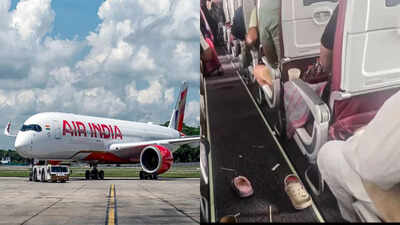
NEW DELHI: The Aircraft Accident Investigation Bureau (AAIB) has made an “interim safety recommendation” the Directorate General of Civil Aviation urgently “take appropriate actions as deemed fit to prevent abuse of psychoactive substance” in its preliminary report into the probe of the severe turbulence on Air India’s Phuket-Delhi flight AI 2379 on Aug 4, 2026. While the probe is still on, the prelim report officially confirms that the “confirmatory (dope) test report of the pilot-in-command (PIC) was found non-negative” and that the Airbus A320 had suffered an extremely rare multiple hydraulic failure.When the “event” occurred, “initially, (the aircraft) gained 372 feet and fell by 292 feet from its assigned flight level of 36,000 feet…. seat belt signs were off. Consequently, some passengers and cabin crew suffered injuries,” the report says. The “event’s” impact on the aircraft cabin damage was such that a “lavatory commode was uprooted from its original location.”The report says in its conclusion: “Detailed investigation regarding technical and other aspects are underway. In this case, it has been observed that the PIC was found non-negative for psycho-active substance in the confirmatory test. The confirmation of use of psycho-active substances is a serious concern, and AAIB recommends appropriate actions by DGCA on priority. The preliminary report is published as per ICAO guidelines. The investigation is in progress. The final report will be published in due course.”The final report will tell what caused the extremely rare instance of all three hydraulic systems on an A320 failing one after the other in a matter of seconds — whether it happened due to something going wrong with the hardware or software or due to some manual intervention.“At 04:02:43 UTC, while cruising at flight level 36,000 feet, the aircraft’s flight control (F/CTL) system detected loss of green hydraulic system. Further, at 04:02:47 UTC, the flight control system detected loss of blue and yellow hydraulic systems. At 04:02:48 UTC, the autopilot got disengaged and a continuous repetitive chime (CRC) came. At 04:02:51 UTC, the Stall warning triggered for 2 seconds.”“The co-pilot, who was the pilot flying (PF), responded and tried to control the prevailing situation. Subsequently, PIC took over the controls. Meanwhile, the aircraft encountered an altitude upset. Initially, it gained 372 feet and fell by 292 feet from its assigned flight level of 36,000 feet during the event. At around 04:02:52 UTC, the blue hydraulic system was recovered, and few seconds later, the yellow hydraulic and the green hydraulic systems were also recovered. Consequently, this led to the recovery of the flight control surfaces. Subsequently, the aircraft operation returned to its normal operating condition,” says the report.The hydraulics on an Airbus A320 use pressurised liquid to act as the “muscles” that move heavy flight controls, lower the landing gear, and stop the wheels. The hydraulics on an Airbus A320 use pressurised liquid to act as the “muscles” that move heavy flight controls, lower the landing gear, and stop the wheelsThe cabin supervisor (head cabin crew) apprised the cockpit about the injuries suffered by the passengers and cabin crew. The flight crew assessed the cabin situation and took the decision to continue the flight to its destination, Delhi and not divert to the nearest en route airport.The aircraft cabin suffered significant damage during the “event”. The overhead ceiling panel was found cracked or deformed at various places. Most of the passenger service unit (PSU) panels were found dislocated or bent at various places. The overhead handrail was found broken, and the sealing panel was found dislocated near the 10th row. The forward right-side emergency exit handle was found broken.In a statement, Air India said: “We acknowledge the release of the preliminary report by the Aircraft Accident Investigation Bureau (AAIB) and continue to extend our full cooperation to the investigation, including providing access to all relevant operational, maintenance and technical records. Safety remains Air India’s highest priority. Our pilots undergo rigorous training, regular proficiency checks, medical examinations and other regulatory assessments in accordance with applicable national and international requirements.
Share your thoughts in the comments
Be respectful · TOI community guidelines
Following the incident, Air India has started voluntary testing of 100% of its pilots as a further step to reinforce its safety-first approach.”“The airline maintains zero tolerance for any breach of safety, fitness or regulatory requirements and will take appropriate action wherever warranted. Air India remains committed to implementing any recommendations arising from the investigation,” AI said.