
Amit Mehra, a software engineer based out of Gurugram, has been trying to zero in on a day to have a quiet evening with his wife for the past five months. Nothing urgent. There’s no thundering crisis. It’s just that in the daily grind, he and his wife of 14 years, Sonali, have been feeling the distance for a while now. “I can feel it, and so can Sonali,” says Amit. But he’s exhausted. So they both have gotten used to just doing the bare minimum needed to keep their relationship alive — maybe a dinner here, a movie there — but the distance doesn’t seem to close. Experts are calling this a “low-effort relationship“.
Not falling out of love, running out of energy
Yes, it sounds demeaning. It sounds insulting. It also sounds as if couples these days are not willing to put in the work that’s needed to keep love and relationships alive. But thinking that wouldn’t just be judgmental, it would be wrong. Low-effort relationships aren’t the result of couples falling out of love. Increasingly, experts say, it’s because they have run out of energy.Burnout has long been discussed in the context of work. We know it affects productivity, mental health and physical well-being. But we hardly talk about how it’s affecting our personal lives. Relationships these days aren’t ending with slammed doors, dramatic fights or heartbreaking betrayals. They are simply fading.One forgotten anniversary becomes two. Date nights are replaced by “maybe, next weekend.” Conversations shrink into logistical updates about groceries, bills and school pickups. At bedtime, two people lie inches apart, each illuminated by the blue glow of their own phone, scrolling through different worlds.Like Mehra, Ankita Sharma, a brand collaborator with a media house, has seen her relationship with her husband Sumit just decline for “no apparent reason”. “Whenever I feel like bringing up the subject, I choke up. I feel like instead of addressing it like a mature adult, I’ll just start to scream and cry.”
The butterfly and the reel
Clinical nutritionist and wellness consultant Dr Ananya Bhowmik has seen this all too often in the past few years. “It’s not just relationships. This extreme exhaustion leading to minimal effort among couples in a relationship is hurting them physically too.” Some stop eating, some binge eat for emotional comfort. “At times, even after losing considerable weight, a patient would not look happy at all. That spark of life that kept people happy seems to be gone these days,” she says.Dr Bhowmik explains in very simple terms what she thinks is happening to us personally due to burnout. Says she, “Let’s say, you see a yellow butterfly sitting on an orange flower. It immediately lifts your mood because you are seeing this nature’s wonder with your own eyes. That gives a certain amount of stimulus to your nervous system.“But when you see that same thing on a reel, it will not stimulate you similarly. The most tricky and dangerous part here is though you won’t feel the stimulus like you did in natural surroundings, your mind will perceive the reel or slow-motion video of the same butterfly on the same flower as a ‘happy moment’.”That’s what is happening with low-effort relationships too. The effort is there, but also not there. And eventually, it seems fake. Because it’s not giving us the simple happiness of being together, like we’ve seen our parents enjoy.Adds Dr Bhowmik, “Millennials, and to some extent even Gen Z, have seen real relationships and happy times when it came to their parents. They are expecting to feel the same authenticity but the pressures of modern life is such a huge wall between couples that it is becoming an insurmountable problem. It’s only the last 15 years or so that smart gadgets have completely taken over our lives. The thing is we haven’t forgotten what authenticity feels like, and we are trying to recreate it with whatever minimum energy modern life allows us for relationships. But it’s not enough to feel the love.”The ‘low’ in low-effort relationships is not by choice; it’s just the reality of a 24×7 connected life we have today. When you are sitting and talking to each other, looking at each other’s eyes, and you can chat for hours without realising that it’s been one hour, that is what this generation is missing.Bhowmik adds, “The tragic part is we all had the taste of it before. We probably did not know how much it helped us bond, but our senses were wired like that. We were, in general, happy people because we had human touch and human connection. Texts, smileys, and heart emojis, at the end of the day, are poor substitutes for an hour of just really looking into each other’s eyes, listening to one another and laughing at old jokes.“
When burnout follows you home
Belgian psychotherapist and author Esther Perel has long argued that routine, domestic responsibilities and ongoing stress dampen desire, and that when emotional energy is drained by work and household demands, partners tend to prioritise safety and quiet routines over romance.Today, burnout doesn’t stop at the office door. It follows us home, settling quietly into our closest relationships. After a day of endless notifications, packed schedules, financial worries and emotional overload, many couples simply don’t have the bandwidth for the kind of attention love quietly demands.Love, after all, isn’t sustained by grand declarations. It survives on small everyday acts or regular catch-up moments between couples, even if it’s for 20 minutes. Remembering how your partner takes their coffee, asking how the meeting went and actually listening to the answer, looking up from your phone when they’re telling you about their day. These moments appear insignificant, but relationship researchers have long argued that they form the invisible architecture of intimacy.When they disappear, relationships don’t just collapse overnight. They slowly become functional rather than fulfilling. Says Dr Santosh Bangar, senior consultant psychiatrist, Gleneagles Hospital, Mumbai, “Burnout may not have a direct impact on the relationship, but may slowly weaken the emotional connection between partners due to the failure to address the situation.” Possibly, even the failure to recognise it.
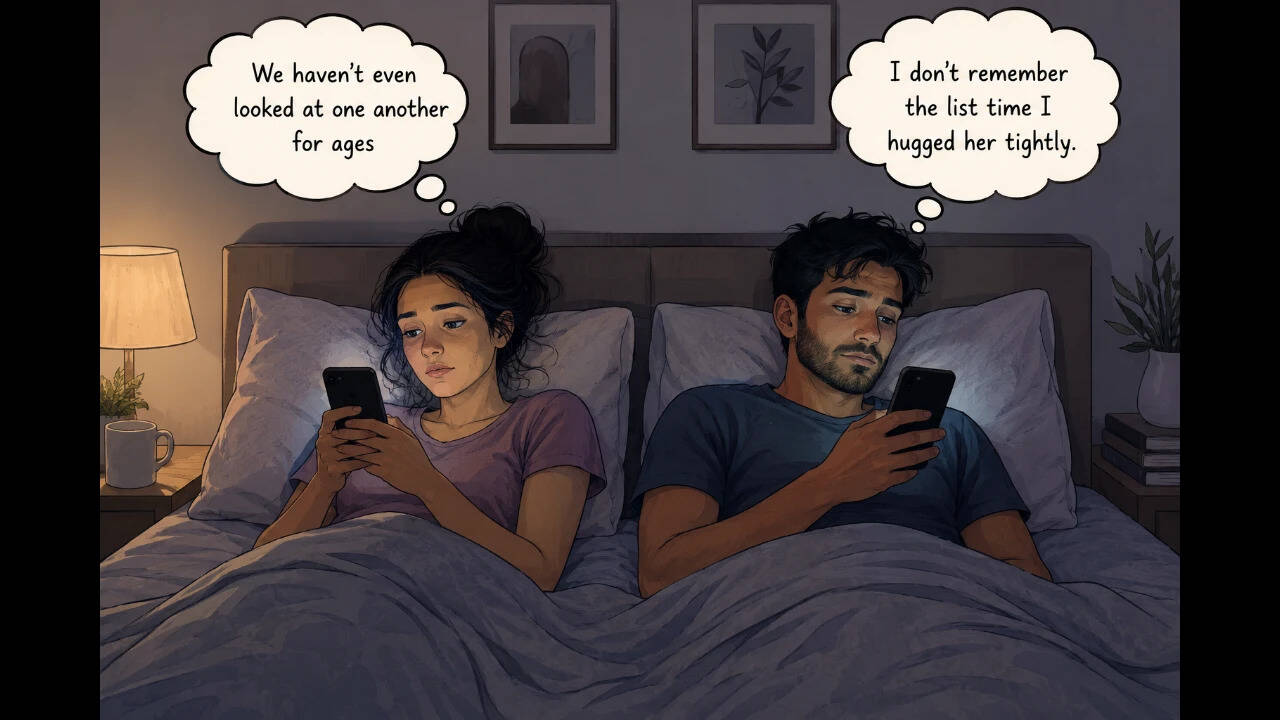
Couples settle into bed after work, not to reconnect, but to disconnect together
Our ‘parallel scrolling’ lives
The most visible version of this shift is what therapists call parallel scrolling. Couples settle into bed after work, not to reconnect, but to disconnect together. One watches short videos, the other checks emails or social media. Hours pass in silence. They are physically together, emotionally elsewhere.Technology often gets the blame, but the phone is more symptom than cause. Scrolling has become the easiest form of recovery after mentally exhausting days. Unfortunately, it also becomes the easiest way to avoid conversation, vulnerability and emotional presence.
Too many roles, too little left over
Modern relationships are also carrying a heavier emotional load than ever before. Today’s couples aren’t just partners. They are expected to be best friends, co-parents, financial planners, therapists and career supporters all at once.At the same time, many are navigating economic uncertainty, rising living costs, demanding jobs and shrinking support systems. The expectations have expanded, but the emotional resources haven’t. So we may genuinely love our partners and still consistently fail to make them feel loved.It usually shows up first in the texting, where messages turn transactional:
- Did you pay the electricity bill?
- Can you pick up milk?
- Who’s collecting the kids?
Even couples without children notice conversations revolving around logistics rather than curiosity. Weeks pass without asking questions like: What’s been on your mind lately? What are you excited about these days?Emotional neglect doesn’t always look like indifference. Often, it’s just exhaustion. This helps explain why many people describe feeling lonely inside otherwise stable relationships. They are simply living with partners who are emotionally depleted. As are they. The affection is still there, buried beneath deadlines, sleep deprivation and an endless list of responsibilities.
Intimacy stubbornly refuses to be efficient
We live in an era obsessed with efficiency. We optimise our workdays, automate our homes and outsource countless daily tasks. Yet intimacy stubbornly refuses to become efficient. Relationships cannot be sustained through shortcuts or multitasking, and presence cannot be automated.Psychologists often distinguish between time spent together and quality attention. Couples may technically spend hours in the same room, yet never truly connect. Simply occupying the same physical space doesn’t nourish emotional intimacy. Eye contact, active listening, shared laughter and uninterrupted conversation do.
No alarm bells announcing a breakdown
The danger of low-effort relationships is that they rarely trigger alarm bells. There is no obvious crisis demanding attention. Instead, partners slowly adapt to emotional distance until it becomes normal. They stop expecting affection because disappointment feels more exhausting than acceptance. One day, someone says, “I don’t know when we stopped being us.”Adds Dr Bangar, “If someone is constantly stressed or exhausted, he/she will be irritated, fatigued, have less patience, feel frustrated, avoid meaningful conversations, forget important moments, or spend more time on their own rather than with each other. This leads to issues like loneliness, misunderstandings, and emotional distance from the partner which is concerning. Hence, it is imperative for couples to get regular breaks, strike a work-life balance, spend quality time with each other, appreciate each other’s company to rekindle the relationship and re-discover lost emotional connection.“
What actually helps
The encouraging news is that relationships usually don’t require extraordinary gestures to recover. In fact, the opposite may be true. Research consistently suggests that consistent, everyday moments of connection matter more than expensive holidays or elaborate surprises.A ten-minute walk after dinner without phones. Morning tea together before the day begins, a few extra seconds in a hug, one meaningful question before bed, looking at each other instead of at another screen. None of this is revolutionary. It is just attention.Perhaps that’s what makes the low-effort relationship such an important cultural conversation. It challenges the comforting belief that love naturally sustains itself once commitment is established. Burnout may be unavoidable in a life like this one, but what it does to a relationship is not.Dr Bhowmik says another significant factor behind low-effort relationships is that there is no work-life balance among couples today. “That demarcation has to be brought back as an emergency. Not just for couples to survive a relationship. But to find ourselves, our own souls. It is not a cliche when people say ‘take care of yourself, so that you can take care of another’.”So the real question is whether low-effort relationships are on the rise because we have also developed a low-effort relationship with ourselves. After all, it is difficult to bring presence, intimacy and tenderness to another person when we have so little left for ourselves. That is a story for another day though.