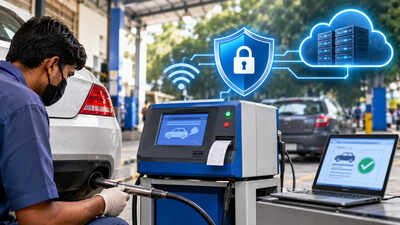
NEW DELHI: Emission test results from vehicles tested at PUC centres in Delhi and adjoining cities in NCR can soon no longer be manipulated, with govt introducing stringent standards to ensure that actual pollution levels are recorded. The emission readings will be digitally signed and transmitted directly to the central server for enforcement purposes.The upgraded PUC equipment (gas analyser and smoke meter), compliant with the new standards, will first be rolled out in Delhi-NCR, followed by entire NCR, cities covered under National Clean Air Programme and, eventually, the rest of the country in a phased manner. The test run has started at a few PUC centres in Delhi, officials said.Officials said the phased deployment of PUC testing equipment complying with modified standard won’t have any impact on the acceptability of PUC certificates issued by other states and from centres that will take time to either get new equipment or upgrade them. They added that the nation-wide roll out is expected in the next two years.Under the amended automotive standards (AIS) published by road transport ministry, emission readings recorded by PUC equipment will have to be digitally signed within the instrument itself before being transmitted to the central Pollution Under Control Certificate (PUCC) server. The equipment will use a dedicated cellular connection to send the data, leaving no scope for operators or computer systems at testing centres to manually enter, modify or override measured emission values.The amended standards lay down detailed technical specifications and testing procedures for petrol and diesel emission-testing equipment, including gas analysers and smoke meters. A key feature is the installation of a specialised hardware security chip — Trusted Platform Module (TPM 2.0) — in each instrument. The chip will generate and securely store a unique private key that cannot be extracted or copied. Every emission test result will be digitally signed using this key, establishing the authenticity of the readings and the identity of the equipment that generated them.
Share your thoughts in the comments
Be respectful · TOI community guidelines
The instrument will transmit the signed data directly to the central server through its own SIM or eSIM connection. The computer at the PUC centre will be restricted to entering vehicle details, initiating the test and printing the certificate. It will not be able to alter the actual emission readings.Any unauthorised opening of equipment, attempts to modify its software, manipulation through external commands or unauthorised removal of its SIM will trigger an alert and suspend further testing and signing until the instrument is verified. Live emission readings will not be displayed during the test, preventing operators from influencing the outcome. If oxygen concentration is 5% or higher, the test will be aborted and a retest sought.