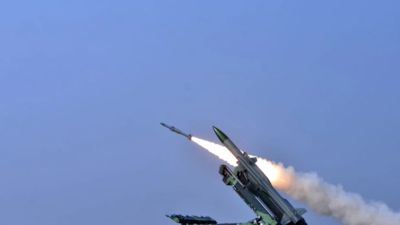
Recent and ongoing conflicts have demonstrated the importance of air defences. From the use of air power during Operation Sindoor, when Pakistan’s efforts to damage key Indian military capabilities failed miserably, to the conflict in West Asia and Ukraine, where the need for robust air defence has emerged as the most critical factor. When a drone, a cruise missile or a fighter crosses into Indian airspace, the decision about what to do next increasingly takes just seconds. The system that makes this possible is the Integrated Air Command and Control System (IACCS), and Bharat Electronics Limited (BEL) says it has now completed development of the critical core technologies for its next-generation upgrade, which aims to make the Indian Air Force‘s air-defence network AI-native.
What IACCS is
IACCS is an automated command and control network for air defence, run by the Indian Air Force (IAF) and built around BEL’s systems. It runs on the Air Force Network (AFNET), the encrypted digital grid launched on September 14, 2010, and brings together data from ground radars, airborne warning aircraft, drones, air traffic control and civil radars, air-defence weapons and command nodes. From these, it builds a single Recognised Air Situation Picture, so commanders at every level can see the same airspace in real time. The IACCs has multiple nodes and sub-nodes across the nation.
The upgrade
The new version adds an AI-native decision-support architecture that scores and ranks threats, including drones, cruise missiles and saturation raids, and recommends the best weapon, whether a long-range interceptor such as the S-400 or Project Kusha class, a medium-range system like Akash-NG, or a fighter intercept. It fuses data from radars such as the indigenous Arudhra and Ashwini, Netra airborne warning aircraft, satellite feeds and fighter sensors, and has in-house cybersecurity hardening and standoff launch detection. A human commander stays in the loop. The network now links the IAF with Akashteer and the Navy’s Trigun maritime domain-awareness network through the Joint Air Defence Centre, creating a common operational picture across the three services.
The Operation Sindoor test
The system’s value was on view during Operation Sindoor, which began on May 7, 2025, with strikes on nine terrorist sites in Pakistan. IACCS coordinated both offensive and defensive operations, and a node was shown at the military briefing on May 12. It helped detect and track drones and missiles, including low-signature targets, and matched them with weapons such as the S-400, Akash and counter-drone systems, so that layers did not duplicate each other. Between May 8 and 10, Pakistani drones and missiles were intercepted. Akashteer had been tied in only months earlier.The upgrade builds on a Phase-III modernisation accelerated after Sindoor. For a force that expects drone swarms and saturation attacks in the next war, the speed at which a threat is spotted, ranked and answered will count as much as the weapons themselves.