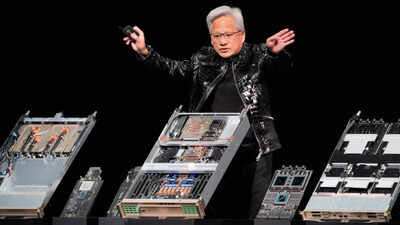
Nvidia went 33 years without ever having to say who would follow Jensen Huang. That is now the company’s most urgent question, and it has to be answered with the share price falling and the world watching. Colette Kress is minding the shop as interim CEO while directors look for a permanent chief. Investigators in Washington are still digging, and the push to sell American AI chips to China has lost the executive who argued for it hardest.The board removed the preeminent face of the AI infrastructure boom after reports of two affairs, including one with a woman suspected of spying for China. Huang fought to keep his job, The New York Times reported, but plans for Kress to step in were already in motion by Wednesday. Nvidia stock slid 10% to $156 after the news, a level it last saw in June 2025.
Colette Kress is interim CEO, so who runs Nvidia next and why Jensen Huang is hard to replace
Kress was always meant to be a bridge. She will run the company and its finances at the same time, and the search for a permanent chief is open to outsiders as well as insiders. Directors had been working with an outside firm to identify potential replacements even before the announcement, a sign the board had planned for this outcome.A shortlist has already taken shape. Analysts and investors keep coming back to two internal names: Kress and Ian Buck, the engineer who runs product for hyperscale AI. Outside names include Arm chief Rene Haas, who previously worked at Nvidia, and Apple hardware chief Johny Srouji. Jeff Fisher, a 32-year Nvidia veteran, has also come up. Minotaur Capital’s Armina Rosenberg has suggested a split arrangement, with a finance-minded leader such as Kress sharing the top job with a technologist such as Buck.The difficulty is less about names than about how Nvidia was built. Huang has said he is opposed to succession planning. He managed more than 60 direct reports, a flat setup that will be hard to unwind. He once said traditional org charts made no sense to him, and he claimed to read several thousand emails a day. His Santa Clara office is built around an enormous oval desk facing his lieutenants, with stadium seating behind them.Money is tied to his name too. Nvidia sits on about $99 billion in equity investments, spread across frontier AI labs, neoclouds and infrastructure firms. In August, it lined up more than $500 billion in data centre financing with six large financial institutions. Morningstar’s Brian Colello wrote this week that it is unclear what those arrangements look like under another CEO, and that borrowing could get costlier without Huang orchestrating them. Futurum Equities’ Shay Boloor framed the long-term risk around vision: Huang has been the person who consistently identified where computing is going.
Alice Huang spy investigation, FBI and Congress: Jensen Huang’s troubles are not over
Leaving Nvidia does not take Huang out of the line of fire. The board’s own inquiry, run with the law firm Wachtell, Lipton, Rosen and Katz, has an uncertain future now that its subject has gone. The federal investigations are wider. The Justice Department is running several probes that touch on Alice Huang, The Wall Street Journal reported, and Trump said on Monday that the FBI was examining the relationship.New detail has emerged on how long Washington knew. According to the Times, a classified memo overseen by Secretary of State Marco Rubio circulated among officials before Trump’s China trip in May, warning that the Megaspeed executive was allegedly working for China’s Ministry of State Security. Trump had also reportedly been briefed about her roughly a year ago and chose not to act.Then there is the money trail. Megaspeed’s sister company in Malaysia spent $4.8 billion or more on Nvidia chips and technology between June 2024 and February 2026, according to trade records cited by the Times. That is an unusually large bill for a small firm, at a time when Nvidia hardware is rationed. Both companies deny wrongdoing, and Beijing has dismissed the claims as “nothing but smears.”Capitol Hill is next in line. In a November 4 letter, the Republican chairs of three House committees asked Huang to a closed-door briefing on November 18. They want to know about his dealings with Alice Huang and whether Beijing shaped Nvidia’s decisions or US chip export policy. Lawmakers have also raised the threat of a subpoena.The board’s ability to act was never in doubt. Nvidia has one class of stock with one vote per share, and independent directors hold 10 of its 11 seats. Unlike the founders of Meta or Alphabet, Huang had no super-voting shares to protect his job.
What Jensen Huang’s exit means for US chip export controls, China and the AI boom
The biggest effects may show up in policy. Huang was corporate America’s leading advocate of selling to China, and in 2025 he called US export curbs “a failure.” His pitch was that American chips in Chinese data centres would make US technology the global standard. In July 2025, he made that case to Trump in the Oval Office, and days later H20 sales to China were cleared. By December, Trump allowed sales to approved Chinese buyers, with the US government taking a 25% cut.The lobbying and the scandal are separate things. CSET analyst Hanna Dohmen has noted that Nvidia had every commercial reason to push for looser rules, intelligence operation or not, since each restriction caps its sales. The affair has still damaged the messenger. A trio of bills to restrict chip sales abroad has gained momentum. One of them, already passed by the House and awaiting the Senate, would extend controls to cloud computing, stopping Chinese firms from renting advanced Nvidia servers in countries such as Malaysia. Chinese AI stocks fell on Thursday on fears that their access to top-end chips could narrow.The White House has not turned on him. Trump called Huang “an honorable guy” and said he had “done an amazing job for our country.” Huang’s financial grip on Nvidia also remains large even without a board seat. More than half of his 922 million shares sit in a trust he co-manages with his wife, Lori. Elon Musk has said he would be open to hiring him.
Nvidia stock and Q3 earnings: What investors will watch on November 17
Kress faces her first public test within a week. Nvidia reports third-quarter fiscal 2027 results on November 17, with the earnings call at 2 pm PT, or 3:30 am IST on November 18. She has sat beside Huang on these calls for years. On this one, analysts will spend as much time on leadership as on data centre revenue.The sell side moved before the board did. As reports of Huang’s likely removal surfaced on Wednesday night, Bernstein downgraded the stock and halved its target from $400 to $200. Oppenheimer dropped its target entirely and warned of a possible “brain drain,” and Evercore cut its target to $186 from $330. Earlier in the week, tech analyst Dan Ives had already put a number on the Huang premium: $300 a share with him, $225 without. Estimates are that the slide could erase roughly $1 trillion from Nvidia’s market value this month alone.There is a bull case, and it rests on the product pipeline. Blackwell demand, the Rubin roadmap, networking and the CUDA software ecosystem were all locked in before the scandal, which is why some analysts want the leadership crisis kept apart from the business.The board has promised continuity. Whether Nvidia’s customers, lenders and engineers believe it will become clearer on November 17, when a company that has spoken in Huang’s voice since 1993 reports for the first time without him.