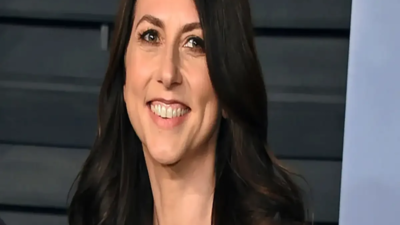
MacKenzie Scott’s approach to philanthropy has rarely followed the usual pattern of wealthy donors seeking public recognition for their contributions. Her donations often reach organisations without much advance publicity, and details of individual gifts can remain difficult to track. Yet the scale of her charitable giving became clear in figures covering America’s largest donations in 2025. As reported by Fortune, Scott contributed around $7 billion during the year, representing roughly one- third of the $19.2 billion distributed through major charitable gifts. The amount also pushed her cumulative donations to $26.2 billion over five years, even as her personal fortune remained substantial.
MacKenzie Scott’s 2025 donation far outpaced other major philanthropists
The figures, shared with Fortune by Giving USA and Indiana University’s Lilly Family School of Philanthropy in June, placed Scott well ahead of other major donors in 2025. Her estimated $7 billion contribution accounted for the $19.2 billion classified as megagifts. Fortune reported other names among the year’s biggest contributors included Michael Bloomberg, who gave $4.3 billion, and Bill Gates, whose donations reached $3.7 billion. Warren Buffett contributed approximately $1.34 billion, while Susan and Michael Dell together gave close to $1 billion.Scott’s position was particularly striking because her giving was spread across thousands of organisations rather than concentrated in a handful of highly publicised projects.
American charitable giving reached $617.2 billion in 2025
The largest gifts formed only part of a much wider increase in charitable contributions across the United States. Giving USA and the Lilly Family School of Philanthropy reported that total giving reached $617.2 billion in 2025, marking a 5.7% rise compared with the previous year.The estimate included contributions from individual donors, estates, charitable foundations and corporations to organisations working across the country. Religious institutions, human services, education and healthcare were among the major recipients, alongside international affairs groups and organisations supporting arts and culture.Gabe Cooper, vice chair of the Giving USA Foundation and founder and chief executive of Virtuous, said, “It was a positive year for charitable giving, with virtually all categories of recipient organizations achieving solid or better growth at the aggregate level.”
Why Scott’s name was missing from a major donor ranking
Despite contributing billions of dollars, Scott did not appear on the Chronicle of Philanthropy’s annual list of the 50 biggest donors. Her absence was not an indication that she had given less than other people featured in the ranking.The publication explained that Scott and her representatives had declined to provide information about her donations. It also pointed out that some contributions may have gone into donor-advised funds, making it difficult to establish whether they met the criteria used for its list.Scott has maintained a relatively private approach to her charitable activities. Unlike some wealthy philanthropists, she does not regularly publicise individual donations or provide detailed explanations of every organisation receiving money. Her donations are often announced by the organisations receiving them, rather than through a central public record released by Scott herself.
Earlier acts of kindness influenced her approach to giving
Scott has previously described how experiences from her own life shaped her understanding of generosity. Some of the examples she has discussed involved relatively small amounts of money, but their effect on her circumstances was significant. During her college years, a roommate gave her $1,000 when she was facing the possibility of leaving her studies because of financial difficulties. She has also recalled a dentist who provided treatment without charging her after recognising that she could not afford the cost.These experiences became part of the thinking behind her philanthropic work. Rather than viewing generosity only through the amount of money transferred, Scott has written about how assistance can create consequences that extend far beyond the original act.In an essay published on 9 December, she reflected on how the effects of kindness can spread in ways that are difficult to measure. She questioned the assumption that contributions without an immediate financial return have limited value, suggesting that their wider benefits may not always be visible in conventional calculations. She has also written about the personal effects of giving. Referring to research into generosity and human behaviour, Scott noted that acts of kindness can activate pleasure-related areas of the brain and are associated with improved health and longer-term happiness.“It is these ripple effects that make imagining the power of any of our own acts of kindness impossible.”
Her Giving Pledge commitment has not stopped her wealth from growing
Scott’s large-scale philanthropy accelerated following her 2019 divorce from Amazon founder Jeff Bezos. As part of the settlement, she received a substantial holding of Amazon shares, providing the financial resources behind much of her subsequent charitable activity.She later signed the Giving Pledge, a commitment made by some of the world’s wealthiest individuals to give away most of their fortunes during their lifetimes or through their estates. Her donations have continued to reduce the amount of wealth she retains, although the value of her remaining assets has also been influenced by changes in Amazon’s share price. By the time of the 2025 giving figures, her estimated net worth was still close to $37 billion.Her former husband Bezos has also made charitable contributions, although Scott’s lifetime giving has been considerably larger relative to the amounts attributed to him.