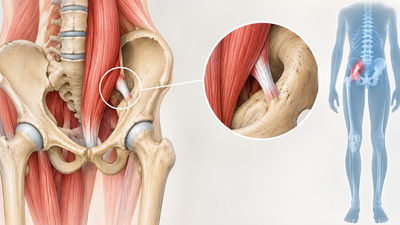
What began as an unusual observation during a cadaver study has uncovered a possible new variation in human anatomy. Tulane University students may have identified a previously unknown muscle attachment in some humans, after noticing an unusual structure while studying donated cadavers. According to a report by Tulane News, the discovery was made by undergraduate students Cooper Bruce and Dominic Roy in the anatomy lab at the Tulane School of Medicine. Their observation led to a broader investigation involving 200 additional donated specimens. Researchers found that the attachment was present in 28% of the sides examined, suggesting that it represents an anatomical variation rather than a structure found in everyone.
An unusual structure inside the pelvis
The structure was found deep inside the pelvis, near the front of the hip. It is a small muscular head connected with the larger psoas major, a muscle involved in moving the hip and helping stabilise the body. Researchers have described the newly identified structure as the iliac attachment of the psoas major. R. Shane Tubbs, professor of neurosurgery and surgical anatomy director at the Tulane School of Medicine, said that, to the researchers’ knowledge, this is the first report of an iliac attachment of the psoas major in humans. The discovery and the subsequent investigation were outlined in the journal Clinical Anatomy.The finding is particularly notable because anatomy is often taught through established diagrams, descriptions and models. Yet the students encountered a structure that did not correspond with the anatomical descriptions they had studied. That prompted them to investigate rather than assume that what they saw was simply a familiar structure appearing differently.
Discovery began with cadaver research
Bruce and Roy were examining cadaver specimens when they noticed the unusual muscle. Roy brought the observation to Tubbs, who encouraged the students to investigate it further. What began as a single unexpected observation developed into a larger anatomical study. The students examined 200 additional donated specimens to determine how frequently the attachment appeared. They found it on 28% of the sides examined.This finding indicates that the attachment is not present in every person. Instead, it appears to be an anatomical variation, meaning that some people have the structure while others do not. The students also reviewed anatomical literature dating back through history, including material written in languages such as French and German. This literature review formed part of their effort to determine whether the structure had previously been documented or described.
Why the muscle attachment could matter
The discovery could have implications beyond anatomy textbooks. Because the attachment is located around the hip and connects with the psoas major, recognising its presence could be relevant to doctors and surgeons working in the area. According to Tulane, the attachment may help steady the psoas muscle. Researchers also said the findings could eventually be relevant to people with diseases, injuries or tendon irritation involving the hip. One condition mentioned in connection with the research is snapping hip syndrome, which can cause a snapping sensation during movement such as walking.For surgeons, knowing that an additional attachment may exist could be important when operating around the hip. Tubbs noted that recognising the extra attachment could alert surgeons to another structure that may need to be considered during treatment. The findings do not establish that the newly identified attachment directly causes differences in movement or hip problems. Instead, they provide anatomical information that could help researchers investigate whether the variation has functional or clinical significance.
A reminder that human anatomy still holds surprises
The discovery also highlights the role of direct anatomical research. Roy said that examining real cadavers reinforced for him the value of studying actual human specimens rather than relying only on models. The cadavers allowed the students to observe a variation that might not have been apparent through standard representations of the human body.For Bruce, the discovery became his first major research project and gave the anatomy work a new purpose. Roy subsequently applied to Tulane’s Master of Science in Anatomy programme and said the experience strengthened his plans to pursue medicine. Bruce is now pursuing a master’s degree in neuroscience at Tulane. The finding therefore began with a simple observation in an anatomy lab but developed into a broader examination of human anatomical variation. While further research will be needed to establish exactly what role the attachment plays in movement, stability or hip conditions, the study adds another detail to scientists’ understanding of how the human body can vary from one person to another.