


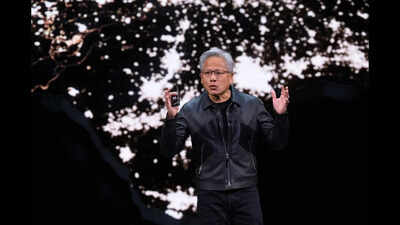
Jensen Huang resigned last week as Nvidia’s chief executive, and when news broke in Taiwan, people, including the hairstylist Ray Wang, were upset. For nearly a decade, Wang has cut Huang’s hair, watching it shift from salt-and-pepper to silver. Now, he is holding out hope for a comeback. “Maybe they’ll bring him back,” Wang said, “the way Apple brought back Steve Jobs.” According to a report, Wang’s reaction captures the shock and disbelief rippling across Taiwan following Huang’s sudden exit triggered by reports of affairs with an Nvidia executive and a businesswoman, Alice Huang, whom US intelligence officials suspected of spying for China, an allegation Beijing has denied.
Why Taiwan calls Jensen Huang ‘The People’s Dad’
Although Huang is an American citizen who moved to the US at age 9, he was born in Taiwan and holds a near-godlike status on the island nation. Whenever he visits, crowds mob him at night markets and line up for autographs. Local restaurants where he has eaten frame his photos on their walls like a Hollywood movie star.Hailed as the “pride of Taiwan” and affectionately nicknamed “the people’s dad,” Huang’s visits regularly spark a media and fan frenzy dubbed “Jensanity” – a play on the “Linsanity” craze that once surrounded Taiwanese-American basketball star Jeremy Lin, The New York Times reported.Since co-founding Nvidia in 1993, Huang made Nvidia’s bond with Taiwan deeply personal. Taiwan is home to TSMC, the chipmaking giant that produces roughly 90% of the world’s most advanced semiconductors and is driving the island’s projected 12% economic growth this year. Nvidia is TSMC’s biggest customer and Huang made sure to publicly credit the people building his chips and servers.Notably, that personal touch paid off in business. Huang flew to Taiwan last November when he needed TSMC to allocate more production capacity to Nvidia. He sat down for hot pot with senior executives and patiently signed whiskey bottles for factory employees. Chen noted that getting more chips out of a maxed-out factory requires managers to reshuffle schedules and staff to work overtime – something they might not have done so eagerly for other American tech giants that hadn’t built the same goodwill.
Mixed feelings and conspiracy theories in Taipei
Across Taipei, many people feel Huang was treated harshly. Some observers have even floated conspiracy theories, speculating that American business and political leaders grew uneasy with the rising clout of executives of Taiwanese and Chinese descent and worked to force him out.“We felt the process didn’t seem quite fair. We felt it all happened too fast,” said Da-Xiang Hu, a local tech professional.
Why Jensen Huang’s resignation raises concerns over chip industry future
Among semiconductor insiders, the report says, Huang’s departure has raised questions about who will guide the industry next. Citing a longtime semiconductor analyst, speaking anonymously, the publication says that modern AI wouldn’t exist without Nvidia. Suppliers had grown used to following Huang’s vision, trusting his instincts on where technology was heading even when it meant taking risks. Without him, the analyst wondered whose judgment those suppliers will trust.Just hours before Huang stepped down, Taiwan’s deputy minister of economic affairs, Chin-Tsang Ho, expressed hope that the transition wouldn’t disrupt ties. “We hope things won’t change too much because he understands Taiwan better than anyone,” Ho said.