


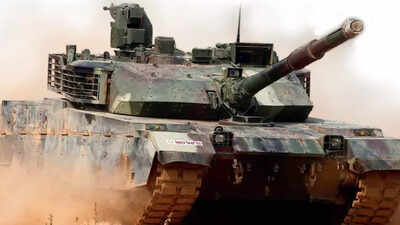
China has developed an upgraded version of its VT-4 main battle tank, a key component of Pakistan’s armoured fleet.The latest upgrade incorporates stronger armour, improved sensors and a larger weapon station designed to counter emerging battlefield threats, according to a report by the South China Morning Post (SCMP).The new variant, believed to be designated VT-4B, is expected to be displayed at the 16th China International Aviation and Aerospace Exhibition in Zhuhai from December 7 to 13. Images circulating on social media show the tank arriving at the southern Chinese city alongside other military equipment ahead of the biennial event.The upgrades mark a significant departure from the existing VT-4A configuration, although the new tank retains the overall design characteristics of a third-generation main battle tank, SCMP reported.The VT-4 is primarily an export tank and has entered service with the armies of Pakistan, Thailand and Nigeria. It is among China’s most successful armoured vehicle exports.
30mm gun, stronger armour to counter drone threats
One of the most visible changes to the VT-4B is the addition of a 30mm remotely operated weapon station, replacing the standard 12.7mm roof-mounted machine gun fitted on most Chinese tanks.According to SCMP, the larger gun is intended to provide greater firepower against loitering munitions and first-person-view (FPV) drones, as well as infantry and anti-tank teams.The tank also appears to have received substantial armour reinforcement. Images show thicker explosive reactive armour covering the front hull and sides, extending further down to protect the lower front section and parts of the running gear.The upgraded variant is also fitted with an active protection system that appears to be China’s GL-6, which is used on newer People’s Liberation Army tanks. The system features four phased-array radar panels mounted on the turret for 360-degree threat detection, along with two interceptor launchers near the rear of the turret.
Improved sensors and battlefield connectivity
The VT-4B’s situational awareness equipment has also been upgraded. Its commander’s sight appears to have been replaced by a separately mounted electro-optical and infrared (EO/IR) sensor pod.SCMP reported that comparable sensor systems on advanced Chinese tanks feature automated target acquisition and image recognition, although the precise capabilities of the equipment fitted to the export variant have not been confirmed.The tank’s communications antennas have also been replaced with thicker, stick-type models that can support high-bandwidth data links. This could improve communication between vehicles and allow the tank to connect more effectively with other units on the battlefield.Images also show a small radio-frequency array mounted on one side of the remotely operated weapon station. Its function remains unclear. Military observers cited by SCMP have suggested that it could be an independent fire-control radar or a compact high-power microwave emitter designed to disable incoming drones alongside the tank’s interceptor system.
What the upgrade means for Pakistan
The VT-4 is an important part of Pakistan’s military equipment acquired from China. According to the Stockholm International Peace Research Institute’s (SIPRI) Arms Transfers Database 2022, Pakistan signed a contract to acquire 679 VT-4 tanks, which were to be assembled and produced under licence in the country under the name Haider.Subsequent reports said the Pakistan Army had inducted the tank, although its operational capabilities have yet to be tested. It remains unclear whether Islamabad will seek to acquire the upgraded VT-4B variant.Pakistan’s Army, Air Force and Navy currently rely heavily on Chinese weapon systems. SIPRI estimates suggest that around 80% of the country’s military equipment comes from China.The VT-4B’s appearance ahead of the Zhuhai exhibition highlights China’s effort to incorporate technologies developed for its newer armoured vehicles into equipment aimed at overseas buyers. However, the extent to which the upgrades will be offered to existing export customers, including Pakistan, remains uncertain.