


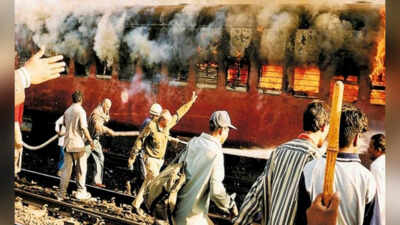
NEW DELHI: Former CBI special director Rakesh Asthana, who led the Gujarat Police investigation into the 2002 Godhra train burning, has rejected a passage in Congress leader Sonia Gandhi’s memoir describing the cause of the fire as “disputed”, maintaining that the investigation and subsequent court proceedings established that it was deliberately set.In an interview with news agency ANI, Asthana said investigators had examined different theories and possibilities before collecting evidence that connected the accused to the crime.He argued that the findings had been upheld by the Nanavati Commission, a Supreme Court-appointed Special Investigation Team (SIT) and the courts.Reacting to the passage in Gandhi’s memoir, Belonging: A Journey of Love, Asthana said, “That is completely wrong, the investigation is authentic. It has been proved in the court of law. Even now, if someone is creating doubt about it, then it is for political reasons; there can be no other explanation for it.”Sonia writes in her memoir, “The riots were triggered when four coaches of the Sabarmati Express were set on fire and 59 pilgrims died. The train was returning to the state capital Ahmedabad from Ayodhya, carrying Hindu karsevaks, volunteers for the Ram temple. The cause of the fire remains disputed, but the turmoil that followed spread to many parts of the state.”Asked whether the doubts were being raised for vote-bank politics, Asthana said the investigation had treated the deaths as a criminal matter, irrespective of the victims’ religion.“All the people who died in Godhra were Hindus. And whoever’s death it may be—whether a Hindu’s, a Muslim’s, a Christian’s, or a Sikh’s—death is death, murder is murder. So we investigated it as a criminal act. But unfortunately, the issue was made out in such a way that an attempt was made to investigate the case to benefit Mr. Modi,” he said.
Asthana says SIT re-examined Gujarat Police investigation
Asthana said the Gujarat Police’s investigation, which began with the CID Crime unit and continued until 2008, was subsequently examined in detail by a Supreme Court-appointed SIT headed by then CBI Director RK Raghavan.He said the Supreme Court constituted the team in 2008, with former Uttar Pradesh director General of Police CB Satpathy also part of the investigation. Satpathy headed the SIT in Raghavan’s absence, Asthana said.The team re-examined the entire investigation, visited the site and questioned the officers who had conducted the original probe.“They examined the entire investigation again. In fact, they examined us as well. We explained to them what investigation we had carried out. They visited the site and examined everything. They then concluded that they could not find any flaw in the investigation conducted by the Gujarat Police,” Asthanan said.He said Raghavan and Satpathy submitted their findings to the Supreme Court, which accepted the report. The subsequent trial proceeded on the basis of the investigation, leading to convictions in 2011, he added.
Nanavati Commission and Banerjee Committee reached different conclusions
Asthana also cited the findings of the Nanavati Commission, constituted by the Gujarat government in 2002 to investigate the Godhra incident and the communal riots that followed.He said the commission, initially headed by Justice KG Shah before Justice Nanavati was appointed in May 2002, examined the train burning and the subsequent riots separately. Its report on the Godhra incident, submitted in 2008, concluded that the fire was part of a pre-planned conspiracy and had been deliberately set, he said.According to Asthana, around 44,000 affidavits were submitted before the commission and more than 1,000 witnesses were examined.He contrasted these findings with those of the committee headed by Justice UC Banerjee, which was constituted by then Railway Minister Lalu Prasad Yadav in 2004. The committee concluded that the fire was accidental and suggested that a stove carried in the karsevaks’ coach had caused it, Asthana said.He added that the Banerjee Committee’s report was challenged before the Gujarat High Court, which held that the committee was illegal because a commission under the Commission of Inquiry Act was already examining the incident. Asthana said the report was subsequently set aside.“The fact is that the investigation established that the fire was deliberate. The commission established it, the Supreme Court-appointed SIT established it, and the courts convicted the accused on the basis of the same evidence,” he said.
Share your thoughts in the comments
Be respectful · TOI community guidelines
59 people killed in Sabarmati Express fire
On February 27, 2002, coach S-6 of the Sabarmati Express caught fire near Godhra railway station in Gujarat, killing 59 people, including women and children. The train was carrying Hindu karsevaks returning from Ayodhya.The incident was followed by communal violence in several parts of Gujarat, in which hundreds of people were killed.In 2011, a special court convicted 31 people in connection with the train burning. The Gujarat High Court in 2014 upheld the convictions of 11 accused while acquitting 20 others.The Supreme Court subsequently upheld the Gujarat High Court’s verdict and dismissed appeals filed by the convicts in the case.