


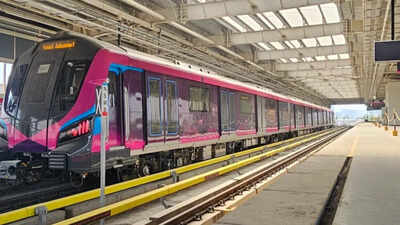
On November 3, Prime Minister Narendra Modi inaugurated and laid the foundation stones for Pune Metro projects worth around Rs 21,800 crore.The project he inaugurated was Line 3 of Pune Metro, popularly known as the Pink Line. Built at a cost of approximately Rs 8,300 crore, the 23.2-km corridor connects Maan, on Pune’s northwestern outskirts, with the District Court Metro station in Shivajinagar, central Pune. Also known as Civil Court station, it serves as an interchange with Line 1 (Purple Line) and Line 2 (Aqua Line), connecting passengers to other parts of the Metro network.PM Modi described the Pink Line as “special”. Beyond the connectivity it offers, the corridor stands out for its distinctive approach to operations, infrastructure development and sustainability.
Why Pune needed the Metro
Over the years, Pune’s population has grown significantly, with people from other parts of Maharashtra as well as outside the state migrating to the city. Pune was home to over 12 lakh people in 1981, according to that year’s national census. The figure rose to more than 31 lakh in 2011, the latest national census, meaning the city added around 19 lakh people in 30 years – an increase of nearly 160%.Migration to Pune and the subsequent population expansion have largely been driven by the growth of its IT, manufacturing and educational sectors. Pune is counted among India’s leading IT hubs, alongside Bengaluru and Hyderabad. Several prominent colleges and universities are also located in the city, further contributing to its growing population and demand for public transport.Against this backdrop, the foundation stone for the first phase of Pune Metro, comprising the Purple and Aqua lines, was laid in December 2016. The network’s commercial operations commenced in March 2022.Although the launch of Pune Metro improved connectivity, several important areas remained outside its network, limiting its reach. The Pink Line addresses part of this gap by connecting Hinjawadi to the existing Metro network.The significance of the Pink Line extends beyond it being just another corridor of the Pune Metro network. Before the route opened to the public on November 4, a day after its inauguration, the network had no connectivity to Hinjawadi, one of Pune’s largest employment centres and a major IT hub. The area houses offices of major technology companies such as Infosys, Tata Consultancy Services, Wipro and Cognizant.

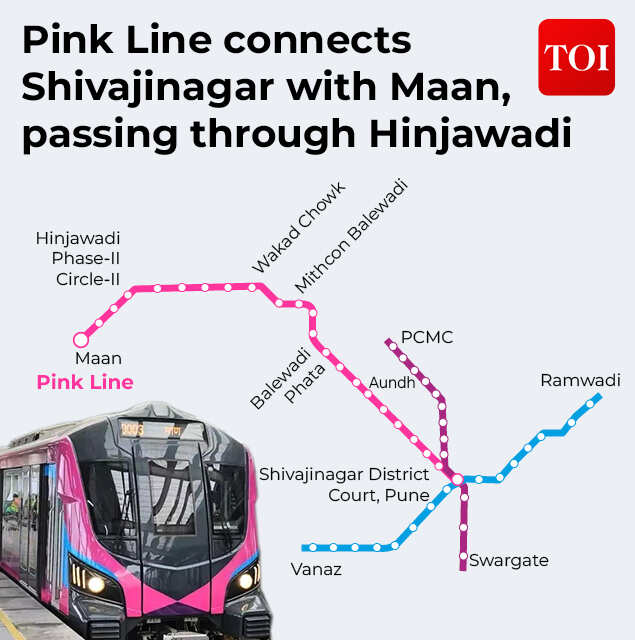
Pune Metro’s Pink Line is the network’s third corridor to open and the first to pass through Hinajwadi, the city’s IT hub
The Purple Line, which runs between Pimpri-Chinchwad and Swargate, and the Aqua Line, connecting Vanaz and Ramwadi, were the only two operational corridors at the time. As a result, software professionals living in other parts of Pune had to rely on road transport to commute to Hinjawadi or relocate closer to their workplaces.With 17 of the corridor’s stations now operational and the remaining six scheduled to open in March 2027, commuters can interchange at District Court station in Shivajinagar and travel directly to Hinjawadi, making daily commutes more seamless.

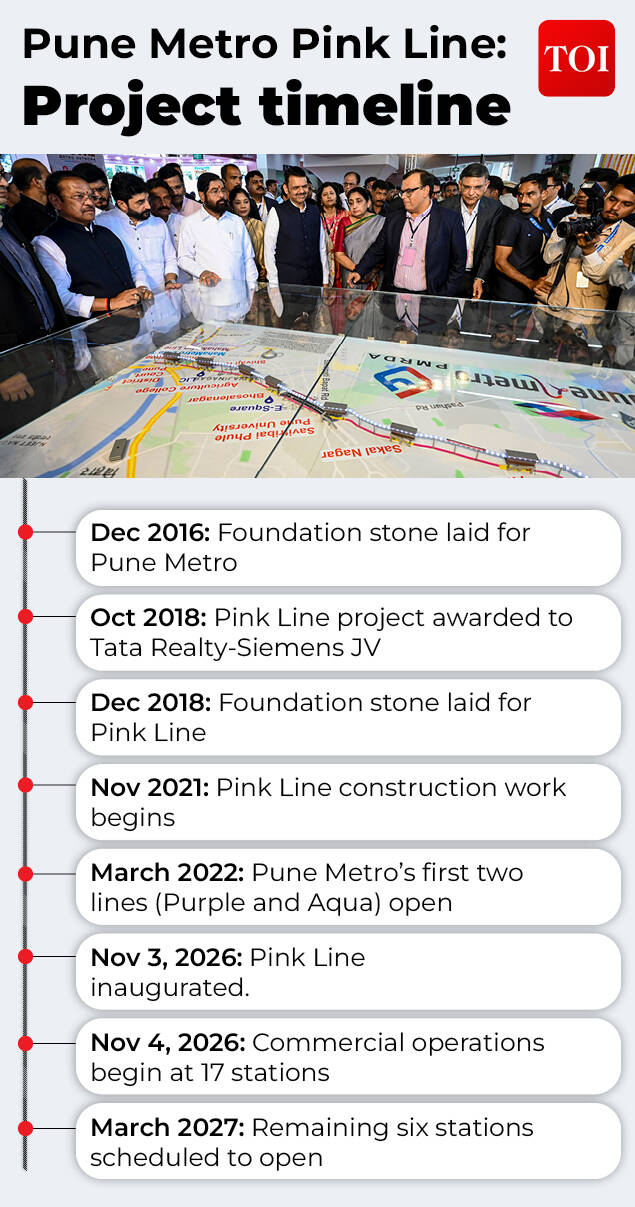
Pune Metro’s Pink Line: A timeline of the project
Commuters have also expressed hope that the Pink Line will ease congestion on roads leading to Hinjawadi.“The entire stretch from Wakad to Hinjawadi Phase-II remains busy and chaotic during rush hours. We expect relief from these snarls,” a commuter told The Times of India in an earlier report.Another commuter, who travels by bike to his workplace at Balewadi near Hinjawadi, noted that the Metro journey took nearly as much time as his two-wheeler commute but offered greater comfort.“My travel time by bike would be around 30-45 minutes, depending on the traffic. It took about 30 minutes to reach Balewadi by Metro. There was no huge drop in the travel time, but the overall comfort in Metro was much more,” he added.Another important feature of the Pink Line, officials say, is its provision for last-mile connectivity through bus services, dedicated pickup zones for taxis and auto-rickshaws, and cycle parking at stations.With the Pink Line now open, the Aqua and Purple lines being expanded, and a fourth corridor taking shape, the focus will increasingly be on integrating the expanding Metro network with other transport modes to improve connectivity across Pune.
Why the Pink Line matters
In October 2011, a woman loco pilot, Priyanka N, drove the inaugural train of Namma Metro in Bengaluru. Since then, several Metro networks across the country have employed women as train operators.However, Pune has taken this a step further by introducing an entire Metro corridor where all train drivers are women.While other Metro networks in India, including Delhi and Bengaluru, also have corridors designated as the Pink Line, Pune’s newest Metro corridor has a special significance attached to the name. Maharashtra chief minister Devendra Fadnavis said the corridor would be called the Pink Line because its trains would be operated exclusively by women.

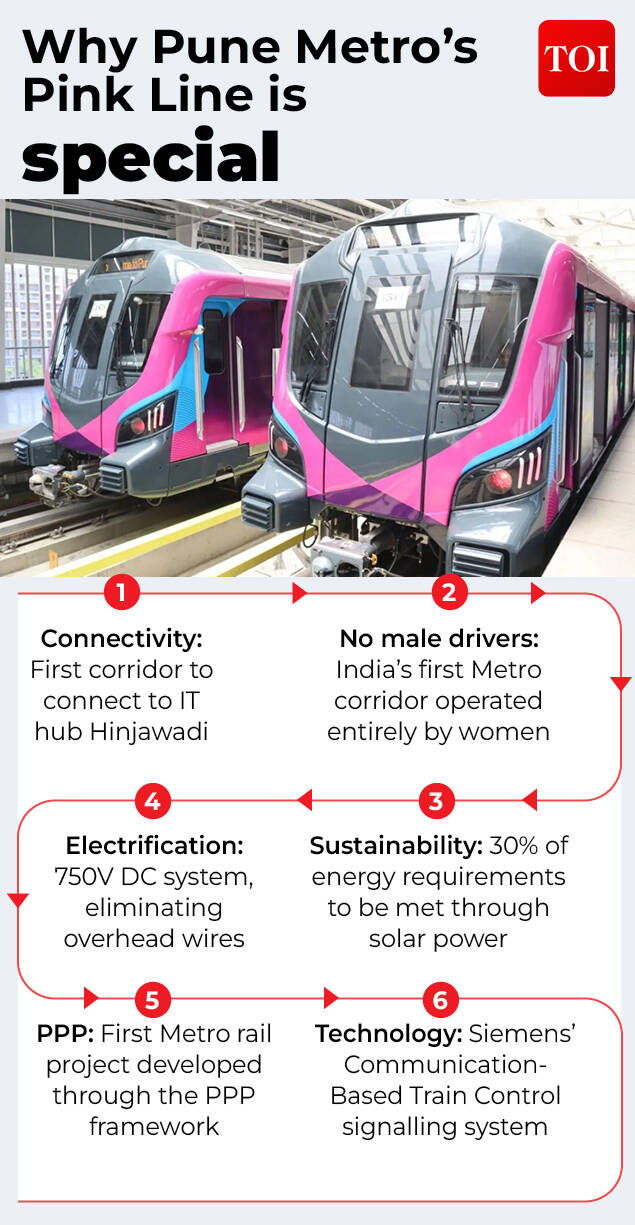
What makes Pune Metro’s Pink Line special
Nearly 15 years after Priyanka N drove the first Namma Metro train, Pune Metro’s Pink Line has become India’s first Metro corridor to have an all-women team of train drivers.As many as 90 women have completed training and obtained competency certificates to operate trains on the Hinjawadi–Shivajinagar route. Recruited through campus drives, they underwent classroom instruction, practical sessions and extensive on-track training before being cleared to operate passenger services. The women have since taken charge of regular train operations on the corridor.Overall, the plan is to have 100 women operators on the line, including the 90 already operating trains on it.Having an entire Metro corridor with women at the controls also marks a significant step towards greater representation of women in operational roles in urban rail transport.
A Metro corridor powered partly by solar energy
Another important feature of Pune Metro’s Pink Line is that 30% of its energy requirements are expected to be met through solar power. The project also uses a 750V DC third-rail electrification system, which eliminates the need for overhead wires.Tata Power Renewables has received a contract from Pune IT City Metro Rail Ltd, which operates Pune Metro Line 3, to install a 7.67 MWp rooftop solar project. The installation will cover all 23 stations and the Metro depot. The electricity generated will be used for captive consumption. The project is expected to help reduce the corridor’s operating costs and dependence on conventional sources of electricity.

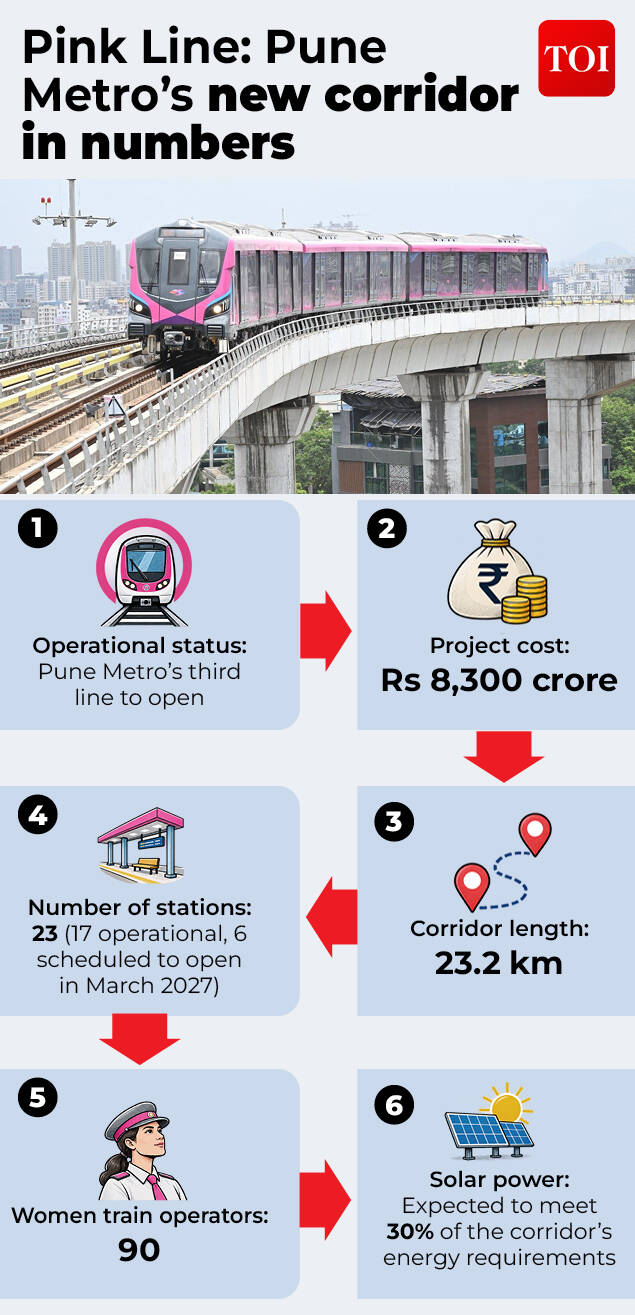
Pune Metro’s Pink Line in numbers
With this, Pune Metro joins several transport projects in India, including other Metro systems, that use solar power. For instance, as of 2023, 35% of Delhi Metro’s total energy consumption came from renewable sources. This included 30% from its off-site solar power plant in Rewa, Madhya Pradesh, 4% from rooftop solar panels and 1% from the waste-to-energy plant in Ghazipur, Delhi.Outside the Metro network, Cochin International Airport in Kerala became the world’s first airport to run entirely on solar power with the commissioning of a 12 MWp solar PV power plant in 2015.The solar power component, therefore, adds another dimension to the Pink Line’s approach to energy use and operational efficiency.
India’s first Metro project under the 2017 Metro policy’s PPP framework
The Pink Line is also significant for the model through which it has been developed. It is India’s first Metro rail project to be implemented under the public-private partnership (PPP) framework of the Centre’s New Metro Rail Policy, 2017, which aims to encourage private investment in transport infrastructure.While cities such as Mumbai and Hyderabad have previously developed Metro projects under PPP models, Pune’s Pink Line is the first to be implemented under the framework of the 2017 policy.The project was developed by Pune IT City Metro Rail Limited, a special-purpose company established as a joint venture between TRIL Urban Transport Private Limited, part of the Tata Group, and Germany’s Siemens, in collaboration with the Pune Metropolitan Region Development Authority.Another technological feature of the Pink Line is its Siemens-supplied Communication-Based Train Control (CBTC) signalling system. While the existing Purple and Aqua lines also use CBTC systems, these are supplied by France’s Alstom.According to Siemens, its CBTC system allows trains to communicate continuously with trackside equipment, enabling high-frequency services while maintaining safe distances between trains. It is designed for semi-automated operations, with provision for a future upgrade to fully automated, driverless operations.The technology adds to the corridor’s operational capabilities while leaving scope for greater automation in the future.
Beyond Metro connectivity
Despite these features and the integration of Hinjawadi into the Metro network, several challenges remain in improving the overall commuting experience in the city, experts say.For instance, despite the Pink Line reportedly recording a ridership of around 50,000 on its very first day, some passengers raised concerns about gaps in first- and last-mile connectivity.According to Tanzeel Allapur, programme associate at Parisar, a Pune-based NGO working on sustainable urban transport since 1995, the administration cannot limit its idea of a good commuting experience to building new Metro lines alone and must focus on improving connectivity to and from Metro stations.“Finding a connecting bus or shared auto, figuring out where to board, and navigating the surroundings of a Metro station all add to the mental effort involved in making that journey. The administration needs to focus on reducing both the physical friction and the cognitive load involved in these transfers,” she told The Times of India.Echoing this view, Jagannarayan Padmanabhan, senior director at Crisil Intelligence, stressed the importance of seamless connectivity rather than simply adding more routes.“Seamless connectivity with PMPML buses, feeder services, autos and shared mobility, supported by integrated ticketing and pedestrian infrastructure, is essential,” he added.Although it is still early days for the Pink Line, improved connectivity and integration with other modes of transport could further build on the benefits it brings to Pune’s public transport network.
Share your thoughts in the comments
Be respectful · TOI community guidelines
The way forward for Pune Metro’s Pink Line
Looking ahead, transport activist Ranjit Gadgil, who heads Parisar, said that with the Pink Line now operational alongside the two existing corridors, authorities must introduce measures to curb private vehicle use to reduce congestion, pollution and road accidents.“With the addition of the Pink Line to the existing two corridors, it is high time the city started implementing measures to curb vehicle use. These could include on-street parking charges, low-emission zones and street designs that prioritise the safety and movement of pedestrians, cyclists and buses rather than allocating more space to motor vehicles,” he added.Ultimately, the Pink Line offers Pune an opportunity to make public transport a more convenient choice for commuters. Its connectivity to Hinjawadi, in particular, could encourage more people working in the IT hub to consider the Metro for their daily journeys.But the real measure of the Pink Line’s success will be whether it can persuade more people to leave their cars and two-wheelers behind and make public transport their preferred choice.