


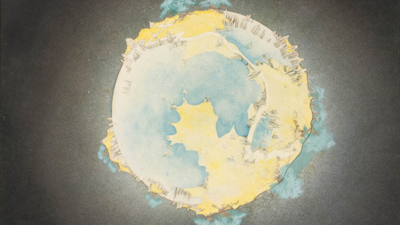
For more than five decades, millions of music fans saw the fantastical miniature planet on the cover of British rock band Yes’ 1971 album ‘Fragile’, but the original painting behind the iconic image had disappeared. Now, the artwork has been reunited with its creator, British artist Roger Dean, after being missing for nearly 50 years. According to Heritage Auctions and the band’s official website Yesworld, the original painting will be offered at auction on December 2, 2026, with an estimated value of £75,000 (approximately $100,000). The artwork was recovered following an investigation by Art Recovery International and returned to Dean in September 2026.The painting, which helped establish one of progressive rock’s most recognisable visual identities, had disappeared from Dean’s Brighton studio sometime between the mid and late 1970s. Its whereabouts remained unknown for decades, even as the album cover became familiar to music lovers around the world.
How the original painting went missing for nearly 50 years
Dean had originally kept the painting at his Brighton studio, where it was stored alongside thousands of his other works, including more than 5,000 drawings and around 400 paintings. According to Art Recovery International, the disappearance was not immediately recognised as a theft. It was only during a comprehensive inventory conducted around the Covid pandemic that Dean began to suspect the original artwork had been stolen.Over the years, several collectors had approached the artist claiming to possess the original ‘Fragile’ cover painting. However, their claims were dismissed until 2021, when one collector sent Dean an image of the artwork that raised concerns.The collector reportedly claimed to have acquired the painting in 1985 from a well-known London-based dealer in rock-and-roll memorabilia. Initial attempts to secure its return were unsuccessful, prompting Dean to report the matter to police and seek help from Art Recovery International, an organisation specialising in the recovery of stolen artworks.Its founder, Christopher A Marinello, an attorney specialising in art recovery, led negotiations to retrieve the painting. After approximately two weeks of negotiations, the organisation secured its return under a confidential settlement agreement. The original was finally reunited with Dean in September 2026, more than half a century after he had last seen it.Speaking about the reunion, Dean said he was excited and curious about whether he would immediately recognise the painting. He said he did recognise it, although he noticed changes after so many years. Describing the experience, he said it looked as it should, adding that it was “magical really”.
The unusual story behind the Fragile album cover
Released in November 1971 in the UK, ‘Fragile’ was Yes’ fourth studio album and marked an important turning point in the band’s career. It was the first Yes album to feature keyboardist Rick Wakeman and also the beginning of a long-running artistic partnership with Dean, whose imaginative landscapes would become closely associated with the band’s identity.The album reached the fourth position on the US Billboard album chart and helped establish Yes as an internationally recognised progressive rock band. Dean subsequently designed several of the group’s album covers, its distinctive logo and elements of its stage designs.The concept behind the ‘Fragile’ artwork was not a conventional illustration of something delicate or breakable. Dean developed a creation myth with his brother, centred on a child who dreams that their planet is breaking apart. In the story, the child builds an ark to carry family, friends and fragments of the planet in search of a new home. Dean described the idea as a story of evolution and renewal rather than destruction. The fractured planet was imagined as a source from which a new world could eventually emerge.The original painting measures 17.5 by 17.5 inches and was created using watercolour, gouache, spray paint, pencil and collage. One of its most distinctive features is the miniature landscape on the central globe, which contains tiny trees resembling bonsai.When Dean was reunited with the artwork, he recalled being particularly fond of the miniature trees and explained that he had deliberately painted them around the edges of the planet. The original also contains an interesting difference from the familiar album sleeve. The spaceship or ark visible on the finished cover was not part of Dean’s original painting. It was added later during the album’s production process.Another detail emerged when the artist examined the reverse of the recovered painting. It contained what appeared to be an earlier attempt at the composition, including the faint outline of a planet. Dean suggested that he might initially have intended this side to be the front before deciding to turn the board over and develop the final image on the opposite side.
A December auction
The recovered painting is expected to become a major attraction at Heritage Auctions’ Entertainment and Music Memorabilia Signature Auction on December 2. The estimated value is £75,000, with a starting bid of £37,500. According to Heritage Auctions, this is the first time an original album-cover painting from Dean’s celebrated 1970s collaboration with Yes has been offered at auction. The sale therefore represents a rare opportunity for collectors to acquire the actual artwork behind one of progressive rock’s most recognisable album covers.Following its recovery, Dean signed the reverse of the painting in blue watercolour crayon and silver ink, adding two new inscriptions to the historic work. The artist has also indicated that he would be open to discussing restoration or touch-ups, depending on the preference of its eventual buyer. The recovery has also drawn attention to the work of Art Recovery International. Marinello said bringing an artwork of such cultural significance back after more than 50 years was a remarkable outcome. He described its return to Dean as an important step in closing a chapter in the painting’s history.For generations of Yes listeners, the fantastical world on ‘Fragile’ has been inseparable from the band’s music. Now, after decades of uncertainty, the original painting is set to enter a new chapter, this time as a rare piece of music and art history available to collectors.