


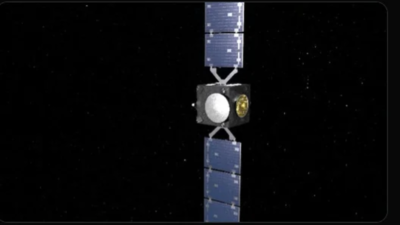
Humanity’s first attempt to deliberately change the motion of an asteroid has entered a crucial new phase, with a European spacecraft reaching the site of NASA‘s historic collision to investigate what happened beneath the debris. According to the Associated Press, the European Space Agency’s (ESA) Hera spacecraft has begun close inspections of the Didymos asteroid system and its smaller moonlet Dimorphos, which NASA deliberately struck in September 2022 as part of a planetary defence experiment. The spacecraft is currently observing the pair from approximately 25 to 30 kilometres away, gathering data that could help scientists determine whether deliberately crashing spacecraft into threatening asteroids can become a reliable way to protect Earth.The mission follows NASA’s Double Asteroid Redirection Test (DART), which made history on September 26, 2022, when a spacecraft deliberately slammed into Dimorphos at approximately 22,000 km per hour. The collision was designed to test whether the force of a spacecraft hitting an asteroid could alter its movement, potentially providing humanity with a way to redirect space rocks that might otherwise collide with Earth.
What happened when NASA deliberately hit an asteroid?
Dimorphos is approximately 151 metres wide and orbits a much larger asteroid called Didymos, which measures around 780 metres in diameter. The two form a binary asteroid system, meaning the smaller object revolves around the larger one. Scientists selected the pair because their orbital relationship made it possible to measure the effects of the collision without having to send another spacecraft to observe the impact.NASA’s DART spacecraft, weighing approximately 580 kg at the time of impact, was directed towards Dimorphos on September 26, 2022. Travelling at approximately 6.1 kilometres per second, it struck the asteroid in what became the first full-scale demonstration of a kinetic impactor being used to change the motion of a celestial object. The results exceeded the mission’s initial expectations. Before the collision, Dimorphos took approximately 11 hours and 55 minutes to complete one orbit around Didymos. Following the impact, observations from telescopes on Earth confirmed that its orbital period had shortened by approximately 33 minutes.NASA initially reported a 32-minute change in October 2022, before subsequent measurements established a more precise reduction of 33 minutes, with an uncertainty of approximately one minute. The agency had defined a change of at least 73 seconds as the minimum threshold for mission success.The collision also produced a spectacular cloud of debris. Material thrown off Dimorphos extended more than 10,000 kilometres into space, while observations identified 37 metre-sized boulders that had been displaced from the asteroid. The material ejected during the collision is particularly important because it appears to have amplified the force of the spacecraft’s impact.
Why has Europe sent another spacecraft to the asteroid?
Although DART successfully changed Dimorphos’ orbit, the experiment left scientists with several unanswered questions. They know the collision altered the asteroid’s movement, but understanding exactly how the impact changed its physical structure is essential before the technique can be used in a real planetary emergency.This is where ESA’s Hera mission comes in. Launched in October 2024, the spacecraft has travelled through deep space to reach the Didymos system in November 2026. Its primary objective is to conduct a detailed investigation of the aftermath of the DART collision, measuring the asteroid’s mass, composition, internal structure and the physical consequences of the impact.According to ESA’s November 11 update, Hera has entered an early characterisation phase, maintaining a distance of approximately 25 to 30 kilometres from the asteroid pair. It is using this stage to collect broader observations of the two objects and determine how Dimorphos looks after being struck by NASA’s spacecraft.The spacecraft is expected to move closer, to approximately 20 kilometres, as it enters its more detailed investigation phase in December. Scientists will examine whether DART created a distinct crater or dramatically reshaped the asteroid’s surface. They also want to understand how much material was thrown into space and how the asteroid’s internal structure influenced the impact.Hera’s observations are particularly important for calculating what scientists call the momentum enhancement factor, or beta. It measures how effectively an impact transfers momentum to an asteroid, including the additional push produced when material is blasted away from its surface. A spacecraft does not simply transfer its own momentum to the target; the ejected debris can provide an additional force in the opposite direction.The mission will also deploy two smaller spacecraft, called CubeSats, named Juventas and Milani. These miniature probes will conduct closer investigations of the asteroid pair. Juventas is equipped with radar technology to investigate Dimorphos’ internal structure, while Milani will study its surface composition and dust environment. The probes are also expected to approach and potentially land on Dimorphos after completing their observations.
Could this experiment save Earth from an asteroid collision?
The wider objective of the DART-Hera partnership is to establish whether the kinetic impact method can become a dependable planetary defence strategy. Scientists believe that if an asteroid heading towards Earth is detected sufficiently early, a spacecraft could potentially be sent to collide with it and gradually alter its trajectory.Even a relatively small change in an asteroid’s movement could become significant over time, provided the intervention happens early enough. However, the success of such an operation would depend on several factors, including the asteroid’s size, mass, composition, internal structure and the amount of time available before a potential collision.NASA has also reported that DART’s impact slightly changed the orbit of the entire Didymos system around the Sun, in addition to changing Dimorphos’ movement around its larger companion. Research published in March 2026 found that the system’s roughly 770-day orbit around the Sun had changed by a fraction of a second, offering further evidence that a kinetic impact can influence an asteroid’s trajectory.