


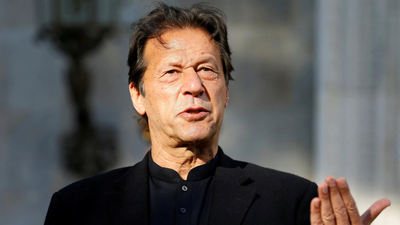
Is Pakistan witnessing the first signs of a possible thaw between jailed former prime minister Imran Khan and the country’s powerful military establishment? The release of two of his sisters and his recent hospital visit for eye treatment have come amid speculation that a political settlement involving Army Chief Field Marshal Asim Munir has taken place.His sisters, Uzma Khan and Noreen Niazi were released on Thursday from Lahore’s Kot Lakhpat Jail after the Punjab government withdrew their extended detention orders. The two had spent 53 days in custody after being detained ahead of a Pakistan Tehreek-e-Insaf (PTI) protest march. Their sister Aleema Khan remains behind bars.The release came a day after Imran Khan was taken from Adiala Jail to Islamabad’s Pakistan Institute of Medical Sciences for an eye examination and treatment. Doctors administered an injection for an issue affecting his right eye, besides treating his blood pressure. He was discharged in the early hours of Thursday and returned to prison.The developments have coincided with renewed speculation about a possible deal involving Khan and the military establishment. Pakistan interior minister Mohsin Naqvi, however, dismissed reports of any behind-the-scenes arrangement on Thursday, saying Khan and his family would receive whatever relief the courts granted them.
PTI ready to make peace?
The possibility of a rapprochement is not entirely new. In August, one of Imran Khan’s closest aides, PTI spokesperson Zulfikar Bukhari, had told Reuters that the former prime minister would not confront the military if released.“If Imran Khan was released tomorrow, hypothetically, he wouldn’t do anything that would effectively damage the country,” Bukhari had said, describing him as “magnanimous”.He had also suggested that Munir could take the initiative to ease tensions, saying the army chief could extend a “healing hand” to the country.“That doesn’t mean you go loggerheads with the establishment, with the military leader,” Bukhari said, adding that personal grievances could be set aside in the national interest.The remarks marked a notable shift in the PTI’s public rhetoric after years of confrontation with the military establishment following Khan’s ouster in a no-confidence vote in 2022.Bukhari, however, had mentioned that there were no talks between the PTI and the military. He also acknowledged that it was unclear whether Khan himself shared the willingness to reconcile being expressed by party leaders outside prison.
Nawaz Sharif, Benazir Bhutto precedent
The latest speculation has also been fuelled by opposition leader Mahmood Khan Achakzai’s claim in October that Khan could be facing pressure to accept an arrangement similar to those involving former prime ministers Nawaz Sharif and Benazir Bhutto.Sharif left Pakistan in 2000 after being ousted and imprisoned following the military coup led by General Pervez Musharraf. Bhutto spent years abroad in self-imposed exile after her government was dismissed in 1996.Achakzai alleged that the ruling Pakistan Muslim League-Nawaz and Pakistan Peoples Party were part of a political arrangement that could pave the way for a similar outcome in Khan’s case. However, he did not establish that any such agreement had been reached.An exile arrangement could potentially offer a way out of the prolonged confrontation, but there is no confirmation that Khan has agreed to leave Pakistan or that negotiations with Munir are under way.
Why a deal may not be straightforward
Imran Khan’s relationship with the military establishment deteriorated after disagreements over key appointments and foreign policy. He has accused the military leadership, including Munir, of orchestrating his removal. The military denies interfering in politics.Despite being in prison since August 2023, Khan remains the central figure in Pakistan’s political confrontation. His party continues to demand his release, access to family members and lawyers, and relief in the cases against him.The PTI’s position also raises a crucial question: can its leadership outside prison negotiate or signal a compromise without Khan’s explicit approval? Bukhari’s August remarks came with the caveat that the former prime minister’s own thinking might be different.For now, the signals remain contradictory. Two members of Khan’s family have been released, he has received medical treatment, and a senior PTI aide has previously spoken of reconciliation. But the government has denied any political bargain, and there is no evidence of direct negotiations with Munir.Whether the latest developments represent isolated legal and medical decisions or the beginning of a fresh political opening remains the question.