


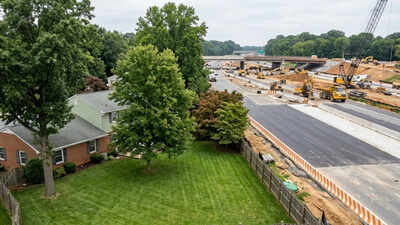
A Virginia couple who wanted additional compensation for the impact of a highway expansion on their property have lost their legal battle. An appeals court has ruled that they cannot claim losses caused by the wider road project when the government had temporarily acquired only a small section of their land.According to Find Law, Omar Mohammad El-Rashed and Eliana Eyad Albelbaisi owned a home in McLean, Virginia, near Interstate 495 (I-495). In March 2023, the Virginia Department of Transportation (VDOT) began proceedings to use a portion of their property temporarily for construction work.The land involved was a narrow strip at the back of their home, covering 1,458 square feet. VDOT offered $29,700 for its temporary use, including compensation for trees and vines. The couple accepted the payment but continued to argue that the amount did not cover the financial impact of the project on their property.Their appraiser, Dennis Gruelle, estimated that the highway expansion and the temporary acquisition together could reduce the property’s value by almost $500,000. The couple wanted this estimate considered while determining their compensation.However, the Court of Appeals of Virginia upheld the lower court’s decision to exclude the larger damages claim. In its November 10 ruling, the court said the compensation had to relate to the land actually acquired and the effects directly caused by its temporary use. It also rejected the couple’s request for legal fees and costs.
Dispute began over a small strip of land
Before the expansion, the section of I-495 near the couple’s home had eight lanes. A sound wall and a wooded area stood between the highway and their property. VDOT owned land next to the couple’s parcel, with trees on both sides of the boundary.The department sought temporary rights over a strip less than 10 feet wide behind the house. The 1,458-square-foot area was required for construction activities involving slopes. VDOT valued its use at $29,700, of which $28,200 was for the temporary construction easement and $1,500 covered natural trees and vines.The couple believed the offer was insufficient. They initially argued that the land’s rental value over an estimated five-year period was $50,495. They also placed the value of the landscaping taken by VDOT at $3,000, bringing their estimate for the easement itself to $53,495.Their appraiser also considered the possible impact on the entire residential property. He attributed the estimated reduction of almost $500,000 to the removal of trees, the rebuilding of the sound wall closer to the house and the new highway lanes being closer to the property.The Commissioner of Highways opposed this larger estimate. The department argued that the couple could seek compensation for the temporary acquisition, but could not include losses arising from the entire I-495 expansion.
Lower court blocks wider project damages
The dispute went before a circuit court, where the Commissioner asked the judge to prevent Gruelle from presenting his nearly $500,000 estimate.The department’s position was that the government had acquired only a temporary right to use a small portion of the property. The wider highway construction was a separate matter, and the claimed reduction in the home’s value was not directly linked to the land acquired.The circuit court accepted this argument. It allowed evidence about losses connected to the temporary easement but excluded the appraiser’s assessment of the wider project’s impact.The court also ruled that the couple could not seek compensation for effects such as noise, dust, vibration and the loss of trees from land already owned by VDOT when those effects were linked to the larger construction project.Following this decision, the couple obtained another assessment from Gruelle. He calculated that disruption directly associated with the temporary easement, including noise, dust, vibration and the use of other parts of their property to reach the construction area, could reduce the remaining property’s value by $124,850, or five per cent.However, the department also challenged this revised estimate. Before the circuit court ruled on that challenge, both sides reached an agreement. They fixed compensation for the temporary easement at $29,700, while allowing the couple to appeal the earlier decision excluding their wider damages claim.
Appeals court explains why additional damages were rejected
The couple argued that compensation should account for the full I-495 project rather than just the temporary use of their land. They relied on Virginia’s rules for calculating the value of acquired property and damage to the land that remains with its owner.The appeals court disagreed. It said the central issue was the connection between the government’s acquisition and the losses claimed by the couple.Under Virginia law, compensation can cover damage to the remaining property when that damage results from the acquisition. But the judges found that the couple’s larger claim arose mainly from the highway expansion, not from the temporary easement itself.The court also examined whether the claimed effects were specific to the couple’s property. It found that the wider project’s impact, including construction noise and changes affecting nearby properties, could also be experienced by other landowners in the area.The judges distinguished these effects from disruption caused directly by VDOT’s temporary use of the acquired strip. They said the couple had already received compensation for losses associated with that temporary use under their agreement.The ruling did not mean that every form of damage to the remaining property was excluded. The court noted that direct physical damage caused by the department’s use of the acquired land, such as damage to the house or landscaping, could qualify for compensation.However, the couple’s appeal concerned losses attributed to the highway project as a whole. The court found that these did not meet the legal requirements for additional compensation in this case.El-Rashed and Albelbaisi also asked the appeals court to reimburse the legal expenses they had incurred while pursuing higher compensation.The judges rejected this request because the couple had not established a contractual, statutory or other legal basis for recovering those costs.