


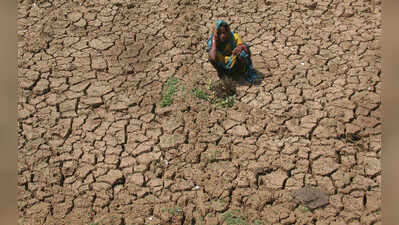
Bhubaneswar: Odisha could witness a sharp rise in drought vulnerability and population exposure over the next few decades, with moderate and severe drought exposure projected to increase by 72% to 103% by mid-century, according to a new study by Rajkumar Guria and Manoranjan Mishra of Fakir Mohan University.The research highlights how climate change and population growth together could reshape drought risks across the state, particularly in western, southern and central districts. Published in the Nov issue of the journal Physics and Chemistry of the Earth, the study used different models to assess future drought patterns in Odisha under different climate scenarios.Researchers developed a new Graph-based Vulnerability Propagation Model (GVPM) to understand how drought impacts spread across interconnected regions rather than remaining confined to individual districts.The study found that population exposure to moderate drought could rise by 77.7% under the SSP2-4.5 scenario (where emissions plateau by 2050) and 72.4% under the SSP5-8.5 scenario (where emissions double from current levels by 2050, continuing to climb) during 2025-2062. Exposure to severe drought could increase by 102.6% and 86%, respectively, over the same period. Population growth is likely to be the biggest driver behind the increase in drought exposure, particularly in urban and densely populated districts, said Mishra.The analysis revealed that southwestern Odisha will remain particularly vulnerable. Districts such as Koraput, Rayagada and Kalahandi emerged as persistent “super hubs” that may play a critical role in the propagation of drought conditions across the state. Meanwhile, Boudh, Angul and Nayagarh were identified as “bridge hubs” that could facilitate the transmission of drought impacts between otherwise unconnected regions.Researchers observed that drought connectivity across Odisha is likely to strengthen under future climate conditions, with synchronised drought patterns expanding towards northern and central districts. The study suggests that northern districts, including Keonjhar and Mayurbhanj, may become increasingly important in the state’s future drought network.“One of the key findings is the projected expansion of highly vulnerable areas. Regions classified as having high-to-very-high drought vulnerability could increase from 18.2% of Odisha’s geographical area during the historical period to 40.1% under the high-emissions SSP5-8.5 scenario during the mid-century period,” said another researcher, Guria. The western undulating zone, western central tableland and Eastern Ghat highlands are expected to remain the most drought-prone agro-climatic regions, he added.The study also identified Cuttack, Khurda, Puri, Angul, Boudh, Balangir, Subarnapur and Nayagarh as persistent hotspots of population exposure due to a combination of population concentration and climate risks. Moderate drought probability is projected to rise in future decades, while severe droughts may intensify during the mid-century period before showing signs of moderation later in the century.The researchers said the findings underscore the need for targeted adaptation measures, including drought-resilient crops, watershed-based groundwater recharge, improved water management and early-warning systems.However, they cautioned that the GVPM framework has not yet been validated against historical drought impact data and should be treated as a diagnostic assessment of future vulnerability rather than an operational forecasting tool.