



NEW DELHI: For couples who struggle to conceive naturally, starting a family can become a journey marked by medical consultations, uncertainty and emotional stress. Advances in reproductive medicine have made it possible for many to explore alternatives when pregnancy does not happen through natural conception.One of the most widely known options is in vitro fertilisation (IVF), a form of assisted reproductive technology (ART) that helps eggs and sperm meet outside the human body.

Does IVF guarantee pregnancy? What are the risks?
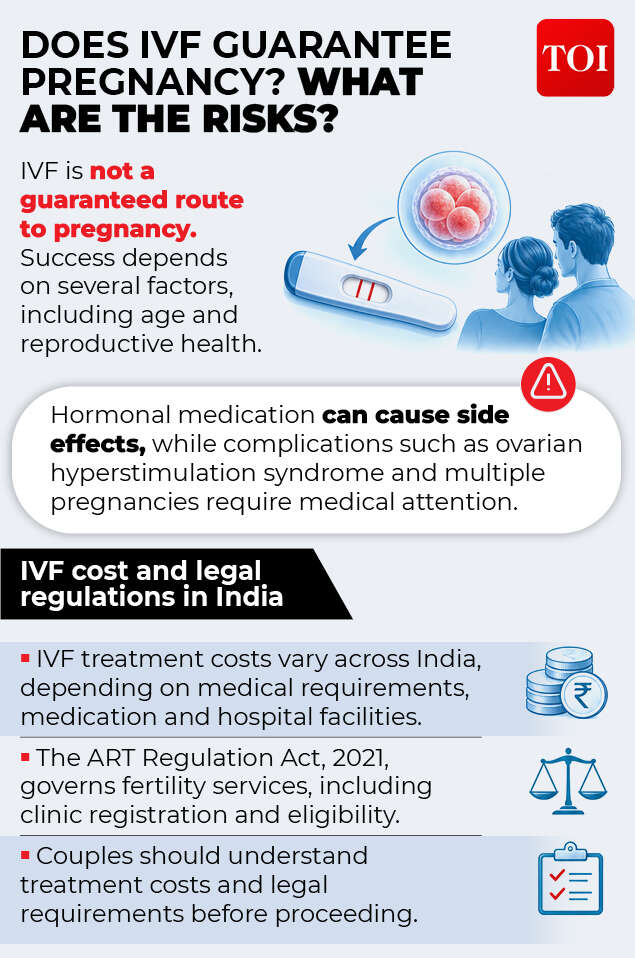
Commonly known as the test-tube baby procedure, IVF has helped many couples experiencing fertility problems pursue parenthood. However, the treatment is not a guaranteed route to pregnancy. It involves several medical procedures, hormonal medications, laboratory work and careful monitoring. Some patients conceive in their first cycle, while others may need multiple attempts.Understanding how IVF works, who may benefit from it, its success rates, possible complications and financial implications can help couples make informed decisions.
What is IVF and how does it work?
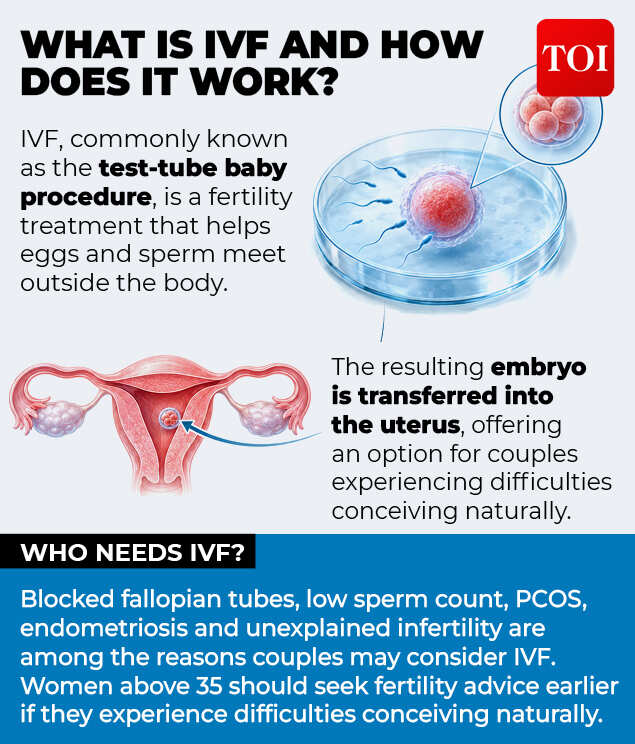
In vitro fertilisation is a fertility treatment in which a woman’s egg and a man’s sperm are combined in a laboratory to create an embryo. The resulting embryo is then transferred into the woman’s uterus, where it may implant in the uterine lining and develop into a pregnancy.

What is IVF and how does it work?
The term ‘in vitro’ refers to a process taking place outside the living body, in a controlled laboratory environment. Unlike natural conception, where fertilisation usually occurs inside the fallopian tube, IVF allows fertilisation to take place in a laboratory.The treatment involves collecting mature eggs from the ovaries, obtaining sperm, fertilising the eggs and monitoring the development of embryos before transferring one into the uterus.According to a report on IVF, the procedure generally involves ovarian stimulation, egg retrieval, fertilisation, embryo culture and embryo transfer. The exact treatment plan, however, depends on the patient’s medical condition, age and reproductive health.
Why do couples opt for IVF?
IVF may be recommended when a couple has difficulty conceiving because of underlying fertility problems or when other treatments have not been successful.Some of the common medical conditions that may lead doctors to recommend IVF include:
- Blocked or damaged fallopian tubes: When the fallopian tubes are blocked or damaged, the egg and sperm may not be able to meet naturally.
- Male-factor infertility: Low sperm count, poor sperm movement or abnormalities in sperm function can affect fertilisation.
- Ovulation disorders: Conditions such as polycystic ovary syndrome (PCOS) can interfere with regular ovulation and make conception difficult.
- Endometriosis: This condition can affect reproductive organs and interfere with fertility.
- Diminished ovarian reserve: A reduction in the number of available eggs can make conception more difficult.
- Unexplained infertility: Sometimes, medical investigations do not identify a clear reason why a couple is unable to conceive.
- Previous unsuccessful fertility treatments: IVF may be considered when other fertility treatments have not resulted in pregnancy.
Age is another important consideration. Female fertility gradually declines with age, particularly after 35, as both the quantity and quality of eggs decrease. This can affect the chances of natural conception as well as the outcome of fertility treatment.

What are the Stages of IVF?
A report on IVF and fertility treatment notes that couples should consider seeking medical advice after 12 months of unsuccessful attempts to conceive through unprotected intercourse. Women above 35 are advised to seek consultation after six months rather than waiting longer.
What happens during an IVF cycle? A step-by-step guide
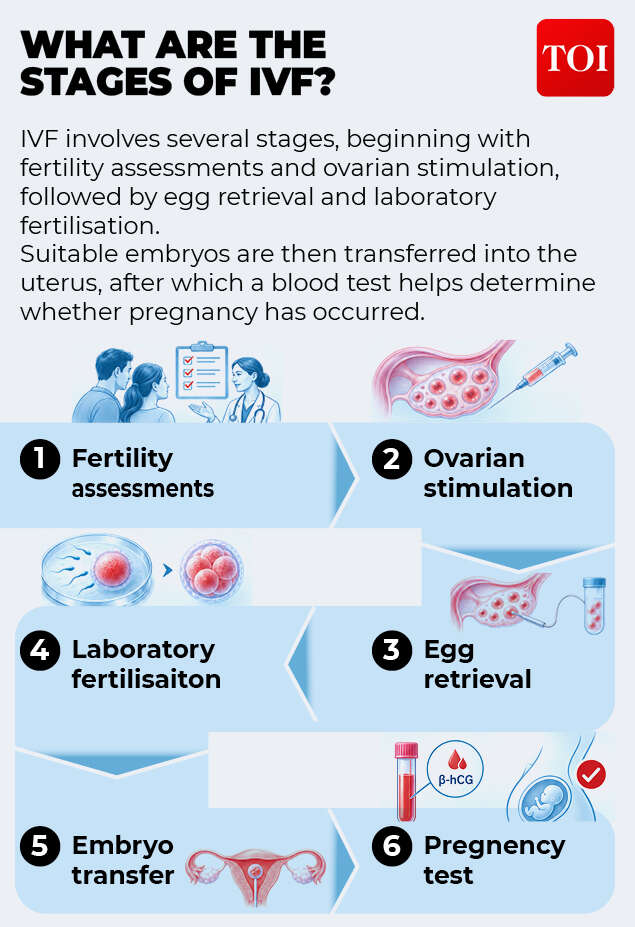
IVF is not a single procedure performed in one sitting. It involves several stages, and the treatment can take several weeks, depending on the patient’s response to medication and the doctor’s treatment plan.Initial consultation and fertility assessmentThe first stage involves a detailed medical evaluation of both partners. Doctors review their medical history and conduct investigations to understand the possible causes of infertility.For women, the assessment may include blood tests to evaluate hormone levels, ultrasound examinations to check the ovaries and uterus, and tests to assess ovarian reserve.For men, semen analysis helps evaluate sperm count, movement and quality.These investigations help fertility specialists determine whether IVF is appropriate and develop a treatment plan according to the couple’s needs. Ovarian stimulationDuring a natural menstrual cycle, the ovaries usually release one mature egg. However, IVF requires multiple eggs to improve the possibility of obtaining embryos suitable for transfer.Doctors therefore prescribe hormonal medications, generally through injections, to stimulate the ovaries to produce several eggs.The patient is monitored through regular ultrasound scans and blood tests to check follicle development and hormone levels. The dosage and duration of medication depend on how the ovaries respond to treatment. Egg retrievalOnce the eggs have matured, doctors administer a trigger injection to prepare them for collection.Egg retrieval is generally performed around 34-36 hours after the trigger injection. It involves using an ultrasound-guided needle to collect eggs from the ovarian follicles.The procedure is usually performed under sedation or anaesthesia. The collected eggs are then sent to the embryology laboratory for assessment.Fertilisation in the laboratoryAfter egg retrieval, sperm is collected from the male partner or obtained through an appropriate medical procedure when required.The eggs and sperm are brought together in a laboratory dish to allow fertilisation.In certain cases, doctors may recommend a specialised procedure called intracytoplasmic sperm injection (ICSI). In this technique, a single sperm is injected directly into a mature egg to assist fertilisation. It may be considered in cases involving severe male-factor infertility or previous fertilisation difficulties.Embryo developmentAfter fertilisation, the resulting embryos are monitored in a controlled laboratory environment.Embryologists observe their development over the next few days to assess which embryos are suitable for transfer or freezing.Some embryos may not develop normally, and not every fertilised egg will become a suitable embryo. This is one reason why the number of eggs retrieved does not necessarily determine the final outcome of an IVF cycle.Embryo transferOnce an embryo is considered suitable, it is transferred into the woman’s uterus using a thin catheter.The procedure generally does not require major surgery. The embryo is placed inside the uterine cavity with the aim of allowing it to attach to the uterine lining.Depending on the medical circumstances, doctors may recommend a fresh embryo transfer or freeze the embryo for transfer during a later cycle.Pregnancy testAfter embryo transfer, patients are advised to wait for the recommended period before taking a pregnancy test.A blood test measuring human chorionic gonadotropin (hCG), a hormone associated with early pregnancy, is used to determine whether implantation has resulted in pregnancy.A positive result is an important milestone, but further medical monitoring is required to assess the progress of the pregnancy.
What is the difference between IVF and ICSI?
IVF and ICSI are both assisted reproductive techniques, but they differ in how fertilisation takes place.In conventional IVF, eggs and sperm are placed together in a laboratory dish, allowing sperm to fertilise the egg naturally within that controlled environment.In ICSI, an embryologist selects a single sperm and injects it directly into a mature egg using specialised equipment.ICSI is generally considered in cases involving significant sperm-related fertility problems or previous fertilisation failure. It is not necessarily required for every couple undergoing IVF.The choice between conventional IVF and ICSI depends on the findings of fertility investigations and the specialist’s assessment.
Does IVF guarantee pregnancy?
One of the biggest misconceptions surrounding IVF is that it guarantees pregnancy.Although reproductive technology has advanced considerably, the outcome varies from patient to patient. A successful fertilisation or embryo transfer does not automatically mean that a pregnancy will follow.Several factors influence the chances of success, including:
- Age of the woman: Age plays a significant role because egg quality and quantity generally decline over time, particularly after 35.
- Egg quality: The quality of eggs affects fertilisation and embryo development.
- Sperm health: Sperm count, movement and quality can influence fertilisation.
- Embryo development: Not every fertilised egg develops into an embryo suitable for transfer.
- Uterine health: Conditions affecting the uterus and its lining may influence implantation.
- Underlying medical conditions: Conditions such as PCOS, endometriosis and other reproductive health problems can affect treatment outcomes.
Some couples may achieve pregnancy after their first IVF attempt, while others may require additional cycles. In certain cases, treatment may remain unsuccessful despite several attempts.A report featuring women’s experiences of IVF highlighted the emotional challenges associated with repeated unsuccessful cycles. One woman, Shweta Batra, shared that she underwent five unsuccessful attempts before conceiving during her sixth IVF attempt.This illustrates why couples should discuss realistic expectations and individual success probabilities with their fertility specialist rather than relying on general success-rate figures.
What are the possible risks and side effects of IVF?
Although IVF is widely used in fertility treatment, it is not completely free of risks. Most patients tolerate the treatment, but hormonal medications and medical procedures can cause physical side effects.Some commonly reported side effects include:
- Bloating and abdominal discomfort.
- Headaches.
- Breast tenderness.
- Mood changes.
- Mild reactions at injection sites.
One of the more serious but uncommon complications is ovarian hyperstimulation syndrome (OHSS). It occurs when the ovaries respond excessively to fertility medication, becoming enlarged and painful. In more severe cases, it can lead to complications requiring medical attention.Egg retrieval also carries procedural risks, although serious complications are uncommon.Another concern is multiple pregnancy, particularly when more than one embryo is transferred. Twin or higher-order pregnancies can carry additional health risks for both the mother and babies.Doctors therefore assess the number and quality of embryos before deciding how many should be transferred. Single embryo transfer may be recommended to reduce the risk of multiple pregnancies.Patients should discuss possible complications, warning signs and the need for follow-up care with their fertility specialist before beginning treatment.
Can IVF lead to twins or multiple pregnancies?
IVF does not automatically result in twins. The possibility of a multiple pregnancy depends partly on the number of embryos transferred.When more than one embryo is transferred, there is a possibility that more than one may implant and develop into a pregnancy.However, transferring a single embryo can reduce the likelihood of multiple pregnancies. Even in such cases, identical twins can occasionally occur if the embryo divides.Doctors generally consider the patient’s age, medical history and embryo quality when deciding the most appropriate transfer strategy.The aim of modern fertility treatment is not simply to achieve pregnancy but also to reduce avoidable risks and improve the chances of a healthy outcome.
How much does IVF cost in India?
The cost of IVF varies depending on the hospital, city, fertility specialist, laboratory facilities and the patient’s medical requirements.A standard IVF package may not cover every expense. Medication, hormonal injections, blood tests, egg retrieval, embryo freezing, storage and additional procedures can increase the overall cost.A report on fertility treatment in Mumbai noted that a private-sector IVF cycle could cost more than Rs 1 lakh, with some couples requiring more than one cycle.Another report on KEM Hospital’s affordable IVF facility said the centre aimed to offer treatment at approximately one-fifth of the cost charged by some private-sector facilities, where a cycle could cost up to Rs 3 lakh.Public hospitals have also taken steps to improve access to infertility treatment through free or subsidised services.For instance, a report published in July 2024 highlighted infertility treatment initiatives at Mumbai’s Cama Hospital, KEM Hospital and LTMG Hospital. These initiatives were intended to make fertility care more accessible to couples who could not afford private treatment.Before beginning IVF, couples should request a detailed cost estimate and clarify whether medication, laboratory procedures, embryo freezing and storage charges are included.
What does Indian law say about IVF?
In India, assisted reproductive technology, including IVF, is regulated under the Assisted Reproductive Technology (Regulation) Act, 2021.The legislation provides a regulatory framework for ART clinics and banks and establishes eligibility requirements for people seeking these services.Under Section 21(g) of the Act, the prescribed age range for a woman seeking ART services is 21-50 years, while the age range for a man is 21-55 years.The law also provides for the registration and regulation of ART clinics and banks. These provisions are intended to establish accountability and ensure that fertility services are provided through regulated facilities.Age-related restrictions have, however, become the subject of legal challenges. In April 2026, the Bombay High Court granted interim relief to two women above 50, allowing them to undergo medical assessments to establish their fitness before proceeding with ART treatment.Such developments highlight the medical, legal and ethical questions surrounding access to fertility treatment, particularly for older couples.Couples considering IVF should check their eligibility and consult a registered ART clinic to understand the applicable legal requirements.
The emotional side of IVF: Why support matters
While IVF is largely discussed in terms of medical procedures and success rates, the emotional experience can be equally demanding.The treatment involves repeated consultations, injections, medical tests and waiting periods. Patients may experience anxiety before egg retrieval, uncertainty during embryo development and emotional distress while waiting for pregnancy results.An unsuccessful cycle can be particularly difficult for couples who have already spent considerable time, money and emotional energy trying to conceive.A report featuring women who underwent IVF documented experiences of disappointment, repeated attempts and the importance of support from partners and family members.A separate report published in November 2026 also highlighted the emotional strain associated with fertility treatment. It emphasised the importance of counselling, clear communication with doctors and psychological support throughout the process.Couples should be encouraged to discuss their concerns openly, understand the treatment plan and seek professional counselling if they experience persistent anxiety or distress.It is also important to remember that an unsuccessful IVF cycle is not necessarily the end of the journey. The next steps depend on the medical findings and the couple’s willingness and ability to continue treatment.
What should couples ask before choosing an IVF clinic?
Choosing a fertility clinic is an important decision because treatment involves sensitive medical procedures, laboratory work and substantial financial investment.Before starting treatment, couples should consider asking:
- Is the clinic registered under the Assisted Reproductive Technology (Regulation) Act, 2021?
- What investigations are required before treatment?
- What are the realistic chances of success based on our medical history?
- What does the quoted IVF package include?
- Are embryo freezing and storage charged separately?
- What happens if the first cycle is unsuccessful?
- What measures are in place to ensure the correct identification and handling of eggs, sperm and embryos?
Understanding these details can help patients make informed decisions and avoid unexpected expenses or confusion during treatment.Ultimately, IVF is an important development in reproductive medicine, offering an option to people facing different fertility challenges. However, it is not a universal solution, nor does every patient require it. A proper medical assessment, realistic expectations, transparent treatment costs and emotional support remain essential throughout the journey.