


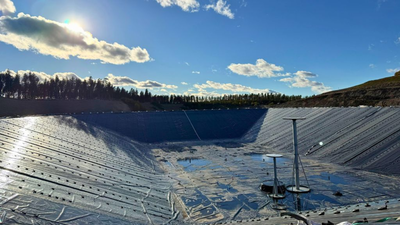
Finnish city of Hyvinkaa with about 47,000 residents is filling a former gravel pit with roughly 100 million gallons of tap water. The 380,000 cubic metres will fill a 66-foot-deep basin to form a giant heat storage that the local utility calls the world’s largest pit thermal energy storage, according to a report by Ecoticias.Hyvinkään Lämpövoima Oy, the city’s municipal heating company, expects the reservoir to cover close to a quarter of local heat demand. Water from the city mains began flowing in early October 2026 and the filling is expected to last until late April 2027.
Preparing for the winters
The basin is located in the Kulomaki gravel pit and reaches about 66 feet deep. Its cover will measure 738 by 541 feet (225 by 165 meters). The utility compares that area to about five soccer fields. Inside, the water will stay between 104°F and 194°F (40°C and 90°C). Three diffusers set at different heights move it in and out of the basin. During charging, pumps pull cold water from the bottom and send it through a heat exchanger. It returns warm through the top diffuser, and discharging reverses that path. According to the project page, a middle diffuser is kept for a future heat pump or for cooler waste heat of around 158°F (70°C).Finnish summers bring plenty of cheap electricity but little need for heating. The utility will charge the store with heat from electric boilers and nearby industrial waste heat when energy costs little. In winter, when demand and prices peak, that heat goes into the district heating network.“Once completed, the heat storage facility will above all mean more stable heating prices for residents of Hyvinkää,” CEO Sanna Kytömäki said in the utility’s October announcement. With the boilers, the company adds, the network can drop fossil fuels almost entirely.
18,000 megawatt-hours per charge
One full charge holds about 18,000 megawatt-hours of heat. The utility says that could warm about 1,000 detached houses for a year. It could also supply hot tap water to around 20,000 people over the same period. A second figure, 90,000 to 100,000 megawatt-hours, is the heat expected to pass through the store each year. Operators will charge and drain it again and again. Its maximum charging and discharging power of 60 megawatts sets how fast it can respond on a cold day.Since the site lies in a groundwater area, the project’s water permit needs close monitoring. The basin floor and embankments use a double liner with leak wells to flag any failure. Divers or a robot could repair a leak, the utility says. Warmer groundwater next to the basin is the main environmental risk the company lists. A separate aquifer system with heat pumps will collect heat that seeps into the ground below. That cools the groundwater and sends the recovered energy into the network, while 18 new observation pipes track conditions on the site and nearby.The project costs €33 million at current exchange rates. Finland’s Ministry of Economic Affairs and Employment granted roughly €7.7 million in investment aid. The company expects fuel savings of several million euros a year and about 4,850 U.S. tons (4,400 metric tons) less carbon dioxide annually.Those numbers are projections for a basin that has not stored any heat yet. Crews still have to build the permanent cover between April and October 2027. Since charging can start only in late summer 2027, it is yet to be seen how much heat the water will lose over the months. In October, Kytömäki said construction was halfway done and on schedule, with no accidents on the site.