


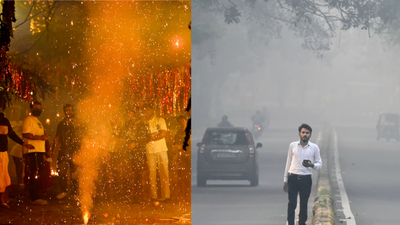
NEW DELHI: Delhi recorded its most polluted Diwali in five years, with the average air quality index (AQI) reaching 376. However, actual pollution levels may have been considerably higher than official figures suggested, as several monitoring stations stopped reporting data during peak firecracker hours on Sunday night.According to data released by private monitoring agencies, pollution levels across Delhi-NCR were significantly higher than those reported by government agencies. Several areas recorded extremely hazardous air quality, raising questions about the accuracy of official data and the functioning of the monitoring network.Experts tracking pollution levels said several stations failed to provide readings during the most critical hours of Diwali night. The gaps in data coincided with a sharp rise in pollution and widespread violations of the Supreme Court’s restrictions on firecracker use.Anumita Roychowdhury, executive director of the Centre for Science and Environment (CSE), said the failure to record pollution levels during this period was difficult to explain, given the public investment in the monitoring network.“When substantial public funds have been invested in establishing Delhi-NCR’s air quality monitoring network — the densest in the country — backed by active operation and maintenance contracts, a data eclipse precisely during peak Diwali pollution is inexplicable,” she said.She said the absence of real-time readings also affected the authorities’ ability to issue timely health warnings and respond to the emergency.“While the severity of exposure is evident on the ground, credible official data is needed for institutional accountability, public awareness and mitigation. Losing data does not reduce the public health emergency,” Roychowdhury said.Delhi cabinet minister Kapil Mishra was also asked about the missing readings during a press conference. He asked reporters to share details of the monitoring stations that were reportedly not working and said he would seek action.An analysis by the Centre for Research on Energy and Clean Air (CREA), based on data from Delhi’s 59 air quality monitoring stations, found that the number of stations not reporting readings increased significantly through Sunday night. More than 20 stations were without data between midnight and 2 am, during the peak smog hours.The number of stations with missing readings was one at 7 pm on Sunday. It increased to seven by 10 pm and 23 by 11 pm. By midnight, 29 stations were not reporting data.The situation worsened at 1 am on Monday, when 36 stations had stopped reporting readings. This left just 23 of the city’s 59 stations providing data. At 2 am, 35 stations were still not reporting.The number gradually came down in the following hours, with 30 stations missing data at 3 am, 20 at 4 am, 19 at 5 am and 16 at 6 am. By 7 am, 13 stations were not reporting readings, while seven continued to have missing data at 8 am. The figure fell to two by 9 am, with one station continuing to report no data until 11 am.At 4 pm on Monday, Delhi’s average AQI was 344, compared with 376 at the same time on Diwali. However, readings were available from only 47 of the 59 monitoring stations. Of these, 40 recorded air quality in the very poor category and seven in the poor category. Bawana recorded the highest AQI at 396, followed by Burari at 393.The missing data also became a political issue. Senior AAP leader Saurabh Bharadwaj accused the Delhi government of manipulating pollution figures and described the alleged practice as “data fraud”. He claimed that the authorities were trying to show lower pollution levels than those actually recorded, putting public health at risk.The controversy gained attention as government and private agencies reported sharply different AQI figures on Monday morning.At 8 am, the official AQI for Delhi stood at 370. However, Swiss air quality monitoring platform IQAir recorded an AQI of 245 on the US scale at 8.30 am, placing the air in the ‘very unhealthy’ category. Its readings showed a PM2.5 concentration of 170 micrograms per cubic metre (µg/m³), around 34 times the World Health Organisation’s annual guideline value.Another platform, AQI.in, reported a reading of 637 for Delhi on Monday morning and classified the air quality as “hazardous”. It also recorded a post-Diwali peak AQI of 2,283.The differences between these figures have raised questions about the availability of monitoring data and the methods used by various agencies to calculate and report air quality. Such differences have also been the subject of disputes in the past.After Diwali last year, the AAP had accused the BJP-led Delhi government of deliberately switching off air quality monitoring stations to conceal the rise in pollution levels. The party claimed that several stations operated by the Central Pollution Control Board (CPCB), Delhi Pollution Control Committee (DPCC), India Meteorological Department (IMD) and Indian Institute of Tropical Meteorology (IITM) had stopped reporting data as pollution levels rose on Diwali night. It alleged that the stations started functioning again the following morning. Experts monitoring the readings in real time had also reported similar gaps.Radhey Shyam Sharma, head of the Department of Environmental Studies at Delhi University, said access to reliable pollution data was essential, especially during a public health emergency.“Transparency in data should be there. There is also the question of accountability. We are talking about an emergency situation, a severe emergency,” he said.He said missing readings could cause confusion and panic among residents, adding that the lack of data did not help address the city’s annual pollution problem. Sharma also stressed that accurate information was necessary for policy decisions and for assessing the severity of pollution.He pointed out that private and government agencies might follow different methods when calculating average AQI readings.“Private agencies do not necessarily average the readings in the same manner. The official data should clearly specify the location and time of the readings. The exposure levels need to be clear so that there is a better picture of the situation,” he said.Sharma added that average AQI figures did not necessarily reflect peak pollution levels, when people could face the highest exposure to harmful pollutants. He said the monitoring network needed better management and that the focus should remain on public safety and accountability for the missing data.Official figures showed that Delhi recorded an average AQI of 376 on Diwali, its worst reading for the festival in five years. The air remained heavily polluted the following morning, with the AQI at 371 at 10 am on Monday. Smog and fog covered the city, while the post-Diwali reading was the highest for the day after the festival since 2021.The latest controversy also revived questions about the alleged use of large water sprinklers near monitoring stations to bring down pollution readings.Bharadwaj claimed that water was being sprayed near the Jahangirpuri monitoring station to reduce its average reading. He also accused the government of switching off stations during Diwali night.“They are constantly sprinkling water near the Jahangirpuri AQI station so that the average comes down. Similarly, the government switched off AQI monitoring stations on Diwali night and committed data fraud. How do you trust such a government?” Bharadwaj said.Comparing air quality monitoring devices with machines used to check blood sugar levels, he said inaccurate readings could put people’s lives at risk because they might make decisions about medication and food based on incorrect information.“If anyone has diabetes or a blood pressure problem, they check that every day because their medication depends on the levels.“People check their diabetes levels regularly because what they eat and when they take medicines depends on it. If their machine is tampered with and shows normal levels, they will not take their medicines; they will eat sweets and die. This is what the government is doing right now.”Bharadwaj also alleged that the Delhi government had installed 20 new monitoring stations in open and green areas with less traffic and lower population density. He claimed the move was intended to lower the city’s average AQI and understate the severity of its pollution.