


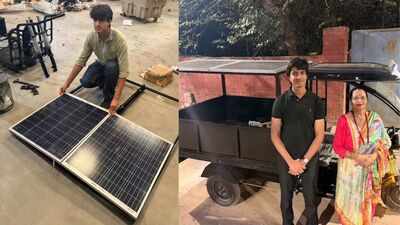
What can a school student do with some knowledge of mathematics, an interest in automobiles and a problem he wants to solve? For 17-year-old Akshit Khera from Gurugram, the answer was a working solar-assisted three-wheeler that could help make everyday transport more affordable for families.The Class 12 student designed and built the vehicle at a final cost of Rs 102,536, with an estimated running cost of 13 paise per kilometre. As reported by India Today, Akshit developed the prototype with a weatherproof two-seat cabin, a cargo box and a 400W solar panel that also serves as a roof. The project was driven by a simple concern: how can people who depend on local transport afford a vehicle of their own? Akshit summed up his approach by saying, “I didn’t have a workshop, a team of engineers or a big budget. I had a question, some school maths and physics, and a lot of curiosity.”
A conversation at home gave him the idea
The project did not begin with a school assignment or a competition. It started after Akshit spoke to his housemaid’s family, who had moved to Gurugram and were finding local transportation expensive. The man in the family worked as a driver and transported cargo. When Akshit asked why he did not buy a vehicle and start a small business of his own, he learnt that the purchase price and running expenses made it difficult.Electric loaders were an option, but their prices, estimated at Rs 1.5 lakh to Rs 2 lakh, were still too high for the family. Akshit then spoke to around 20 other families and found that the need for an affordable vehicle was not limited to one household. “I spoke to about 20 more families, and it became clear that there was a real need for an affordable, low-running-cost vehicle that could serve different purposes,” he said. He wanted to build something that could carry goods as well as passengers. His first thought was to make a completely solar-powered vehicle. But after studying sunlight availability across seasons and calculating the distance it needed to travel, he realised that relying only on solar energy would not be practical. He therefore chose a solar-assisted design.
How the solar three-wheeler works
The vehicle can cover at least 50 km on a single charge, with the solar panel providing additional energy during the day. Its design includes seating for two and a cargo box, with a stated carrying capacity of up to 300 kg. The 400W solar panel has two purposes. It generates electricity to support the vehicle and also works as a protective canopy over the cargo area.According to Akshit’s calculations, solar energy can meet around 63 per cent of the electricity needed for an average daily run of 50 km. This contribution is expected to change with the seasons. His estimates put it at around 41 per cent during the monsoon and up to 87 per cent in peak summer. The 13-paise running cost is also an estimate based on these calculations, not a figure established through extensive real-world testing. Akshit says the vehicle uses around 2.46 kWh of energy to cover 50 km. With the estimated solar contribution taken into account, the remaining electricity cost works out to approximately 13 paise per kilometre.
From a Rs 1.35 lakh estimate to a Rs 1 lakh build
Keeping the cost under control was one of the biggest parts of the project. The initial estimate was around Rs 1.35 lakh, but Akshit reviewed the design and components to bring the final cost down to Rs 1,02,536. He reduced the battery requirement from 5.38 kWh to 3.072 kWh and used heavier steel tubes only at important load-bearing points. This helped reduce the vehicle’s weight by 26 kg and save around Rs 2,100. He also visited Delhi’s Mayapuri automobile market, compared quotations from different vendors and negotiated component prices. These efforts helped him save more than Rs 17,000.The project also required several practical decisions. Akshit chose a lithium-ion battery over a lead-acid alternative, considering its longer lifespan. He selected painted steel sheets for the cargo box floor instead of plywood, which could swell or deteriorate after repeated exposure to rain.Finding someone to fabricate the vehicle was another challenge. More than a dozen workshops across Gurugram, Delhi and Faridabad turned down the project before a fabricator named Arun agreed to help. Akshit also had to redesign the charging system after the solar panel’s voltage requirements made his original controller choice unsuitable. Reflecting on the experience, he said, “The biggest lesson for me was that every setback was cheaper to fix on paper than in reality.“
A prototype today, a bigger plan for tomorrow
Akshit’s interest in vehicle design had already taken him beyond the classroom. In 2025, he worked as the lead design and manufacturing engineer for Apex Racing at the STEM Racing World Finals in Singapore. The team competed against 82 others and recorded the seventh-fastest average time. His parents, Amit Khera and Kanchan Khera, supported him through the calculations, vendor visits and fabrication process. Their support helped him take the idea from paper to a working prototype.However, Akshit does not consider the three-wheeler a finished commercial product yet. It has undergone only initial testing, and he wants to evaluate its performance under different sunlight and weather conditions before making stronger claims about its efficiency. He estimates that large-scale manufacturing could reduce the cost by 10 to 20 per cent. He hopes to work with an automobile manufacturer on safety checks, durability testing, certification and a service network, while keeping affordability at the centre of the design.He has also committed to donating the vehicle to a family in need. For now, his next steps include exploring lighter solar cells, better materials, swappable batteries and shared solar-charging points. His project is a reminder that innovation does not always begin with expensive equipment or a professional team. Sometimes, it starts with noticing a problem around you and being curious enough to try solving it.