


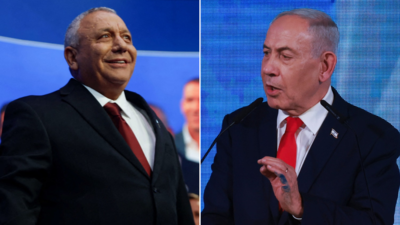
Israeli President Isaac Herzog on Saturday tasked opposition leader Gadi Eisenkot with forming the next government, giving Prime Minister Benjamin Netanyahu’s main challenger the first opportunity to assemble a coalition after the October 27 election produced no clear parliamentary majority.Eisenkot, a former military chief and head of the Yashar party, secured the backing of representatives from parties accounting for 67 lawmakers during consultations with Herzog. Netanyahu, whose Likud party emerged as the largest in parliament with 27 seats, received recommendations from factions representing 46 lawmakers. His broader bloc holds 53 seats in the 120-member Knesset, while Eisenkot’s opposition bloc has 48. A majority requires 61 seats.The announcement came shortly after Netanyahu called for a “national unity government” in a video statement, urging the formation of an alliance among Zionist political factions. He also warned against “hastily swearing in a government with terrorist supporters” — an apparent reference to the Arab-led parties.Netanyahu has argued that a broad alliance is needed to protect Israel and confront regional threats, particularly Iran. He said such a government would “permanently remove the nuclear threat from Iran, preserve Israel as a Jewish state, and bring unity among us,” according to Al Jazeera.The opposition rejected the appeal. Democratic Party chairman Yair Golan said, “Netanyahu’s government must be replaced, and a government of salvation and change must be formed to safeguard Israel’s democracy, security, and future. We are committed to making every effort to make this happen,” he posted on X.Eisenkot’s path to power, however, remains complicated. One option is a minority government backed by the two Arab-led parties, Ra’am and the Joint List, which together hold 19 seats. Both have indicated willingness to support an alternative government, but several of Eisenkot’s potential partners have ruled out relying on Arab parties.Another possibility is an agreement with ultra-Orthodox factions holding 13 seats. That would require difficult negotiations over exemptions from military service for ultra-Orthodox seminary students, an issue Eisenkot and some of his partners have pledged to address.A unity arrangement with Likud is also mathematically possible, although it would require major political compromises from both sides.Herzog’s decision gives Eisenkot 28 days to negotiate a coalition, with a possible two-week extension. If he fails, Netanyahu could be given an opportunity to form a government. Should successive attempts prove unsuccessful, Israel could face another election, prolonging the political uncertainty.