


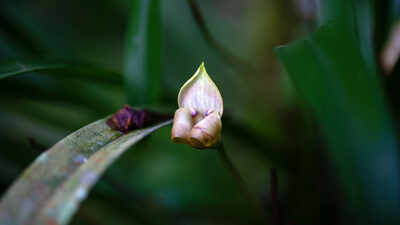
It is a rare botanical treasure hidden beneath the thick canopy of Australia’s subtropical rainforests, and for most of its life it remains out of sight. It has no leaves, relies on an underground fungus to survive and flowers for only a short time each year. A local teacher’s accidental find offers a surprising glimmer of hope for a species so elusive that even seasoned botanists have had trouble locating it beyond one known spot. About 50 more Bonville leafless orchids have now been found in a rainforest near Boambee, which could change the conservation outlook for one of Australia’s rarest plants.
A surprise discovery for botanists
For years the critically endangered Bonville leafless orchid was thought to be found in just one location on the Mid North Coast of New South Wales. That changed in October 2026 when teacher and botany enthusiast Nick Lambert ventured into another patch of rainforest near Coffs Harbor in search of the elusive species.ABC News report states that Lambert’s interest was piqued after a visit to the original orchid habitat on October 22 with botanist Dr Lachlan Copeland. Encouraged by his results, he decided to check out other pockets of rainforest in the area the next day. His search brought him to an undocumented cluster near Boambee, about five kilometers from the original site.Copeland, who lived on the property where the species was first discovered in 2018 later inspected and confirmed the discovery. Later, the orchid was given the scientific name Danhatchia copelandii, in his honor.The significance of Lambert’s find is better appreciated in the context that some 30 botanists had visited the original location previously, in attempts to locate additional populations, without success.
An orchid like most orchids
Even among the many orchids the Bonville leafless orchid is odd. It is about 10 cm tall with reddish hairy stems and tiny flowers that appear above the rainforest floor. It has no leaves, so cannot photosynthesize, and is therefore entirely dependent on a fungus below the soil for its nutrition.Zenith Infra Group website notes that the plant is mostly hidden underground throughout the year, emerging from the ground only for a week or two when it blooms. It is very hard to find because it is small, has a muted coloring and can blend into fallen leaves.That brief blooming window also poses challenges for researchers, who must time their surveys just right to have any hope of spotting the plant.
A huge increase in its population
The orchid’s numbers at its original Bonville habitat were of particular concern until recently. In recent years, Copeland had recorded only six to seven plants, although his seasonal surveys had produced variable numbers, from about four to as many as 43.This spring he found 17 plants at the original spot. The discovery of about 50 more near Boambee thus represents a substantial addition to the known population, increasing the total number of identified plants to more than 60.Brett Summerell, chief scientist at the Botanic Gardens of Sydney, told ABC News the discovery is important because endangered species with small populations often struggle with issues related to low genetic diversity. Another population is also an important safeguard against the possibility of a disaster affecting the original habitat.
Why its native habitat needs protection
Unlike many other threatened plants, the Bonville leafless orchid is not one that can be rescued by growing it in a nursery or moving it to the safety of a botanical garden. It requires a relationship with an underground fungus to survive, and scientists have been unable to reproduce the exact conditions to grow it outside its natural environment.This is where habitat protection is paramount. Protecting the orchid is protecting the wider ecosystem of fungi, insects and other organisms connected to its survival, reports ABC News.On that score, there is encouraging news. The newly discovered Boambee population is likely to fall within the boundaries of the proposed Great Koala National Park, providing the rainforest habitat with a layer of protection.
A discovery of lasting scientific value
The find will also extend the botanical record of Australia. A specimen will be deposited at the National Herbarium of NSW at Mount Annan in Sydney’s southwest for formal identification and inclusion in the state’s scientific collection.As Zenith Infra Group highlights, Lambert’s discovery shows how curiosity and a readiness to investigate can make a substantial contribution to conservation. In this case, a teacher’s decision to explore a neglected section of rainforest has revealed a much larger population of a species found nowhere else on Earth.For the Bonville leafless orchid the find is more than just an increase in numbers. It’s a second known refuge, renewed scientific interest and a better shot at protecting a remarkable species whose survival is still intimately tied to the forests it lives under.Image Courtesy: istock