


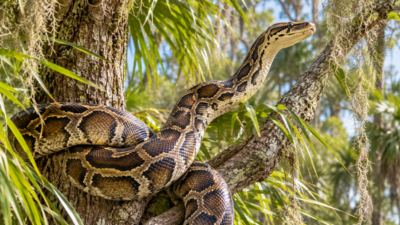
Florida’s invasive Burmese pythons are known for moving through wetlands and dense vegetation, but new research has revealed that some also spend time high above the ground. Scientists tracking 356 snakes in Big Cypress National Preserve over eight years recorded occasional tree-climbing behaviour, with one adult male reaching a height of seven metres. The findings show that these movements are more common during the cooler winter months, when pythons may use branches to bask and absorb heat. The discovery offers wildlife managers fresh information about the snakes’ movements and raises questions about their possible encounters with native birds.
How scientists tracked 356 Burmese pythons in Florida
Burmese pythons have established themselves across much of southern Florida, where they occupy a range of natural environments. Their ability to live in different habitats has made them difficult to monitor, and understanding where they spend their time remains a persistent problem for wildlife managers. To examine their movements more closely, scientists from the US Geological Survey (USGS) and collaborating institutions followed 356 snakes in Big Cypress National Preserve. The tracking work took place between 2017 and 2024 and included 188 adult pythons and 168 juveniles.Rather than relying on occasional sightings, the team used radio telemetry to record the locations and habitat choices of individual snakes. The resulting dataset contained more than 4,000 observations, allowing the scientists to examine how often the reptiles entered trees and shrubs and whether certain conditions made this behaviour more likely.USGS reported that fewer than 3% of the recorded observations involved snakes positioned in trees or shrubs. Across the tracked animals, around 14% of adults and 17% of juveniles were documented using vegetation above the ground at least once.
Why Burmese pythons climb trees in winter
Both young and mature snakes were more likely to enter trees during the cooler, drier months, with December and January standing out in the tracking records. For adult pythons, many of the sightings during this period involved basking. As reptiles depend on external sources of heat to regulate their body temperature, finding a suitable position in the sun can help them warm up when surrounding conditions become cooler.One documented encounter in January 2022 illustrates how high an adult python can climb. A male was observed basking on a coastal plain willow branch approximately 2.5 metres above the ground in Big Cypress National Preserve.A USGS researcher recorded the animal while carrying radio-tracking equipment nearby. Other observations revealed even greater heights. In February 2022, an adult male was first located on a Brazilian peppertree around five metres above the ground.
Finding pythons remains a major challenge for Florida managers
The new findings have practical implications because locating Burmese pythons in the Everglades is already difficult. Their ability to remain concealed in dense vegetation, combined with their behaviour and habitat choices, makes routine detection unreliable.Current estimates suggest that the probability of finding an individual python during a detection effort can fall below 5%. Knowing that some individuals use trees during particular months gives wildlife managers another behaviour to consider when planning monitoring and removal work.
Could climbing pythons pose a risk to nesting birds
The study also raises questions about the possible interaction between Burmese pythons and native wildlife. The Everglades supports several bird species that nest in trees and shrubs, creating opportunities for encounters with predators capable of reaching elevated branches.During the tracking investigation, scientists did not record pythons attacking or eating birds in trees. However, earlier research has documented the reptiles feeding on bird nests in the region, including those belonging to Great Egrets and White Ibises.
What the findings mean for the future of python research
The investigation, published with contributions from the USGS and its collaborators, adds detail to the understanding of an invasive species that has proved difficult to study in the wild. Its findings show that describing Burmese pythons simply as ground-dwelling or generalist predators does not capture every aspect of their behaviour.Their occasional use of trees appears to be influenced by seasonal conditions, with cooler weather providing a possible explanation for increased basking activity. The relatively small proportion of arboreal observations also makes clear that climbing should be treated as one part of their behaviour rather than a defining characteristic.