


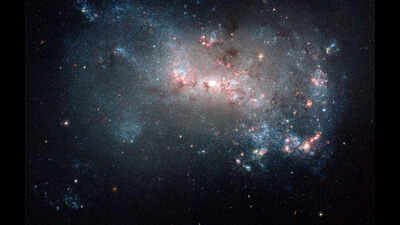
Our cosmic neighbourhood is full of surprises, some you cannot even imagine. In a paper published on Monday in The Astrophysical Journal, researchers using the Hubble Space Telescope studied 37 nearby dwarf galaxies and found that much of the oxygen they expected to find was missing. In fact, these galaxies retained just 11% of the oxygen their stars had produced over time. The rest appears to have been blown out into space, leaving astronomers with a rather interesting mystery to solve.
What are dwarf galaxies?

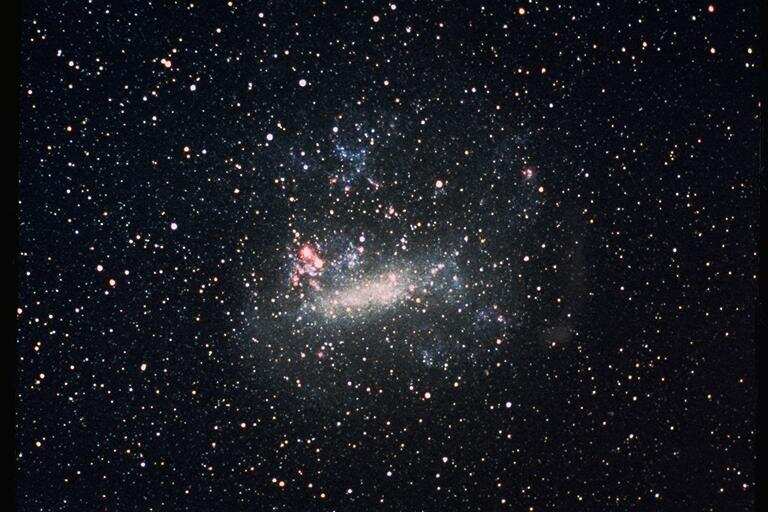
The Large Magellanic Cloud, a satellite galaxy of the Milky WayImage Credit: NASA taken via Wikipedia
Dwarf galaxies are small galaxies containing anywhere between a few thousand and hundreds of millions of stars. This is considerably smaller than our Milky Way, which is estimated to contain around 100–400 billion stars. The Large Magellanic Cloud, a galaxy that closely orbits the Milky Way and contains billions of stars, is one example of a dwarf galaxy, although its classification has occasionally been debated.Despite their smaller size, dwarf galaxies are important to astronomers because they offer clues about how galaxies form and evolve. Their relatively low mass and weaker gravitational pull make them particularly interesting to study. Unlike larger galaxies, they can struggle to hold on to the gas and other material produced by their stars.Their evolution is also influenced by their surroundings. When dwarf galaxies pass close to larger galaxies, gravitational forces can pull at them, strip away their material and even disrupt their structure. Some eventually merge with larger galaxies, while others continue forming stars on their own.Astronomers classify dwarf galaxies into different types based on their shape, composition and activity. Some are rich in gas and continue producing new stars, while others have very little star formation left. Studying these differences helps scientists understand how galaxies change over billions of years.
Where does oxygen in space come from?

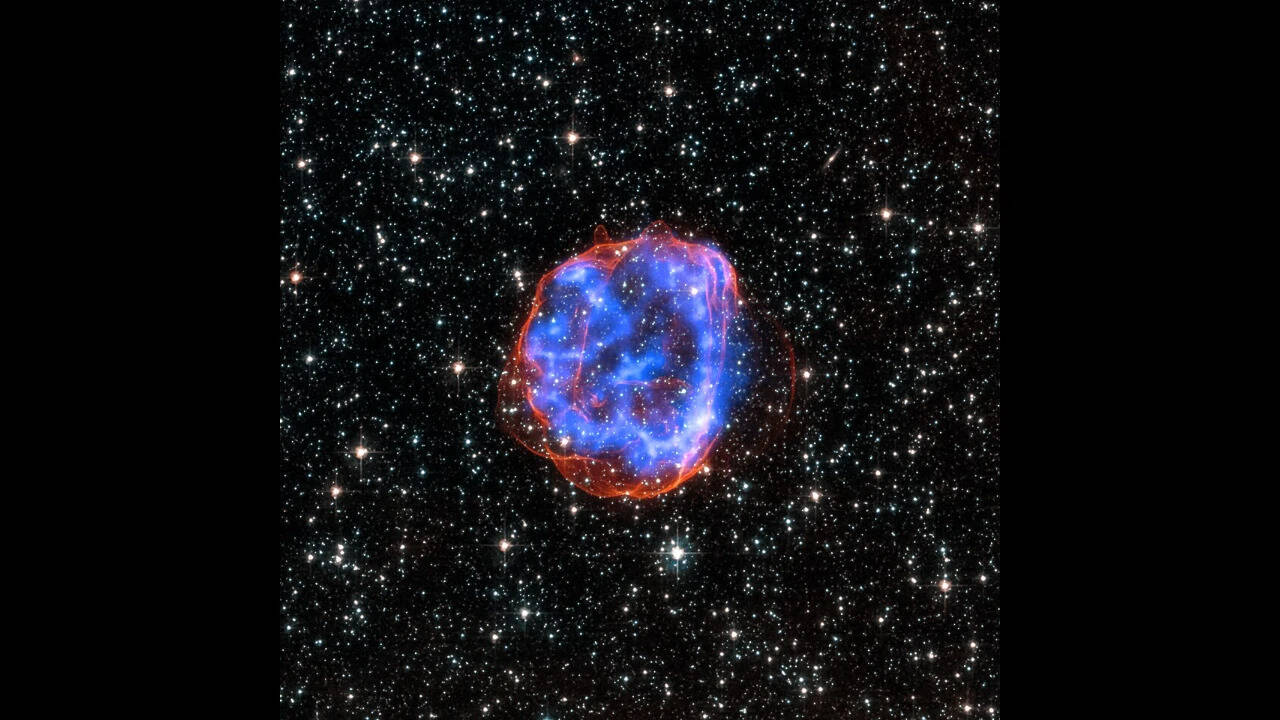
Supernova remnant SNR E0519-69.0 in the Large Magellanic CloudImage Credits: NASA taken via Wikipedia
Oxygen isn’t something we breathe in only on Earth. It is present throughout the universe, and stars are responsible for producing much of it.Stars are essentially enormous factories where nuclear reactions take place. Deep inside them, lighter elements combine to form heavier ones. Through these processes, stars produce elements such as carbon, oxygen, neon and magnesium. Oxygen, in particular, is created during the different stages of a star’s life.When massive stars reach the end of their lives, they can explode in enormous blasts called supernovae. These explosions release energy and scatter the elements formed inside the stars into the surrounding space.In fact, many of the elements that make up our bodies, our planet and everything around us were created inside stars or during stellar explosions. In a way, we are all made up of star material.
The case of the missing oxygen
Since stars produce oxygen, scientists expected dwarf galaxies to contain a considerable amount of it. However, when researchers compared how much oxygen these galaxies should have produced with how much they could actually account for, the numbers did not add up.The team found that the 37 galaxies retained between 4% and 25% of the oxygen produced by their stars, with an average of just 11%. So, where did the remaining 89% go?Co-investigator Grace Telford, assistant professor in the Department of Physics and Astronomy at the University of Utah, explained that oxygen must have been inside these galaxies at some point because their stars produced it. For it to be missing now, it must have been pushed out. This requires enormous amounts of energy, which can come from massive stars and supernova explosions.
Where did the oxygen go?
To investigate, researchers studied the galaxies as part of the Galaxies Losing Oxygen via Winds (GLOW) project, funded by NASA and the National Science Foundation. They used archival observations from Hubble to study individual stars and understand the galaxies’ star formation histories. Data from NASA’s retired Spitzer Space Telescope and ground-based radio telescopes, including the Very Large Array and the Australian Telescope Compact Array, helped them examine the gas and other material within these galaxies.The researchers found that powerful stellar explosions can generate enormous outflows of gas called galactic winds. These winds carry oxygen-rich material away from the galaxies and into the space between them. According to the study, galactic winds are much more effective at removing oxygen from low-mass galaxies than current scientific models had predicted.This is largely because dwarf galaxies have relatively weak gravity. Think of trying to hold on to a balloon in a strong gust of wind. A larger galaxy has a stronger gravitational pull, making it better equipped to hold on to its material. A dwarf galaxy, on the other hand, struggles to keep the gas produced by its stars from escaping.However, scientists have not yet established exactly where all the missing oxygen ends up. Some of it could remain in the diffuse clouds of gas surrounding galaxies, known as the circumgalactic medium, while the rest may have travelled much farther into the space between galaxies.
Why does this discovery matter?
Oxygen is the third most abundant element in the universe, after hydrogen and helium. It is also relatively easy for astronomers to detect and measure, making it a useful marker for understanding how elements are distributed across galaxies.When stars produce elements and release them into space, they enrich the universe with the ingredients needed to form new stars and planets. By tracing oxygen, scientists can understand how galaxies evolve and how material travels beyond their boundaries into the wider universe.The discovery also suggests that existing computer simulations may have underestimated how efficiently galactic winds remove material from smaller galaxies. Understanding this process could help astronomers build more accurate models of how galaxies develop over time.The investigation is far from over. Researchers hope to study even smaller and fainter galaxies using NASA’s Nancy Grace Roman Space Telescope, alongside further observations from Hubble and the James Webb Space Telescope. They also plan to examine individual massive stars to understand how they produce oxygen and help drive it out of their host galaxies.For now, the missing oxygen remains a cosmic mystery. Scientists know that these tiny galaxies are producing it, and that much of it is escaping. The next challenge is to find out just how far it has travelled.